

Think about the names that shape our corporate/tech world: Tim Cook of Apple, Satya Nadella of Microsoft, Indra Nooyi of PepsiCo, Sundar Pichai of Google, Jamie Dimon of JPMorgan Chase, Shantanu Narayen of Adobe.
We know them as visionary leaders, but what was their secret weapon? Look back at their education, and you’ll find a common thread: the Master of Business Administration, better known as an MBA.
You see, an MBA isn’t just a diploma; it’s a passport to the top. It’s a globally recognized degree that equips you with the language of business, opening doors to high-paying management roles and putting you in the room where the big decisions are made.
This guide is your first step to getting there. We’ll walk you through everything – from the basics like the MBA full form, to the admission process, and the incredible career paths that lie on the other side.
- MBA Course Highlights: At a Glance
- MBA Full Form: What Does MBA Stand For?
- Choosing an MBA Program: Compare Full-Time, Part-Time, Executive & Online MBAs
- Top MBA Programs 2025 :
- Popular MBA Specializations : Deep Dive
- MBA Admission 2026: Step-by-Step Guide
- MBA Fees & ROI: Is a Master of Business Administration Worth the Cost?
- Career Opportunities & Scope After MBA
- Conclusion: Is an MBA the Right Choice for You?
MBA Course Highlights: At a Glance
An MBA is designed to build strong managerial, analytical, and leadership skills while preparing you for global business roles. Here’s a quick snapshot of what top MBA programs typically offer:
MBA Program Structure & Learning:
| Particulars | MBA Course Details |
|---|---|
| MBA Full Form | Master of Business Administration |
| MBA Course Duration | Full-Time MBA: 1–2 years Executive MBA: 12–24 months (weekend or modular format) Online/Hybrid MBA: Flexible, self-paced options ranging from 18–36 months |
| MBA Core Curriculum | Finance & Accounting Marketing Management Strategy & Leadership Operations & Supply Chain Economics Data & Business Analytics Organizational Behavior |
| Specializations & Electives | Consulting & Strategy Finance (IB, PE/VC, Corporate Finance) Product Management & Tech Marketing, Brand & Digital Entrepreneurship & Innovation Supply Chain, Operations & Sustainability |
| Teaching Methodology | Case-based learning (Harvard model) Simulations & real-world projects Hands-on labs (tech, design, leadership labs) Experiential learning (global immersions, consulting projects) Cross-functional team assignments |
| Program Structure | Year 1: Core foundation courses Year 2: Electives, specializations, global opportunities Summer Internship: 8–12 weeks (for 2-year programs) |
Career Support & Outcomes
This table highlights the career development resources and post-graduation results you can expect.
| Particulars | MBA Course Details |
|---|---|
| Global Exposure | International study trips Exchange programs Global case competitions Cross-border consulting projects |
| Career Development Support | Dedicated career coaches Resume workshops & mock interviews On-campus recruitment Alumni networking events Access to employer partnerships worldwide |
| Post-MBA Outcomes | Roles in consulting, finance, tech, marketing, operations & strategy Access to top recruiters (MBB, FAANG, global banks, Fortune 500) Salaries ranging from ₹30L to ₹1 Cr+, depending on geography and school tier |
An MBA is designed to build strong managerial, analytical, and leadership skills while preparing you for global business roles. Here’s a quick snapshot of what top MBA programs typically offer:
Ready to start your MBA journey?
Let AdmitStreet be your guide. From profile building to interview preparation, we’re with you at every step.
MBA Full Form: What Does MBA Stand For?
The full form of ‘MBA’ is ‘Master of Business Administration.
Think of it this way:
- “Master of…” means you’re going beyond the basics. You’re not just learning what to do; you’re learning why it works, gaining a command over the entire playbook of business.
- “…Business…” covers the whole game. We’re talking finance, marketing, strategy, people management, and operations—all the pieces that make a company tick.
- “…Administration.” is where the rubber meets the road. This is the art of making things happen. It’s about leading teams, managing resources, and steering the ship.
In short, an MBA is a crash course in how to run a business. It’s designed to take smart people and turn them into decisive leaders.
The Real Goal: Rewiring How You Think
Forget just memorizing formulas. The true value of an MBA is how it changes your capabilities. It builds what you might call your “business brain” in three key ways:
- Business Acumen: You’ll learn to speak the language of money, markets, and operations. You’ll see how a decision in marketing impacts the finance team, and how a supply chain hiccup affects the entire company. It’s about connecting the dots.
- Strategic Thinking: An MBA trains you to stop just fighting fires and start seeing the whole chessboard. You learn to spot opportunities, weigh risks, and make the moves that set a company up for the long haul.
- Leadership Muscle: This is the big one. Through constant collaboration on real-world projects, you learn how to motivate a team, negotiate a deal, and present your ideas with conviction. It’s this hands-on practice that prepared leaders like Satya Nadella and Indra Nooyi to take charge.
It’s less about getting a diploma and more about gaining a new set of instincts for the business world.
Understanding the Top MBA School Tiers
To help navigate the landscape, top global business schools are often grouped into well-recognized tiers based on reputation, selectivity, and career outcomes.
- The M7 (Magnificent Seven): Widely regarded as the gold standard in the U.S., this group includes Harvard, Stanford, Wharton, Chicago Booth, Columbia, Kellogg, and MIT Sloan.
- The T15 and T25: These categories include other elite schools like Yale SOM, Duke Fuqua, Dartmouth Tuck, Berkeley Haas, and Michigan Ross (T15), followed by other top programs like Texas McCombs and USC Marshall (T25).
- The Global Elite: Internationally, programs like INSEAD, London Business School, Oxford Saïd, Cambridge Judge, and HEC Paris consistently rank among the world’s best.
These clusters help applicants compare programs, as schools within each group often offer comparable academic rigor and career placement strength – though individual strengths vary by specialization.
Q1: What is the full form of MBA?
A: The full form of MBA is Master of Business Administration. It is a postgraduate degree designed to develop the skills required for careers in business and management.
Q2: What does an MBA really teach?
An MBA teaches you how all parts of a business work together so you can make strategic, leadership-level decisions.
Q3: What are groups like the M7 or T15, and why do they matter?
These groupings help applicants quickly compare schools based on reputation, selectivity, and career outcomes. Check these articles to have a deep insight :
What are M7 Business Schools?
Q4: Is an MBA only for people who want business careers?
No – its leadership and problem-solving skills apply across industries from tech to healthcare to social impact.
Choosing an MBA Program: Compare Full-Time, Part-Time, Executive & Online MBAs
Top business schools understand that one size doesn’t fit all. They’ve designed a variety of MBA formats to cater to different career stages, goals, and life circumstances. Understanding these options is the first step in finding the program that will best accelerate your career.
1. The Full-Time MBA
This is the classic, immersive experience you often see in movies and headlines. It’s typically a two-year program (especially in the US, while one-year programs are common in Europe).
- The Vibe: Total immersion. You live and breathe business school on campus.
- Who It’s For: Early to mid-career professionals looking for a dramatic career pivot, acceleration, or access to on-campus recruitment with top firms. It requires you to leave your job.
- Top School Example: Stanford Graduate School of Business, Harvard Business School, and Wharton are famous for their transformative, two-year full-time programs that offer a summer internship—a crucial gateway to a new industry.
2. The Part-Time MBA:
Designed for working professionals who don’t want to press pause on their careers. Classes are held on evenings or weekends.
- The Vibe: Juggling act. You immediately apply what you learn in class to your current job.
- Who It’s For: Ambitious employees seeking to upskill for a promotion or take on more responsibility within their current company, often with employer sponsorship.
- Top School Example: Booth School of Business (University of Chicago) and Kellogg School of Management (Northwestern) offer renowned part-time programs that provide access to the same esteemed faculty as their full-time counterparts.
3. The Executive MBA (EMBA):
This is not for beginners. EMBA programs are tailored for seasoned professionals, managers, and executives with 10+ years of experience.
- The Vibe: Strategic summit. The classroom is a network of high-level peers, and the curriculum focuses on overarching leadership and corporate strategy.
- Who It’s For: Senior professionals and leaders being groomed for executive roles. The focus is less on career switching and more on broadening strategic perspective.
- Top School Example: Wharton EMBA (University of Pennsylvania) and TRIUM Global EMBA (a joint program from NYU Stern, LSE, and HEC Paris) are elite programs that cater directly to this experienced audience.
4. The Online/Distance MBA:
Leveraging technology, these programs offer a rigorous curriculum with the flexibility to study from anywhere in the world. They have exploded in popularity and prestige.
- The Vibe: Modern and self-paced. You balance a world-class education with your personal and professional commitments through a digital platform.
- Who It’s For: Globally mobile professionals, those with family obligations, or anyone who needs geographical flexibility without sacrificing quality.
- Top School Example: Carnegie Mellon Tepper School of Business and the University of North Carolina (Kenan-Flagler) have been pioneers in top-ranked, interactive Online MBA programs that rival their on-campus offerings.
5. The Integrated MBA (BBA+MBA):
This is a five-year combined program that students can enter right after completing their 12th grade.
- The Vibe: Seamless journey. It integrates undergraduate business foundations with a master’s level specialization without the need for separate admission.
- Who It’s For: Young, focused students who are certain about pursuing a management career and want to fast-track their education.
- Top School Example: While more common in India (e.g., IIMs’ 5-year Integrated Program in Management), the concept is gaining traction globally as a way to build deep talent pipelines.
Choosing the right type is less about which is “best” and more about which is the best engine for your specific career vehicle.
Top MBA Programs 2025 :
Get an inside look at the world’s best business schools with our in-depth Articles:
- Top MBA Programs in the World (2025) : Rankings, Class Size & Salary Details
- Who are M7 Business Schools: An In Depth Guide on M7 MBA in 2025
- Top MBA Programs in Europe 2025
- Best Business Schools for a Career in Marketing
- Top 15 Business Schools for Finance Careers
- Best Business Schools for a Career in the Technology Industry 2025
- Top 15 Business Schools for Consulting (McKinsey, Bain, BCG)
- Top 10 Master in Finance Programs in the world
- Top One Year MBA Programs in the US
- Top Deferred MBA Programs in the US, Europe, and India
Popular MBA Specializations : Deep Dive
MBA specializations allow you to tailor your degree toward a specific industry or functional role, helping you build advanced expertise while still gaining the broad managerial foundation of a traditional MBA.
Whether you’re pursuing a one-year or two-year MBA, specialization tracks typically begin in the latter part of the program – through electives, experiential projects, internships, and your final dissertation or capstone.
Below is a comprehensive look at the most in-demand MBA specializations, what they offer, where they’re taught, and the career paths they unlock.
| Specialization | Top Global Schools | Key Career Prospects |
|---|---|---|
| Finance | Wharton, Columbia, Harvard, INSEAD, London Business School, Stanford GSB | Investment Banking, Corporate Finance, Private Equity, Wealth Management |
| Entrepreneurship | Harvard, Wharton, Oxford Saïd, UC Berkeley Haas, IE Business School | Startups, Venture Capital, Innovation Management, Business Development |
| Consulting | Columbia, Tuck, Wharton, INSEAD, Chicago Booth, Kellogg | Strategy Consulting, Management Consulting, Operations Consulting |
| Technology Management | Harvard, Cornell Johnson, Stanford, INSEAD, London Business School | Product Management, Technology Strategy, IT Consulting |
| Marketing | Wharton, Columbia, Chicago Booth, LBS, HEC Paris | Brand Management, Digital Marketing, Market Research, Advertising Strategy |
| Healthcare Management | Wharton, Yale SOM, Columbia, Duke Fuqua, INSEAD, Berkeley Haas | Healthcare Administration, Pharma, Biotech, Hospital Management |
| Sustainability & Social Impact | Yale SOM, Columbia, Harvard, INSEAD, LBS, HEC Paris | CSR, ESG Strategy, Environmental Consulting, Sustainable Business Practices |
These specializations are not just academic tracks but strategic career accelerators. Whether students aspire to break into high-stakes finance roles, lead technology product teams, drive sustainability agendas, or build companies from scratch, MBA programs offer targeted pathways to develop the right mix of skills, networks, and industry exposure.
Below is a deeper look at what some specializations involve, the skills you gain, and the opportunities they open.
1. General Management
Builds broad leadership and decision-making skills across strategy, marketing, finance, and operations.
Best for: Those seeking flexibility across industries.
Careers: Consulting, business development, general management, tech leadership.
2. International Business
Focuses on global markets, cross-cultural leadership, and international finance, often with overseas projects.
Best for: Students targeting multinational or mobility-focused roles.
Careers: Global strategy, international business manager, MNC leadership roles.
3. Finance
Covers corporate finance, valuation, M&A, asset management, private equity, and fintech.
Best for: Candidates aiming for high-impact financial roles.
Careers: Investment banking, financial analysis, PE/VC, treasury, CFO-track roles.
Explore : Top 15 Business Schools for Finance Careers
4. Marketing
Emphasizes consumer behavior, brand strategy, digital marketing, and product management.
Best for: Creative, communication-driven problem solvers.
Careers: Brand manager, marketing strategist, product marketer, CMO pathways.
Explore : Best Business Schools for a Career in Marketing
5. Business Analytics
Trains students in data modeling, visualization, customer analytics, and AI-led decision-making.
Best for: Analytically inclined candidates using data for strategy.
Careers: Data analyst, BI manager, analytics consultant, operations strategist.
6. Consulting
Builds structured problem-solving, analytical thinking, and communication for cross-industry impact.
Best for: Those seeking diverse, high-impact roles.
Careers: Strategy, management, and operations consulting.
Explore : Top 15 Business Schools for Consulting (McKinsey, Bain, BCG)
7. Entrepreneurship
Covers venture creation, innovation, business modeling, and startup scaling, often with VC pitch exposure.
Best for: Aspiring founders and innovators.
Careers: Founder, VC associate, innovation manager, growth strategist.
8. Artificial Intelligence
Combines business strategy with AI, ML, automation, and data science fundamentals.
Best for: Leaders aiming to operate at the intersection of tech and business.
Careers: AI product manager, data strategist, BI leader, ML operations roles.
9. Human Resource Management
Focuses on talent strategy, organizational design, culture building, and HR analytics.
Best for: Those passionate about people and organizational development.
Careers: HR manager, talent strategist, L&D leader, HR consulting.
10. Supply Chain Management
Explores logistics, procurement, planning, and global operations risk management.
Best for: Students drawn to operations and global systems.
Careers: Operations manager, logistics lead, supply chain strategist.
11. Healthcare Management
Covers healthcare economics, policy, hospital operations, and life-sciences business strategy.
Best for: Healthcare professionals or career switchers entering health sectors.
Careers: Hospital administrator, healthcare operations leader, pharma strategist.
Q1: What is an MBA specialization?
An MBA specialization is a focused track within the program that helps you build deeper expertise in a specific industry or function.
Q2: When do MBA specializations typically begin?
Specializations usually start in the second half of the MBA through electives, projects, internships, and capstone work.
Q3: Are MBA specializations available in both one-year and two-year programs?
Yes, top schools offer specialization pathways in both formats, with flexibility to tailor your coursework.
Q4: Which specializations offer the highest salaries?
Finance, consulting, and technology management typically lead salary outcomes, especially from top-tier schools.
Q5: Do employers value MBA specializations?
Most recruiters appreciate specialization tracks because they signal targeted skills and industry readiness.
Confused about which specialization fits your career goals?
Let AdmitStreet be your guide.
MBA Admission 2026: Step-by-Step Guide
Applying to leading MBA programs – whether in the M7, T15, or top international schools – follows a rigorous, multi-stage process designed to evaluate academic readiness, professional maturity, leadership potential, and cultural fit. While each school varies slightly, the core sequence remains consistent across top institutions.
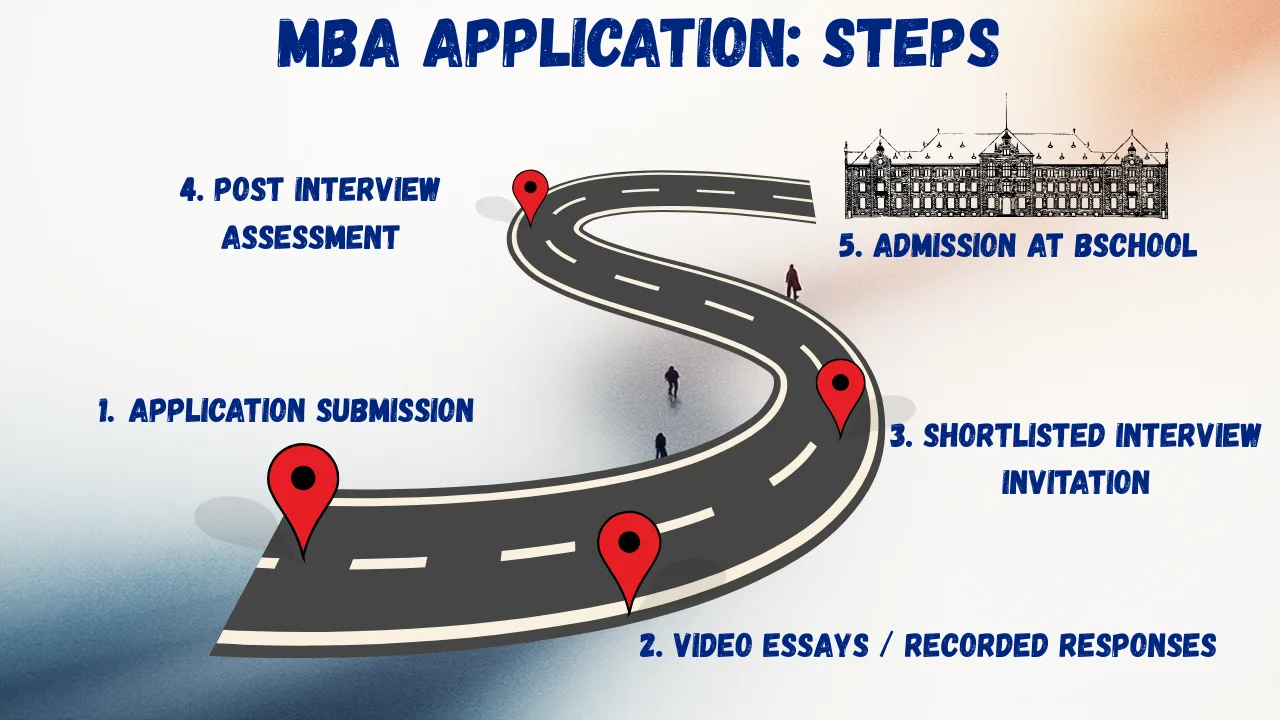
1. Application Submission
This is the formal starting point of the process. Applicants submit:
- A detailed online form capturing academic history, work experience, and personal information
- One or more essays outlining goals, motivations, leadership experiences, and fit with the school
- A professional résumé showcasing achievements and impact
- Test scores (GMAT/GRE; some schools accept EA or waive scores)
- Transcripts from all undergraduate and graduate institutions
- Letters of recommendation, typically from supervisors or mentors who can evaluate performance and potential
Most schools operate in rounds (R1, R2, R3), with earlier rounds often offering better scholarship and admissions odds.
Your resume is the first thing the committee sees. Make sure it’s an invitation to read more.
2. Video Essays / Recorded Responses
Several top schools – such as Kellogg, MIT Sloan, INSEAD, and Yale SOM, require video essays after application submission. These help admissions committees assess communication skills, personality, and presence beyond the written file.
Candidates receive a set of timed questions with limited preparation time, simulating real workplace spontaneity. Questions typically explore:
- Motivation and goals
- Leadership and teamwork
- Behavioral scenarios
- Personal values or interests
This stage provides a more human dimension to your application before interviews.
3. Shortlisted Interview Invitation
If your application is competitive, you’ll receive an interview invite, typically 4–8 weeks after submission.
Interviews at top schools are:
- Behavioral and leadership-focused (e.g., Harvard, Stanford)
- Blind interviews (interviewers only see your résumé—Kellogg, Booth, etc.)
- Panel-based or alumni-led (INSEAD, LBS)
Depending on the school, interviews may include:
- Case discussions (Wharton Team-Based Discussion)
- Leadership exercises (Oxford Saïd)
- Group simulations (HEC Paris)
- Data or situational analysis tasks
The interview is designed to assess clarity of goals, interpersonal effectiveness, and school fit.
Learn : 10 MBA Interview Tips from an Admissions Interviewer
4. Post-Interview Assessment
Some schools add another step after the interview:
- Additional written essays (INSEAD, MIT Sloan)
- Post-interview reflection essays (Harvard)
- Further assessments or follow-up questions
This stage helps admissions committees validate consistency and motivation.
5. Final Decision
Admissions decisions are typically released on a fixed date for each round. Applicants receive:
- Admit
- Waitlist
- Ding (Reject)
If waitlisted, schools may request additional information, updated achievements, or follow-up essays.
Q1: What does the MBA application process at top global schools typically involve?
It involves multiple stages—including essays, recommendations, video assessments, and interviews—designed to evaluate your academic readiness, leadership potential, and personal fit.
Q2: Why do schools include video essays in the application process?
Video essays help schools assess your communication style, personality, and spontaneous thinking beyond what’s visible in written materials.
Q3: Do all candidates face additional assessments after the interview?
Not all, but some schools require post-interview reflections or extra essays to confirm motivation and authenticity.
Q4: When are final decisions released for MBA applications?
Decisions are announced on round-specific dates and typically result in an admit, waitlist, or rejection outcome.
Navigate the MBA admission maze with a proven guide. Our End-to-End Admission Support Program provides the expert strategy and support to secure your spot.
Ready for proof? Meet the students who got into their dream schools.
MBA Fees & ROI: Is a Master of Business Administration Worth the Cost?
Pursuing an MBA at a leading global institution is a significant financial commitment, and understanding the cost structure – as well as the value it delivers—is crucial for applicants. The fees for top schools vary widely due to factors like brand prestige, infrastructure quality, geographic location, faculty expertise, and whether the institution is publicly funded or privately operated.
For example, U.S. private schools like Harvard, Wharton, and Stanford typically charge higher tuition due to premium faculty, cutting-edge facilities, and strong global brands. Meanwhile, schools in Europe and Asia, such as INSEAD, LBS, Oxford, and NUS, often offer competitive one-year programs with lower overall costs because of shorter duration and, in some cases, government subsidies.
Fee Breakdown: What Makes MBA Costs Differ?
MBA fees at top schools usually include tuition, program materials, tech resources, global immersion trips, and campus services. Costs vary due to:
- Program duration (1-year programs cost less overall than 2-year programs)
- Public vs. private status (public universities may subsidize tuition)
- Geographic factors (cost of living in cities like London, New York, or San Francisco is significantly higher)
- Brand value and placement outcomes (schools with stronger global reputations often command higher tuition)
- Curriculum intensity (global immersions, live projects, and career treks add to the total cost)
This variation explains why MBA fees in the U.S. tend to be higher, while Europe and Asia offer cost-effective yet globally respected alternatives.
Financial Aid Options: Making an MBA Affordable
Most leading business schools offer extensive financial support to help students bridge the funding gap:
- Merit-based scholarships for outstanding academic, professional, or leadership profiles
- Need-based grants at schools like HBS, Stanford, and Yale SOM
- Assistantships and fellowships that reduce costs through research or teaching roles
- Education loans from banks and global lenders, often with deferred payment options
- Flexible EMI plans, income-share agreements, or external scholarship options (Fulbright, Chevening, JN Tata, etc.)
With a strategic mix of these funding sources, many students significantly reduce their out-of-pocket expenses.
ROI Analysis: How an MBA Pays for Itself
Despite the high upfront cost, an MBA from a top school is considered one of the strongest professional investments. Graduates from leading institutions command some of the highest global salaries, especially in finance, consulting, and technology roles. The combination of strong starting salaries, rapid career acceleration, and global mobility contributes to a compelling ROI.
In most cases:
- The payback period for top U.S. MBA programs is typically 3–5 years, depending on industry and geography.
- For one-year European and Asian MBAs, the payback period often drops to 1–3 years due to lower tuition and quicker re-entry into the workforce.
When the “MBA Course Fees” are compared to the “MBA Salary” outcomes from top schools, the value becomes clear: the post-MBA salary jump – often 150% to 250% for many candidates – more than compensates for the tuition investment. This financial uplift, paired with lifelong alumni networks, enhanced leadership opportunities, and global career mobility, makes the MBA a high-return decision for most graduates.
Q1: Why do MBA fees vary so much across top global business schools?
MBA fees differ due to factors like program length, school reputation, location, infrastructure quality, and whether the institution is public or private.
Q2: Is an MBA worth the high cost in terms of return on investment?
For most graduates, the post-MBA salary jump, faster career growth, and global mobility deliver strong ROI within 1–5 years depending on the school and region.
Q3: Do one-year MBA programs provide better financial ROI than two-year programs?
Often yes, because their lower tuition and quicker workforce re-entry reduce the overall payback period significantly.
Q4: How long does it usually take to recover the cost of an MBA from a top school?
Most students recoup their investment within 1–5 years, depending on their specialization, geography, and post-MBA industry.
Career Opportunities & Scope After MBA
Graduates from top-tier global MBA programs enjoy some of the strongest career outcomes in the world, with access to high-impact roles across consulting, finance, technology, consumer goods, and emerging sectors. These roles are designed for future leaders who can navigate ambiguity, drive strategy, and lead cross-functional teams.
Job Roles: What Top MBA Graduates Typically Do
MBA graduates step into leadership-track roles across industries. Some of the most sought-after positions include:
- Management Consultant
Helps organizations solve complex problems related to strategy, operations, digital transformation, and organizational design. Consultants structure problems, develop analytical frameworks, and guide executive decisions. - Investment Banker / Finance Manager
Works on mergers and acquisitions, capital raising, valuation, and corporate strategy. Strong analytical, financial modeling, and negotiation skills are essential. - Product Manager (Tech / SaaS)
Leads the development, launch, and scaling of products. PMs work at the intersection of business, technology, and user experience, coordinating engineering, design, and marketing teams. - Marketing Manager / Brand Leader
Oversees brand strategy, market positioning, consumer research, and digital campaigns. Particularly relevant in FMCG, retail, e-commerce, and advertising-driven industries. - General Management / Leadership Development Roles
Rotational roles offered by global companies that groom MBA graduates for senior leadership. These roles focus on business expansion, operations, and cross-functional leadership. - Operations / Supply Chain Manager
Manages sourcing, logistics, supply chain planning, manufacturing strategy, and process improvements—critical functions in global companies. - Entrepreneur / Startup Leadership Roles
Many MBA graduates launch ventures or join high-growth startups in product, business development, or strategy roles—especially those from entrepreneurship-focused programs like Stanford, INSEAD, and Haas.
Salary Trends: What Drives Compensation Differences?
The salary landscape for MBA graduates varies significantly based on school tier, specialization, and prior experience.
College Tier
- M7 & Global Elite Schools (Harvard, Stanford, Wharton, INSEAD, LBS) offer the highest salaries globally, often exceeding $175,000–$220,000 base plus bonuses.
- Top 15 U.S. and Top European Schools typically see $140,000–$170,000 base salaries.
- Schools outside these clusters still offer strong outcomes but generally fall in the $110,000–$140,000 range.
Specialization
- Consulting and Investment Banking continue to offer the highest compensation packages, often crossing $200,000–$250,000+ with bonuses.
- Product Management and Tech roles compete closely, especially in U.S. and European tech hubs.
- Marketing, Operations, and HR roles usually offer more moderate compensation but faster career progression within organizations.
Experience Level
- Early-career applicants (3–5 years) secure strong starting salaries but may take longer to hit senior roles.
- Experienced professionals (8+ years) often transition directly to leadership positions with higher compensation bands.
Top Recruiters from Global MBA Programs
Top business schools attract the world’s most prestigious employers across consulting, finance, and technology. Some leading recruiters include:
Consulting Giants
- McKinsey, BCG, Bain – hiring for roles like Consultant, Strategy Associate, and Engagement Manager.
- Strategy arms of Deloitte, PwC, EY, KPMG recruiting for digital, operations, and transformation advisory roles.
Financial Powerhouses
- Goldman Sachs, Morgan Stanley, JP Morgan, Citi, Bank of America – for investment banking, markets, and corporate finance.
- BlackRock, Fidelity, Vanguard – for asset and wealth management roles.
- Private Equity & VC firms like Carlyle, Bain Capital, Sequoia, Warburg Pincus.
Technology Leaders
- Amazon, Google, Microsoft, Meta, Apple – hiring product managers, program managers, strategy leads, and business analysts.
- High-growth tech companies (Stripe, Uber, Airbnb) for product and strategy roles.
Consumer & Retail Companies
- Procter & Gamble, Unilever, PepsiCo, L’Oréal – for brand leadership and marketing roles.
- Nike, Starbucks, Walmart – for retail strategy and operations management.
Healthcare & Pharma
- Pfizer, Novartis, Johnson & Johnson, Roche – for strategy, operations, and product commercialization roles.
These companies value the leadership readiness, analytical depth, and cross-functional expertise that MBA graduates from top schools bring to the table.
Q1: What kinds of roles do graduates from top global MBA programs usually step into?
They typically enter leadership-track positions in consulting, finance, technology, marketing, operations, or high-growth startups.
Q2: Why do MBA salaries vary so much across schools and specializations?
Compensation differs based on school prestige, the industry you choose, and your prior experience level.
Q3: Who are the biggest recruiters at top global MBA programs?
Leading employers include McKinsey, BCG, Bain, major Wall Street banks, Big Tech firms, and multinational consumer goods companies.
Conclusion: Is an MBA the Right Choice for You?
The key takeaway from everything we’ve discussed is that top MBA programs aren’t just hunting for perfect résumés – they’re looking for thoughtful professionals who understand their journey, can articulate why they want the degree, and show evidence of steady growth and real-world impact. The strongest candidates usually bring a mix of analytical ability, leadership experience, and interpersonal maturity, along with the curiosity to learn from others and the humility to be coached. They don’t need to have it all figured out, but they should show direction, purpose, and the potential to make meaningful contributions both inside and outside the classroom.
An ideal MBA profile typically includes clear career goals, solid work experience, comfort with data-driven decision-making, and the ability to work well in diverse teams. Schools also value adaptability, global awareness, and the willingness to step outside one’s comfort zone traits that signal someone who will not only thrive in a rigorous program but also elevate the people around them.
And ultimately, the real power of an MBA isn’t just the credential – it’s the long-term shift it creates in how you think, lead, and navigate your career. It’s an investment that keeps paying off as your ambitions evolve, opening new paths and giving you the confidence to pursue opportunities you may not have imagined yet.
Ready to start your MBA journey?
Let AdmitStreet be your guide. From profile building to interview preparation, we’re with you at every step.