

Getting admitted into a Master of Business Administration (MBA) program is a competitive and transformative endeavor. Among the various components of a strong application, letter of recommendation hold a special place in shaping an applicant’s profile. These letters provide insights into an applicant’s character, capabilities, and potential as a future business leader.
In this complete guide, you’ll learn:
- What admissions committees actually look for in an LOR
- How to choose the right recommenders and guide them
- Tips for getting an effective LOR
- The GMAC Common LOR format (used by 40+ top business schools)
Let’s get started.
- What Admissions Committees Actually Look For
- How to Choose the Right Recommender
- How to Guide Your Recommender
- Timing: When & How to Ask Your Recommender
- Tips for Getting Effective MBA Letters of Recommendation (LoRs)
- GMAC Common Letter of Recommendation
- Mistakes to Avoid When Seeking MBA Letters of Recommendation
- Next Steps
- FAQs
What Admissions Committees Actually Look For
Admissions officers don’t just read LORs : they decode them. They look for specific evidence of behaviors that predict success in an MBA program and beyond.
Here are the top 5 criteria adcoms evaluate in every recommendation letter:
| Criterion | What They Want to See |
|---|---|
| Leadership under pressure | A specific example where the candidate took charge during a crisis or ambiguity. |
| Problem-solving & analytical rigor | Evidence of data-driven decisions, not just effort. |
| Teamwork & influencing without authority | How the candidate motivated peers or cross-functional teams. |
| Resilience & learnability | A failure or setback that was turned into a growth opportunity. |
| Peer comparison | The candidate ranked against others at same level (e.g., “top 2% of 50+ direct reports”). |
How to Choose the Right Recommender
Selecting the right recommender is a critical step in the process. Ideal recommenders are individuals who know you well and can speak authoritatively about your professional achievements and personal qualities.
Ideally, your recommender should be your current direct supervisor or manager who has observed your work closely and can provide specific examples of your achievements and contributions. However, if you are not planning to divulge your intent of doing an MBA to your manager then you could choose someone else. This could be a former direct supervisor, a client, a mentor, or a senior colleague, depending on who can provide the most compelling and relevant information about you.
When choosing a recommender, consider the following factors:
- Relevance: The recommender should be able to speak to your qualifications, leadership abilities, and character in relation to the MBA program.
- Authority: Opt for someone with credibility and authority in your field who can vouch for your achievements.
- Specificity: The recommender should be able to provide specific examples and anecdotes that illustrate your strengths and contributions.
- Longevity: Ideally, the recommender should have known you for a significant period and worked with you closely to accurately evaluate your abilities and growth.
How to Guide Your Recommender
To ensure that your recommender produces a compelling and effective letter, it is essential to guide them adequately.
Here are a few strategies to help your recommender craft a stellar letter of recommendation:

- Provide Information: Initiate an honest conversation with your recommenders about your MBA goals, and your reasons for pursuing an MBA. Share your resume, a summary of your career achievements, and your aspirations with the recommender. This will help them better understand your background and goals, enabling them to tailor their recommendation accordingly.
- Discuss Your Accomplishments: Have a conversation with your recommender about your most significant accomplishments, experiences, and skills. This will allow them to highlight specific examples that showcase your potential as an MBA candidate.
- Share Your Story: Communicate the narrative you want the recommender to convey. This can help them align their perspective with your intended image in the admissions process.
- Highlight Your Traits and Skills: Emphasize the key traits and skills that are relevant to the MBA program. This will guide your recommender in addressing the specific qualities that the admissions committee seeks.
- Mention the Deadlines: Clearly communicate the deadlines for submission and any necessary guidelines.
- Be Respectful of Their Time: Give your recommender ample time to write the letter. Avoid last-minute requests that may lead to rushed or subpar recommendations.
Get Personalized Guidance on Your LoRs
Struggling with how to brief your recommender? We’ll ensure they highlight your leadership, teamwork, and impact.
Timing: When & How to Ask Your Recommender
Approaching potential recommenders for MBA admissions is a crucial step in the application process. Timing is essential to ensure your recommenders have enough time to write thoughtful and compelling letters.
Here are a few things to keep in mind when approaching a potential recommender:
| What to Do | Key Timing / Tips |
|---|---|
| Plan several months in advance | Start thinking about recommenders at least 6 months before the first application deadlines. Most MBA deadlines are Sept-Jan, so approach in spring or early summer, at least six months before the first application deadline. |
| Communicate early | Reach out as soon as you know your target schools and goals. This lets you gauge their willingness and availability early. |
| Consider the recommender’s schedule | Avoid their busy periods (e.g., tax season for accountants, holidays for retail managers). Approach well before or after those times. |
| Give a reasonable timeframe | Provide at least 4 to 6 weeks for them to write the letter without feeling rushed. |
| Follow up periodically | After the initial conversation, send gentle reminders as the deadline approaches to ensure they don’t forget. |
| Have a Plan B | If a recommender can’t meet your timeline or hesitates to give a strong letter, find an alternative. It’s also wise to have a Plan B to avoid last-minute stress, in case one of your recommenders unexpectedly becomes unavailable or fails to meet the deadline. |
Obtaining effective letters of recommendation for MBA admissions requires careful planning, clear communication, and a collaborative approach with your recommenders. By avoiding common mistakes and following these tips, you can significantly enhance the quality and impact of your recommendation letters, thus strengthening your MBA application.
Tips for Getting Effective MBA Letters of Recommendation (LoRs)

Know What Makes an LOR Impactful
To make sure you have a strong letter of recommendation, you should first know what makes a LoR impactful and compelling. This way you would be able to guide your recommender to get the best possible outcome.
Here’s what sets a strong recommendation letter apart:
- Has Specific Examples: A strong recommendation letter provides concrete examples that illustrate the applicant’s skills, accomplishments, and character traits. These examples give depth and authenticity to the endorsement.
- Is Relevant to the MBA program: The letter should directly relate the applicant’s qualities to the skills and attributes valued in an MBA program. It should demonstrate how the applicant’s experiences align with the demands of business school.
- Provides Personal Insights: The recommender’s personal insights and observations about the applicant can add a unique perspective that goes beyond what’s stated on the resume. These insights can shed light on the applicant’s character, leadership potential, and contributions.
- Is Consistent with the Application: The letter should harmonize with the applicant’s personal essays and other application components. Discrepancies can raise doubts about authenticity.
- Is Honest and Balanced: A good letter doesn’t shy away from constructive criticism. It presents a balanced view, acknowledging areas for growth while highlighting strengths.
Now that you are ready to guide your recommender, here are a few tips that will help you get the best possible Letter of Recommendation (LoR) for the MBA application:
Make Your Recommender’s Job Easy
Make sure you assist your recommender as much as possible. People keep juggling a lot, and giving them some direction can really help.
Here’s what they usually find helpful:
- Share Your Resume: Just pass them the same one you’re planning to submit with your application.
- Fill Them in on Your Goals: Let your recommenders know how you’re portraying yourself in your application. If you haven’t nailed down your essays, at least give them an outline.
- Point Out the Highlights: If you want them to focus on a specific project you handled or a task you aced, give them a heads up. Remind them about those moments that really showcase your skills.
- Name Your Schools: Tell them where you’re applying and what drew you to those schools.
- Mind the Timelines: Make sure you ask for recommendations well before the deadlines. If it’s a last-minute thing, have a chat and explain the time crunch.
- Walk Them Through the Logistics: Don’t forget to let them know how they should submit the recommendation letter when it’s ready—whether through the school’s online system or e-mail. If the schools want a physical letter, share the envelopes and stamps. Any help you can give them will be a big relief.
Get Personalized Guidance on Your LoRs
A strong LoR can elevate your entire MBA application. We can help you strategize, prepare your recommenders, and avoid pitfalls.
GMAC Common Letter of Recommendation
GMAC (Graduate Management Admission Council) Common Letter of Recommendation (LOR) form is a standardized recommendation form that is accepted by several business schools for MBA admissions. It was introduced to simplify the recommendation process for MBA applicants and to provide a common format for recommenders to use when writing letters of recommendation.
What are the components of the common LoR?
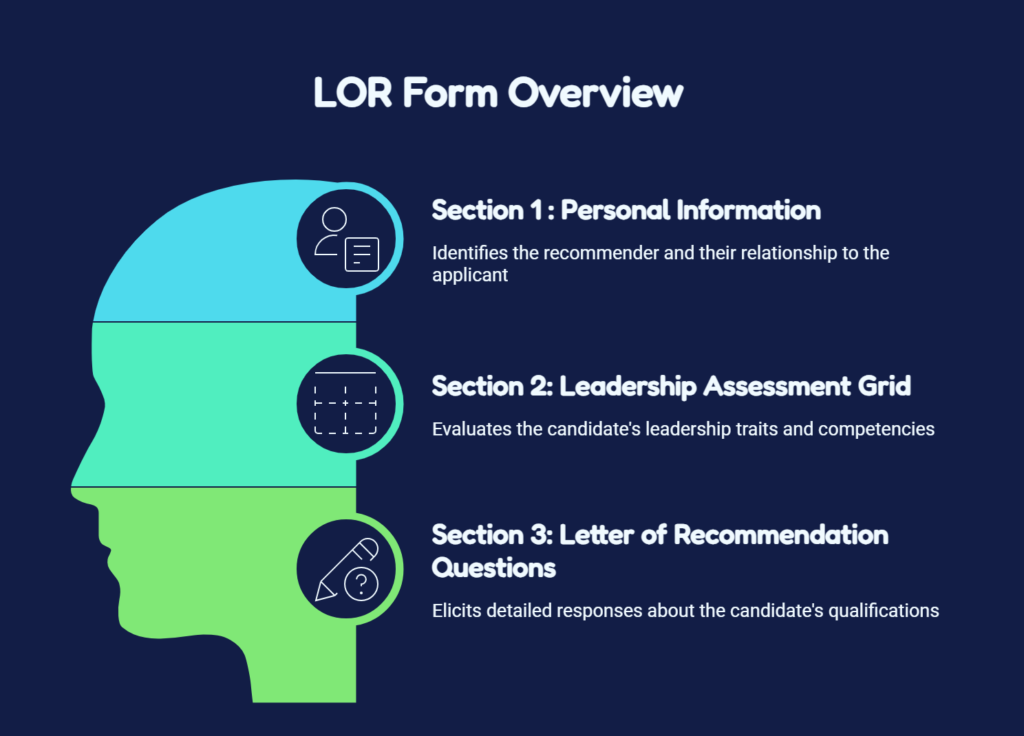
The Common LOR form has three sections:
- Section 1: Personal information about the letter writer. This is where the recommender identifies themselves and their relationship to you.
- Section 2: Leadership assessment grid of candidate. This section is divided into five categories, each identified for the way they help assess the candidate against 16 traits and competencies – like influence, achievement, and cognitive abilities.
- Section 3: Letter of recommendation questions. This essay-style section provides three prompts that must be answered in 500 words or less.
- Please provide a brief description of your interaction with the applicant and, if applicable, the applicant’s role in your organization. (Recommended word count: 50 words).
- How does the performance of the applicant compare to that of other well-qualified individuals in similar roles? (e.g., what are the applicant’s principal strengths?) (Recommended word count: 500 words).
- Describe the most important piece of constructive feedback you have given the applicant. Please detail the circumstances and the applicant’s response. (Recommended word count: 500 words).
Here is the GMAC LoR Template.
Mistakes to Avoid When Seeking MBA Letters of Recommendation

Here are a few mistakes you should avoid while fetching MBA letters of recommendation:
Last-Minute Requests
Avoid approaching your recommenders at the last minute. Rushed letters tend to lack depth and may not adequately highlight your strengths.
Generic Recommendations
Discourage your recommenders from writing generic letters that could apply to any candidate. The letter should be personalized and specific to you.
Not Assisting the Recommender
Don’t assume your recommenders know everything about your achievements and experiences. Help them by providing relevant information and context.
Micromanaging the Process
While offering guidance is helpful, avoid over editing or scripting the entire letter. The recommender’s authentic voice should come through.
Ignoring Guidelines
Ensure your recommenders adhere to any guidelines provided by the MBA program. Failing to follow instructions could reflect poorly on your application.
Choosing Based on Title Alone
Avoid selecting a recommender solely because of their impressive title or seniority. Choose individuals who can provide specific insights into your abilities and accomplishments.
Not Diversifying Recommenders
Relying solely on one type of recommender (e.g., supervisors) might limit the breadth of perspectives in your application. Aim for a mix of professional and personal recommenders, if possible.
Assuming a Positive Recommendation
Never assume someone will provide a positive recommendation without discussing it with them first. Always have an open and candid conversation about your intentions.
Checklist / Key Takeaways for MBA LoRs
| Stage | Action Items |
|---|---|
| Before Asking Your Recommender |
• Identify 2 recommenders who know your work well (not just by title). • Confirm their willingness and availability in advance. • Provide them with your resume, career goals, and key achievements. |
| When Requesting the LoR |
• Ask at least 6–8 weeks before the deadline. • Share the application deadline and submission guidelines clearly. • Offer talking points but never write the letter for them. |
| What Makes a Strong LoR |
• Includes specific examples of leadership, teamwork, and impact. • Balances strengths with areas of growth (credibility). • Uses a clear, professional, and authentic tone. |
| Common Mistakes to Avoid |
• Choosing a recommender only for their seniority/title. • Submitting vague or generic recommendation letters. • Requesting last-minute or pressuring recommenders to rush. |
| Final Checks |
• Ensure recommenders have submitted well before deadlines. • Thank your recommenders sincerely and keep them updated on outcomes. |
Next Steps
Your LOR is a powerful tool in your MBA application. Use the strategies above to turn a routine letter into a compelling endorsement.
Related reading:
- ISB Letter of Recommendation (LoR): A Comprehensive Guide
- How to Create an Efficient MBA Application Timeline
- Top MBA Programs in the World (2025)
- Best Business Schools for a Career in Marketing
- Top 15 Business Schools for Finance Careers
- Best Business Schools for a Career in the Technology Industry 2025
- Top 15 Business Schools for Consulting (McKinsey, Bain, BCG)
- MBA Abroad: A Complete Guide
FAQs
How many Letters of Recommendation are required for MBA admissions?
Most top MBA programs typically require two letters of recommendation, though some schools may accept one. Always check each program’s guidelines.
Who should I ask to be my MBA recommender?
The best MBA recommender is usually a current or recent supervisor who has directly observed your professional impact, leadership, and growth.
When is the right time to ask a recommender for an MBA LoR?
Ideally, you should ask your recommender 6–8 weeks before the application deadline. This gives them enough time to craft a strong and detailed letter.
Can a professor write my MBA recommendation letter?
If you are a recent graduate with limited work experience, a professor can be acceptable. However, professional recommenders are preferred by most MBA programs.
What should I provide to my recommender for the MBA LoR?
Share your resume, career goals, application deadlines, and key achievements so your recommender can write a personalized and impactful letter.
What makes a strong MBA Letter of Recommendation?
A strong MBA LoR highlights your leadership, teamwork, communication, and impact, with specific examples instead of generic praise.
What is the GMAC Common Letter of Recommendation?
The GMAC Common LoR is a standardized recommendation format accepted by many business schools to simplify the application process.
You can check here : GMAC LoR Template.
Get Personalized Guidance on Your LoRs
A strong LoR can elevate your entire MBA application. We can help you strategize, prepare your recommenders, and avoid pitfalls.