

In recent years, MBA video essays have become a popular tool for business schools to evaluate candidates beyond their written applications. While traditional written essays and standardized test scores remain significant factors in the application, many top-tier business schools have started asking applicants to submit video essays.
Video essays allow candidates to showcase their personality, communication skills, and suitability for the MBA program.
In this article we’ll explore everything you need to know about MBA video essays – what it is, why business schools use them, what qualities admissions committees look for, and proven strategies to deliver strong responses.
We’ve also compiled the list of video essay questions for B-schools that include this component in their application process: Kellogg, INSEAD, Rotman, Yale SOM, MIT Sloan, Oxford Saïd, IESE, IE, LBS, Chicago Booth, Haas, UVA Darden, Emory Goizueta, CMU tepper and Vanderbilt Owen.
Quick answer: An MBA video essay (also called a Kira Talent interview, video interview, or video statement) is a short recorded response to admissions questions, used by schools including Kellogg, INSEAD, Yale SOM, MIT Sloan, Oxford Saïd, LBS, IESE, Rotman, Chicago Booth, Haas, Darden, Tepper, Emory Goizueta, Vanderbilt Owen, and IE Business School. Formats range from 45-second prep + 60-second answers (INSEAD) to a single 90-second unscripted take (MIT Sloan). It supplements, not replaces, the written essays and admissions interview.
What Is an MBA Video Essay?
MBA video essays require candidates to respond to prompts from the admissions committee through self-recorded videos instead of relying on written responses.
This component has been introduced as an additional element in the application process for select business schools, without replacing traditional written MBA admission essays or the final admission interview.
Terminology Note: Different business schools use varying terminology. For instance, Kellogg Business School may label it as a video essay, while INSEAD may term it a Video Interview, and MIT may refer to it as a Video Statement. Despite the nomenclature differences, they all essentially entail the same process, with the only potential variation being the video essay’s format.
Types of MBA video essays
There are generally two types of video essays asked in MBA admissions: Live/Impromptu and Pre-recorded. Each type serves a unique purpose and presents its own set of challenges and advantages.
Live/Impromptu Video Essays:
- What it is: Live or impromptu video essays require MBA applicants to respond to questions or prompts in real time.
- How it works: Candidates are typically given a limited amount of time to prepare their thoughts, often ranging from 30 seconds to a few minutes. Once the preparation time is up, they must begin recording their response immediately.
- What it assesses: This format aims to assess an applicant’s ability to think on their feet, communicate clearly, and maintain composure under pressure. Admissions committees use live video essays to gauge an individual’s spontaneity, poise, and how effectively they can address unexpected topics or situations.
Pre-recorded Video Essays:
- What it is: Pre-recorded video essays, on the other hand, allow MBA applicants more control over the timing of their responses.
- How it works: In this format, candidates receive a set of questions or prompts in advance and are allotted a specific amount of time to record their answers. This time frame typically ranges from a few hours to several days, depending on the business school’s requirements.
- What it assesses: Pre-recorded video essays allow applicants to carefully craft and rehearse their responses, emphasizing their communication skills, creativity, and thoughtfulness in addressing the given prompts. This format allows for a more polished presentation but still evaluates an applicant’s ability to convey their ideas effectively through video.
Why do Business Schools Ask for a Video Essay?
Business schools request video essays as part of the MBA admissions process for various reasons. These video essays offer a unique opportunity to assess applicants beyond traditional written materials.
Here’s a list of 10 key qualities that business schools are looking for in applicants and how different aspects of the video essay can help assess these qualities:
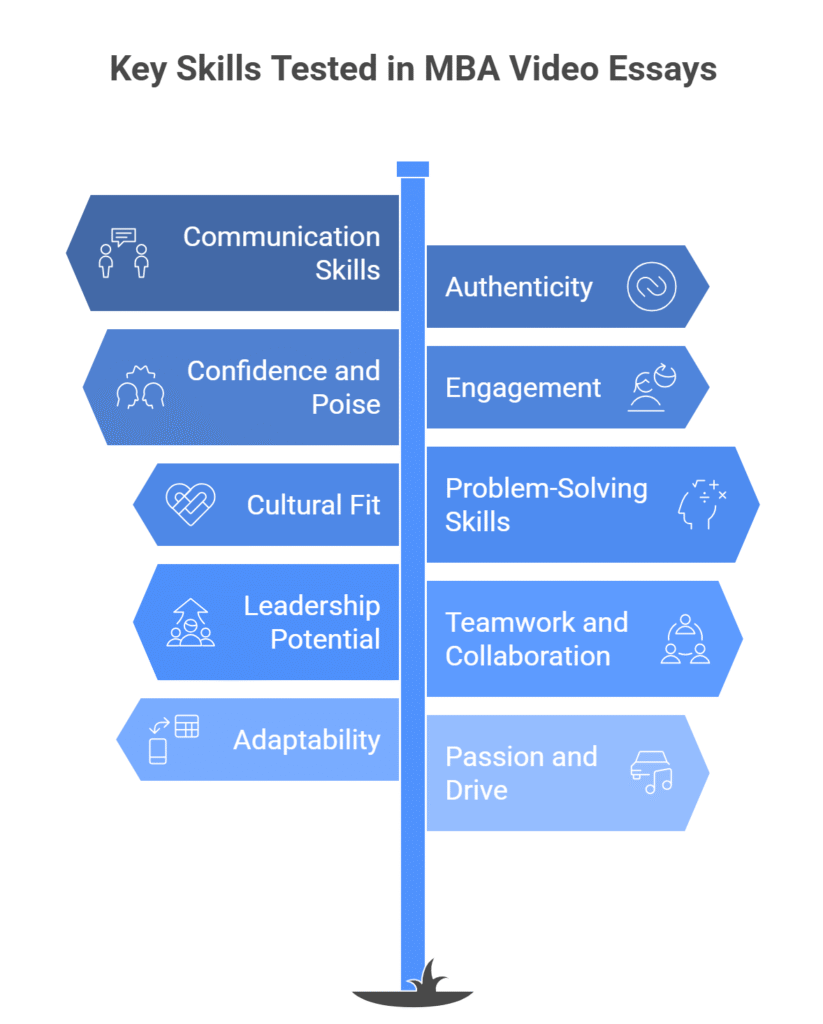
| Quality | What It Demonstrates | Video Essay Component |
|---|---|---|
| Communication Skills | Clarity of Expression | Ability to articulate thoughts coherently and persuasively. |
| Authenticity | Genuine Self-Presentation | Revealed through unscripted, spontaneous responses that show the real personality. |
| Confidence and Poise | Ability to Handle Pressure | Maintaining confidence and composure when answering unexpected questions. |
| Engagement | Ability to Capture Attention | Using storytelling techniques and compelling anecdotes to keep the viewer engaged. |
| Cultural Fit | Alignment with School Values | Expressing genuine enthusiasm for the school and its culture. |
| Problem-Solving Skills | Analytical Thinking | Responding effectively to complex or challenging questions. |
| Leadership Potential | Presence and Influence | Portray yourself as a confident, impactful leader who inspires and motivates others. |
| Teamwork and Collaboration | Ability to Work Well with Others | Sharing experiences that highlight cooperation and collaboration. |
| Adaptability | Flexibility and Resilience | Thinking on your feet and adapting to unexpected prompts. |
| Passion and Drive | Enthusiasm and Commitment | Conveying genuine passion for your goals and drive to make a meaningful impact. |
These qualities are essential for success in an MBA program and in the business world. The MBA video essays serve as a valuable tool for admissions committees to assess these qualities in applicants, allowing them to make more informed decisions about who would thrive in their academic environment and contribute positively to their MBA community.
Pro tip: As an applicant, you should use the video essay as an opportunity to showcase your unique strengths and qualities that set you apart from the competition.
Which business schools ask to submit a video essay?
In the sections below, we’ll walk you through the key video essay questions from top business schools, along with expert tips on how to approach them. For each school, we’ve also provided the complete list of latest video essay questions to help you prepare thoroughly.
1) Northwestern Kellogg
The application has become more focused: requirements now include one written essay for all programs and five short video essays for the Full-Time MBA Programs. While this includes two additional brief video responses, each is just 60 seconds, offering a meaningful way to share your story in less time and with less stress than a traditional essay.
This new approach creates an intentional opportunity for more authentic, in-the-moment reflection, while also enabling the admissions team to gain genuine insights into each applicant. Overall, this shift is designed to create a more approachable experience for candidates.
Here are a few things to consider as you start preparing to work on this section:
- The deadline to submit the video essay is 96 hours from the time when the application deadline occurs.
- Once you apply and make the payment, a link to the video essay will be available at your Application Status Page.
- You will require an internet-connected computer with a webcam and microphone.
- The entire process will take about 30 minutes to complete.
- Here are a few other helpful tips:
- There are sample questions that can be completed by you as many times as you wish to feel comfortable with both the format and technology used.
- Your preparation through practice questions and experience will mimic the actual experience of completing a video essay.
- Practice to be familiar with the format, as you won’t have another chance to re-answer the video essay questions.
- You will have a second to think about the question and one minute to give your answer.
Compilation of Kellogg Video Essay questions (2026)
- Tell us something about yourself that is not on your resume.
- Why do you want an MBA, and why Kellogg?
- How long have you been considering an MBA, and what have you learned about yourself during that journey?
- What unique value, quality, or perspective will you bring to the Kellogg community?
- Who is a leader you admire, and what aspects of their leadership style would you like to emulate?
- Tell us about a time you created an inclusive environment where different perspectives were respected and valued.
- Tell us about a time you supported someone from a different background or with a different opinion.
- Tell us about a time a colleague, mentor, or professional contact helped you. What did you learn?
- Tell us about a time you had to ask for help to achieve a goal. How did you realize you couldn’t do it alone?
- Tell us about a conflict you resolved between team members or stakeholders.
- Tell us about a time when you were the cause of conflict. How did you address it?
- Tell us about a time you had to make a decision that went against your team’s opinion. How did you handle the disagreement?
- Tell us about a time you received feedback that you disagreed with. What did you do?
- Tell us about feedback that changed your perspective.
- What is the most important piece of advice you’ve received, and how has it influenced you?
- Tell us about a time you stepped outside your comfort zone. What did you learn?
- Tell us about a time you faced an unexpected challenge or had to pivot because circumstances changed.
- Tell us about a time you failed. How did you adapt or change your approach the next time?
- Tell us about a time you failed to complete a task. How did you respond?
- Tell us about a time you had to accommodate a last-minute request or unplanned task.
- Tell us about a time you solved a problem in a creative or unconventional way.
- Tell us about a unique solution you implemented at work within the past year.
- Tell us about a time you improved a process or created something of value.
- Tell us about a time you added value in a professional capacity.
- Tell us about a time you had a positive impact on your organization or community.
- Tell us about a professional relationship or connection that helped you achieve a goal.
- Tell us about a time you leveraged your network to accomplish something important.
- What is one misconception your coworkers have about you, and how would you change it?
- Tell us about an experience outside of work and school that motivated you to pursue graduate education.
- What kind of professional environment or culture do you thrive in, and why?
- What is your greatest fear, and how are you working to overcome it?
- If you could change one decision from your past, what would it be?
- Tell us about a time when a conflict affected your team’s productivity. How did you handle it, and what did you learn? (Different from simply resolving a conflict because it focuses on restoring team effectiveness.)
- Tell us about a time when you had to make someone feel included or valued in a group where they might otherwise have been left out. (Slightly more specific than supporting diverse opinions.)
- Tell us about a time when you felt uncomfortable. How did you respond, and what did you learn? (Different from stepping outside your comfort zone, this focuses on emotional discomfort rather than intentionally taking on a challenge.)
- Tell us about a time when you realized you needed to pivot because circumstances unexpectedly changed. Why did the situation arise, and what did you do? (You have a broader unexpected challenge question, but this version explicitly emphasizes the pivot.)
- Tell us about a prolonged period of uncertainty and how you stayed focus.
- Experienced people with different points of view and how you bridged that gap.
- Working with people with different working styles and how you overcame.
- Describe a time when you had to get agreement with different working styles.
- Tell us about a piece of feedback that was hard to hear.
- Tell us about a time you were committed to a colleague’s success.
- Tell us about a time you realized the way you were leading wasn’t working.
Note: Please consider this list indicative and not exhaustive
Unlock your Kellogg admit with these resources :
2) INSEAD
After you’ve successfully submitted your INSEAD MBA online application, an email notification from Kira Talent will swiftly arrive in your inbox, containing a unique link for you to embark on four video interviews.
These interviews entail answering four distinct questions, and it’s essential to note that the questions presented to you may differ from those posed to other applicants. You’ll have a brief 45 seconds to prepare for each question and a minute to articulate your response. There is also a written essay at the end.
These video interviews present a distinct opportunity for you to unveil your passions, motivations, and your true essence. The MBA Admissions Committee seeks an authentic portrayal of you as an individual, eager to witness your ability to think on your feet and effectively communicate your thoughts.
It’s important to emphasize that these video interviews do not replace face-to-face/online interviews with Alumni, which will still be a part of the assessment process. The video essay has to be submitted within 48 hours after the deadline of the Round in which you apply to INSEAD.
Tips for INSEAD Video Essay
- To ensure a seamless experience, INSEAD recommends using either Microsoft Edge or Chrome for recording your Kira videos. Preparing extensively by practicing is encouraged, as it allows you to convey authentic and genuine responses, even though the practice questions and your responses won’t be disclosed to the Admissions Committee.
- Before you begin recording, conduct a brief technology check by testing your camera and microphone. Once satisfied with the technical aspects, shift your focus to the camera, envisioning that you are addressing the Admissions Committee directly.
- Wear Business or Business Casual Attire.
- Lastly, consider keeping a notebook handy during the interviews to jot down key ideas. Remember, you’ll have just 45 seconds to prepare for each answer, followed by 60 seconds to deliver your response to the Admissions Committee.
Compilation of INSEAD MBA Video Essay questions (2026)
- What motivated you to apply to INSEAD, and why is it the right MBA program for you?
- What do you know about the INSEAD MBA program?
- Why should INSEAD select you? What makes you a strong candidate?
- What do you hope to learn or achieve during your time at INSEAD?
- How will INSEAD help you achieve your professional goals?
- What would success at INSEAD look like for you?
- In the event of team underperformance, how would you address the situation?
- How would you handle a teammate who is not contributing their fair share?
- What strategies would you use to earn respect as a new manager?
- Who is a leader or manager you admire, and what qualities inspire you?
- What leadership qualities do you value the most, and why?
- What do you think is the biggest challenge in leading a global team?
- Describe a time you collaborated effectively with someone who had a different opinion or perspective.
- Describe a situation where understanding or listening to another person’s perspective changed your own.
- Describe a recent instance where cultural differences resulted in conflict. What did you learn?
- Tell us about an international or cross-cultural experience that shaped your perspective.
- How do you work effectively in diverse and multicultural teams?
- How is diversity handled in your organization?
- How has your family or organization adopted something from another culture? What were the advantages and disadvantages?
- What would you do if your manager behaved in a way that was offensive to the local culture?
- How would you help a teammate or classmate who is struggling to adapt to a new culture or is hesitant to speak up?
- What advice would you give someone entering a new culture?
- Are you aware of your own biases? How do they influence your thinking and decisions?
- Describe a time you received negative feedback. What was your reaction, and what did you learn?
- How do you provide constructive criticism or difficult feedback to a coworker?
- How do you handle frustration at work and communicate it constructively?
- Tell us about a time you saw someone doing something differently from you. How did you respond?
- What keeps you engaged and motivated at work?
- What are you passionate about outside of work?
- How do you define success in your professional career?
- If you looked back on your life 10 years from now, what would success mean to you?
- What inspires you the most?
- What skills or qualities do you want to develop during your MBA?
- What is the most challenging decision you have ever made?
- What is the most difficult aspect of working with you?
- What do people often misunderstand about you?
- Do you consider yourself to be creative? Why or why not?
- How do you generate new ideas?
- Tell us about a new app, product, or service that has impressed you recently and why.
- What do you think are the qualities of a good friend?
- What are your guiding principles regarding corporate social responsibility and ethical leadership?
- In your opinion, what constitutes unethical leadership behavior?
- What do you think is the most pressing climate challenge today, and how would you address it?
- If you had unlimited resources, what product, service, or company would you build, and why?
- If you won $10 billion, what would you do?
- What are the key elements of starting and running a successful business?
- What skills and qualities are most important for a successful entrepreneur?
- What values should every successful company have beyond making a profit?
- What role does networking play in building a successful business?
- How do you stay focused on your long-term vision or goals?
- How do you balance empathy with making a hard decision?
- What excites you about a diverse, international experience?
- How would you navigate cultural differences clashing with your norms?
- Tell us about a situation in which you shared something you are passionate about with others.
Written Essay Questions: (2026)
- What is something you are deeply passionate about that others might find surprising? What makes it so fulfilling to you?
- How would you contribute within your company to make people healthier?
- Tell us about a time when you adopted a new system, process, or technology.
- Tell us about a time you resolved a situation creatively.
- If you were introducing your country to someone visiting it for the first time, what would you tell them?
- What are the three main reasons you chose to apply to INSEAD?
- What do you think will be the most challenging aspect of pursuing an MBA at INSEAD?
- If you had $1 million to spend on a social impact project, what would you spend it on and why?
- Tell us about a time when you had to decide whether to wait for more information or move forward with uncertainty.
- How do you stay aligned with your personal vision or your company’s vision?
- What is one thing you taught yourself or learned on the go? How have you applied it in subsequent projects or experiences?
- Tell us about a risky decision you made. What did you learn from it?
- Tell us about a time you received negative feedback. How did it make you feel, and how did you respond?
- If given the chance, what kind of leader would you aspire to be?
Note: Please consider this list indicative and not exhaustive
See real MBA journeys : from application strategy to INSEAD admit.
3) Rotman School of Management
Once you’ve submitted your application, expect an email from Kira Talent, a designated service provider. Within this email, you will discover a link granting access to the video essay platform, a crucial component of Rotman’s application process, which comprises two video questions.
Upon accessing the platform and initiating the session, you will be presented with a total of two spoken questions, delivered sequentially, one after the other.
Once you receive the question, you will be granted a 30-second window for contemplation, followed by a 90-second timeframe for your response. It’s essential to note that there are no opportunities for revisiting or reattempting the question; you have just one opportunity to express your thoughts and provide your answer.
Regardless of when you initially submit your application, remember that the clock starts ticking once you access the video essay platform. You must submit your video essay response within two weeks of submitting your application to complete this vital step in the Rotman admissions process.
Compilation of Rotman Video Essay questions (2026)
- Tell us short term goals.
- Why MBA?
- Why Rotman?
- Tell us about your Post-MBA Goals
- Tell us about your most significant achievement
- Tell us about a time when you were challenged without having formal authority.
Note: Please consider this list indicative and not exhaustive
See real MBA journeys : from application strategy to Rotman admit.
4) Yale SOM
In contrast to institutions that integrate video essays into the primary application process, the Yale School of Management requires applicants to answer two video questions after submitting the application and paying the application fee. It should be noted that these video questions do not replace the admissions interview but serve as an additional dimension in the assessment of an applicant’s communication style, English proficiency, and presence.
Once you’ve successfully submitted your application, expect an email notification from Kira Talent, the designated company for Yale’s video essay component. Inside this email, you’ll find a link that grants access to the video essay platform.
The applicants receive two pre-recorded questions from the admissions team members. The nature of the questions is comparable to the questions asked in MBA interviews; there are no tricks or surprises hidden in them. For every question, the applicants have one minute to record their answers.
As answers will be short, candidates must learn how to give concise and well-thought answers in a minute or less. Doing a trial before answering the questions and making sure that there is a good connection will definitely help in giving smooth answers.
According to Yale University, these video questions are meant to be natural. Yale specifically states that candidates should not use AI-written scripts for answering their questions. Instead of giving rehearsed answers, Yale would like to know how the candidates think, talk, and express themselves in real life situations. As Yale explains it, the video questions are taken with a “light touch”. This means that the video questions do not have a big impact on the decisions of the committee.
Compilation of Yale SOM Video Essay questions (2026)
- What’s a difficulty you/your team faced and how did you overcome it?
- Do you agree or disagree with the following statement: Globalization makes it necessary to understand business competitors?
- Do you think that the non-business factors such as social, legal and political factors are given enough consideration by corporations in today’s world?
- Is operational excellence the most important part for any organization?
- Why have you decided to pursue an MBA now?
- Talk about a time when you and your team faced a major obstacle. How did you overcome it?
- Some people say that investors have a big say in defining the company strategy and can often shadow the opinion of internal stakeholders.” What are your views on this?
- Yale has many traditions. What is one of your favourite traditions?
- Tell us about a time when a team member was not doing his share of work and how you handled it
- Tell us about a time you or your team fixed a critical problem at work
- Tell us about a problem that you solved by breaking down into its pieces
- Tell us about a time when there was a potential problem at work and how did you prevent it?
- Mention a vague problem that was given to you and how did you solve it?
- Tell us about a teacher who has impacted you in life?
- Yale School of Drama has produced many world renowned artists (e.g. Meryl Streep). Which artist do you admire most and why?
- Which type of art holds significance to you among the various arts across Yale Center for European arts, Yale Center for Natural arts and Yale Center for British arts?
- New Haven has great architectural significance (something along these lines). What piece of architecture has the greatest significance to you in your hometown or region? Why?
- What is a tradition you hold dear to yourself?
- What piece of advice were you given about pursuing an MBA which you value the most?
Note: Please consider this list indicative and not exhaustive.
Discover how Vedant & Dhruv turned their Yale SOM dreams into reality and got admits from other top schools too :
5) MIT Sloan
MIT Sloan takes a unique approach to video essays, referring to this component as a “video statement.” Unlike traditional written essays, the Sloan video statement allows applicants to introduce themselves directly to the admissions committee in a more personal, authentic manner. This helps the committee assess communication style, presence, and cultural fit beyond the written application.
The video statement has been divided into two portions.
- The first question requires candidates to speak for no more than 90 seconds introducing themselves, giving their background and explaining what has made them who they are. Here the university is very strict about format, which requires the response to be an unedited single take shot when the candidate looks straight at the camera and speaks. There is no room for background music or subtitles, which means that the committee will be able to see the applicant exactly as he/she is.
- Prompt: Every applicant has a story that can’t be captured in a resume. Take up to 90 seconds to share yours – who you are, where you come from, and what’s shaped the person you are today. Be conversational, be yourself. We can’t wait to meet you! (90 seconds)
- The second part of the video application process is less conventional as the applicants receive an randomly generated prompt which makes them improvise. In addition to that, the candidates do not know what kind of questions to expect in order to be prepared for the interview beforehand. For example, the applicants may be asked to explain what achievement they are proud of or how they dealt with a situation when one of their classmates/colleagues refused to participate in the group work.
The following are examples of questions that may be asked in the Video Question 2: (2026)
- What achievement are you most proud of and why?
- Tell us about a time a classmate or colleague wasn’t contributing to a group project. What did you do?
Here are some key tips to help you answer the MIT Sloan video statement effectively.
Question: “Please take a minute to introduce yourself to your future classmates.”
This is your opportunity to introduce yourself and make a personal connection. Unveil your true self, let your personality sparkle, and have a genuine conversation – this is your moment to shine.
Keep the following criteria in mind when creating your videos for MIT:
- Avoid adding background music or subtitles to your video.
- Keep it under 60 seconds, no more!
- Record it all in a single take, no editing allowed.
- Speak directly into the camera.
Compilation of MIT Sloan Video Essay questions (2026)
- Discuss a time you got yourself out of an awkward situation.
- What’s your biggest accomplishment/What achievement are you most proud of and why?
- How would you go about learning a skill?
- Talk about a challenging decision you made at work
- What was the biggest challenge you faced this week?
- Tell us about a time a classmate or colleague wasn’t contributing to a group project. What did you do?
- What did you do when a colleague/team mate wasn’t contributing enough?
- What achievements are you the most proud of?
- What are you most afraid of?
- Tell us about a time you failed, and what did you learn from it?
- Tell us about a moment when you choose to break the policy because you think it’s morally right?
- Choose a theme song for your life and why?
- Something you had to change in a job and how you convince others to do it?
- If you had the chance to deliver a TED Talk, what would it be about?
- What is an interesting project you worked on during an internship?
- Tell us about a time when a colleague at work faced a significant challenge, and you helped them with it.
- Give me an example of when you had to use active listening skills to collaborate with a colleague / client / friend.
- Tell us about a time when you had to lead communications in a crisis.
- Describe a project in which you had to use your analytical abilities.
- Tell us about a time when you had to communicate regularly with stakeholders. How did you ensure the stakeholders were informed and satisfied?
- Tell us about a time you faced an issue while working with a team member. What did you do to resolve it?
- Imagine you woke up to 2000 emails but you could only answer 300.
- Describe a time when you had to make a decision with incomplete information.
- Describe an area you want to improve in the coming year.
- What is the most stressful situation you’ve been in at school / work?
- Say 3 things that you would want to change at your workplace/university if you were a CEO or dean.
- TMAT when you presented a project within a tight deadline without sacrificing quality.
- TMAT when you had to work with someone with a different personality than yours.
- Describe a situation where you had to admit a mistake or failure.
- What is your favorite motto or quote, and why?
- Tell us about an interest you have and never pursued.
- Tell me about a time when you collaborated with people within or outside your organization.
- TMAT when you helped someone outside your family and friends.
- TMAT you delivered fair judgement.
- Describe a project where you collaborated with a cross-functional team from various departments. What strategies did you use to ensure effective teamwork?
- If money was not a concern, what would you do?
- What do you think about green energy?
- If your current personality were a weather system moving through a city, what would the forecast say about your energy, temperament, and effect on the people around you?
- If your superior at work asked you to do something unethical or against company policies, what would you do?
- How would you calculate how many jellybeans in a jar?
- How do you approach solving a complex problem?
- Share an example of how you recently solved a problem.
- Which character in which film would you like to play?
- Tell me about your most recent travel experience.
- An experience you were asked to prioritize and the result.
- What steps would you take before making a big decision?
- Share a time you had to compromise.
- A situation where you faced conflict at your job.
- Explain a time when a co-worker’s request was confusing. What did you do?
Note : Please consider this list indicative and not exhaustive
Unlock your MIT Sloan admit with these resources :
6) Oxford Saïd
In order to learn more about applicants and assess their ability to think quickly, Oxford Saïd’s MBA application process includes an online assessment.
Once the MBA application is submitted, you will find a link in the application status portal. This link allows you to register with Kira Talent, the online assessment platform, and complete the assessment. The assessment can be done anytime before the application deadline for the desired stage, for instance, Round 1 applicants must complete the assessment by the Round 1 deadline.
The online assessment consists of:
- Three competency-based questions, chosen randomly from a pool of available questions. This question allows you to demonstrate skills and qualities such as decision-making, problem-solving, leadership, teamwork, influencing, change management, and communication.
Example: “Could you share an experience where you successfully handled a challenging situation, either in your professional or personal life? How did you approach resolving it?”
For each question, you will have 20 seconds of preparation time, followed by 90 seconds for your response. You will have unlimited practice time. It’s important to note that there are no opportunities to redo the questions, and you have only one chance to respond and share your answers during the assessment.
The entire online assessment should take about 30 minutes to complete, so plan accordingly. 60 seconds to prepare and 90 seconds to respond. For each competency-based question, there is 45 seconds of preparation time followed by 60 seconds to provide an answer.
Compilation of Oxford Saïd MBA Video Essay questions (2026)
- Since when have you wanted to pursue an MBA? Why is now the right time, and what skills do you hope to gain?
- Students apply to many MBA programs. What makes Oxford Saïd unique, and why have you chosen it?
- What specific knowledge or skills do you hope to acquire during the MBA program?
- Tell us about a time you were overloaded with work. How did you manage it?
- Tell us about a time you asked for help. What prompted you to do so, and what was the outcome?
- Tell us about a time you led a diverse team. What specific leadership skills did you use, and why?
- Describe a situation where you faced challenges while leading a project. How did you keep your team motivated?
- Describe a time when you provided leadership to a team.
- Describe an experience where you were responsible for planning a project.
- Tell us about a time you had an idea and had to convince others to support it.
- Imagine you are presenting an innovative business idea, but your audience is uninterested. How would you win them over?
- Tell us about a time when two members of your team were not working well together. How did you handle the situation?
- What would you do if a team member was not contributing their fair share of the work?
- Tell us about a time you had to make an important decision under pressure or with incomplete information.
- Tell us about a significant mistake or failure. How did you respond, and what did you learn?
- Describe a professional or personal challenge you have faced.
- Tell us about a time you had to manage someone else’s frustration.
- Tell us about a time you had to deliver difficult news. How did you approach the conversation?
- Tell us about a time when your opinion strongly differed from someone else’s. How did you handle the disagreement?
- In your view, does effective collaboration require accepting others unconditionally? Why or why not?
- What is your greatest professional or personal limitation or weakness? What have you done to improve it?
- How do you define success, and what outcomes are you striving to achieve?
- How does your organization manage cultural differences?
- How would you define culture?
- Describe your experience working with people who speak different languages or come from different linguistic backgrounds.
- How do you operate effectively within a diverse team or cohort?
- Tell us about a time you supported a colleague outside of a professional setting.
- What project are you currently most passionate about, and why?
- What hobby or personal interest brings you the greatest fulfillment?
- What is an area you are passionate about that you wish more people understood?
- What actions are you currently taking to further develop your passion?
Note: Please consider this list indicative and not exhaustive
See real MBA journeys : from application strategy to Oxford Saïd admit.
7) IESE Business School
IESE Business School has introduced Video Essays as part of the application process last year, replacing the previous personal essay requirement.
The purpose of this change is to gain a deeper and more authentic understanding of applicants. It allows the Admissions Committee to get insights into the thought process and communication style of each candidate.
After submitting the written application and paying the required fees, you will receive a Kira Video Essay link within 24 hours, to be completed by the Application Round Deadline. This link will expire 48 hours after receipt. You will receive detailed instructions along with the link. Upon clicking the link, you can create a Kira account and practice before recording your video essay.
Each applicant will need to respond to four video essay questions starting 2026. For each question, there will be a preparation time before recording the response.
Applicants are encouraged to be concise, as they have a limited time of 1.5 minutes to provide each answer. The Admissions Committee values authenticity and is interested in getting to know the real applicant, rather than hearing what they think the committee wants to hear.
It’s important to note that the application will be considered complete and ready for review only after all components, including the video essays, have been submitted.
Compilation of IESE MBA Video Essay questions (2026)
- How do you pronounce your name?
- Introduce yourself and tell us something about yourself that is not on your resume.
- What unique qualities, traits, or capabilities define you?
- What strengths and abilities would you bring to the IESE MBA community?
- What is one piece of feedback you received that you disagreed with? How did you respond, and what was the outcome?
- If you had to change one thing about yourself, what would it be?
- What is one thing you want to start doing, do more of, and stop doing?
- Every team has different roles or archetypes. Which role do you naturally play, and why?
- What does collaboration mean to you?
- Tell us about a time you worked closely with someone whose personality was very different from yours.
- Tell us about a time you created an environment that helped others grow and succeed.
- Describe a time you demonstrated a spirit of service or helped others outside your professional responsibilities.
- Tell us about a cause you are deeply committed to.
- Tell us about an ethical dilemma you have faced.
- What is the core value of your current employer, and how is it reflected in your day-to-day work?
- What is your ideal workplace environment?
- Describe the culture at your current organization. What do you like, and what would you change?
- What is one thing you like and one thing you dislike about your current job?
- If you were the CEO of your company, what would you do differently?
- Tell us about a time you had to make an important decision without having all the necessary information.
- Tell us about a time you had to deliver unexpected or difficult news. How did you handle it?
- Tell us about a time you had to process a large amount of information or data.
- Tell us about something unexpected that happened in your professional experience. How did you respond?
- When was the last time you were creative? What was the outcome?
- Tell us about something new you recently learned and how it influenced you.
- Tell us about the last book you read and what you learned from it.
- Whose leadership style do you admire the most, and why?
- Tell us about a time you experienced culture shock. How did you handle it?
- Why is studying in an international environment important to you?
- What was the last city or place you visited, and what pleasantly surprised you about it?
- How would you define success in life? Do you consider yourself successful so far?
- If you were graduating from IESE today, what is one thing you would regret not doing during the MBA?
Note: Please consider this list indicative and not exhaustive.
Learn from Real IESE Admits:
8) London Business School (LBS)
Upon your shortlist notification from LBS, you will receive an email with a link to complete your video essays. The link redirects you to the KIRA platform, where you will first be asked to register, verify your email address and set up your microphone and camera.
Once you have completed the set up, you can practice some video essays on the platform. While the practice questions are taken from a question bank and are likely different from the ones you’ll actually see, it is mandatory to practice at least once.
It’s now time to sign in and start your ‘real’ session. You will get two questions in total. The first question is random, and the second is fixed i.e. the same for all applicants. For each question, you will have 40 seconds to prepare and subsequently 90 seconds to answer.
Each question will appear as a video on the screen, with someone from the LBS Admissions Committee reading out the question and text appearing under the video. Your image will then be visible on the screen, at which point, your 40 seconds to prepare will automatically appear. After your preparation time runs out, the clock timer (1.5 minutes i.e. 90 seconds) will start, and you will need to provide your answer within this duration.
Remember, you cannot redo either of the questions, meaning you only get one shot at them. You will also not be allowed to exceed the time limit i.e. the timer ends after 90 seconds, and the screen automatically presents you the next question, or ends the session after the second question.
Video Essays – Question Types & Sample Questions
The first question is random and typically falls within the following categories:
- Self Introspective: Here, you may be asked to reflect on your strengths and weaknesses, successes and failures etc. providing insights into your self-awareness. This question type aims to gauge your ability to assess personal and professional attributes, recognize improvement areas and effectively leverage your strengths.
- Leadership: This question type involves sharing specific instances of leadership experiences, highlighting your approach, decision-making, and impact. The idea here is to evaluate your leadership and negotiation style, ability to inspire others, and how you navigate challenges within a leadership role.
- Behavioral: These are the “Tell Me About a Time (TMAT)” questions which delve into past experiences to predict future behavior. You might be asked to narrate a challenging situation you faced, the actions you took, and the outcomes. These questions assess problem-solving skills, resilience, and the capacity to learn and adapt from previous experiences.
- Motivational: These questions aim to uncover the driving forces behind your pursuit of an MBA or specific career path post-MBA. You may be asked to articulate your goals and the alignment between your personal and professional objectives. The aim is to assess the clarity and sincerity of your motivations.
- Curveballs: Curveball questions are unexpected and designed to test your ability to think on your feet. These might include hypothetical scenarios, unconventional problem-solving tasks, or creative challenges. The purpose is to evaluate adaptability, creativity, and how you handle unexpected situations, without losing your calm.
The second question is fixed: “What will you gain from the LBS MBA that you won’t gain from another MBA program?”
Compilation of LBS MBA Video Essay questions (2026)
- What will you gain from the London Business School MBA Program that you won’t gain from another MBA program?
- Tell us about a time you worked in a dysfunctional team. What did you do to improve it?
- Tell us about a time you received feedback. How are you implementing it now?
- If you could change one thing about your professional experience, what would it be?
- Tell us about a time when you faced conflict at work.
- Tell us about a time when you were exposed to a different culture. Where did you find the most value in this experience?
- Tell us about a time you solved a problem creatively
- Since how long have you wanted to do your MBA? Why now is the right time, and what skills do you hope to gain?
- What will you gain from an LBS MBA that you won’t gain from another MBA?
- Tell us about a time you asked for help and how did it go?
- Tell us about a time you were overloaded with work, how did you handle it?
- Tell us a time when you had an idea and had to convince your project team.
- Do you prefer cats or dogs and explain why?
- What specific skills are you looking to gain at LBS?
- What is the most significant personal weakness that you have identified, what did you do about it and what was the result?
- Imagine you are proposing a business innovation idea for a class project and the audience is not interested. What would you do?
- Tell us about a time you led a diverse team, what specific skill did you use and why?
- You’re giving a pitch and the audience is not active, how do you recognise this and how do you engage them?
- How do you describe the color red to someone who can only see in black and white?
- Tell us something about you not in your resume.
- What is the one feedback you received that you didn’t agree with? How did you react and what was the outcome?
- Tell us one thing you like and one thing you don’t like about your current job.
- What keeps you engaged and motivated at work?
- Do you consider yourself to be creative?
- What do you think is the biggest challenge in leading a global team
- If you look back 10 years into your life, what would success mean to you?
- Who or what inspires you the most?
- What is the leadership quality you admire? Why?
- Tell us about the most pressing climate concern today and how you will tackle it?
- How do you handle frustration at work? How do you openly communicate to resolve the frustration?
- Are you aware of your biases? How does that affect your thoughts?
- If you were given unlimited resources, which product or services would you offer to the community and why?
Note: Please consider this list indicative and not exhaustive
See how Nikhita turned her LBS dream into an offer letter →
9) Chicago Booth
The Chicago Booth Pre-Interview Video Essay requires candidates invited to interview to submit a short 60-second video response prior to their interview date. The admissions committee provides two personal prompts, such as detailing a newly learned perspective that shifted your worldview or sharing a lesser-known aspect of yourself, allowing applicants to select the question that best complements their overall profile. Evaluated strictly by the admissions committee (and not shared with the blind interviewer), the submission provides an additional, unscripted dimension to assess a candidate’s communication style, poise, authenticity, and critical thinking.
Admissions experts emphasize that the video essay is less about slick video production or flawless execution and more about meaningful, focused self-reflection. Because speaking at a natural cadence allows for approximately 160–180 words in 60 seconds, candidates should avoid trying to cover too much ground. The most successful approach leverages a structured narrative framework (such as a condensed STAR method) centered on a single compelling anecdote, clear visual framing, and a natural, conversational tone that connects back to the applicant’s core values.
Unlock your Booth admit with these resources :
10) UC Berkeley Haas
The UC Berkeley Haas Video Essay offers the Admissions Committee an authentic, unscripted glimpse into your personality and cultural fit within a 1–2 minute recording. By asking what makes you “feel alive” and why, Haas looks past your resume to gauge your self-awareness, personal energy, and alignment with their core leadership principles.
Rather than listing extra achievements, focus on a single personal passion or pursuit that reveals a genuine, unseen dimension of your character. The key is showing why this activity energizes you and how that distinct perspective will enrich discussions, teamwork, and student culture at Haas.
Video Essay Question:
Briefly introduce yourself, then tell us what makes you feel alive when you are doing it, and why?
Unlock your Haas admit with these resources :
11) Virginia Darden
The UVA Darden MBA Video Essay gives the Admissions Committee an authentic, real-time look at candidates beyond their written application materials. Candidates invited to submit a video receive a randomly generated prompt from a curated pool and are given a brief 10-second preparation window followed by 90 seconds to record their response. evaluated independently by the admissions committee rather than judging candidates on a single “correct” answer, evaluators use this format to gauge how well applicants organize their thoughts, communicate under moderate pressure, and demonstrate spontaneous critical thinking, skills essential for thriving in Darden’s dynamic, case-method classroom.
Rather than aiming for over-rehearsed perfection or formal presentation, Darden prioritizes genuine self-expression, warmth, and authenticity. The committee places as much weight on how an applicant structures their response as on the answer itself, seeking answers that reveal an individual’s core values and decision-making process. To deliver a compelling response within the 90-second limit, candidates should follow a “show, don’t tell” approach, using concise, real-world examples and personal anecdotes to anchor their points instead of leaning on vague, sweeping generalizations.
Compilation of Darden Video Essay questions (2026)
- If you had to give a TED talk tomorrow, what would it be about?
- Complete the sentence and explain: “I’m overly competitive about…”
- Habit that you swear by.
- Tell us about a time your presence made a situation worse.
- A book or article that had impact on you and why you resonated with it.
- What is one thing you want to try?
- Do you prefer leading a conversation or shaping it from within?
Unlock your Darden admit with these resources :
12) CMU Tepper
Prompt: Please describe your post-MBA career goals.
Time Limit: Up to 2 minutes
How to Structure Your Response
Keep your answer natural, clear, and well-organized. Prepare key talking points, not a memorized script.
- Brief Background
- Share 1–2 lines on your current/previous sector, role, and key takeaways.
- Highlight transferable skills or insights gained.
- Immediate Post-MBA Goal
- State your target sector, function, and geography.
- Explain why you are drawn to this path (interests, strengths, market trends).
- Mention a Plan B if relevant.
- Long-Term Goal
- Share your directional vision (e.g., leadership in a certain industry, entrepreneurship, impact-driven work).
- Explain personal motivations behind it.
- Show how your short-term role is a stepping stone to this long-term plan.
- Why Tepper
- End with one line on how Tepper’s curriculum, community, or resources will help you make this transition.
Tips:
- Be specific but flexible – it’s okay if you haven’t narrowed down to one company.
- Show genuine excitement and clarity of thought.
- Practice timing to keep within 2 minutes.
- Smile and maintain good energy – authenticity matters.
When answering this video question, applicants should keep the following points in mind:
- You will get 2 minutes to answer.
- It is important to be very specific with regard to your future career plans after completing your MBA.
- In case you have not decided on specific companies, mention the kind of industry, company or job function which you would like to join and explain why you find it appealing.
- Let us know the criteria which you consider while choosing career options, as this will help the Admissions Committee to identify companies for you.
- Tell us how your short term post-MBA plan is related to your long term career plans.
What does Tepper really look for in an interview? Lindsay Loyd reveals it all in this exclusive deep-dive.
13) Emory Goizueta
Emory values the stories you share in your written essays, and the video essay gives you a chance to speak directly to the Admissions Committee so they can learn more about you through your responses to a set of randomized questions. You’ll record a short video essay as part of your application. First, test your camera and microphone using the “Start Test” button. Once you confirm everything works, the system will show you a question. You’ll get 30 seconds to prepare and up to 60 seconds to answer.
You can stop early if you finish before time runs out. After recording, you can review your video and choose to submit or try again. You have up to 3 attempts, but each attempt may present a new question. After 3 attempts, your final recording will be submitted automatically.
The video essay requirement includes an informal “small talk” question that enables the Admissions Committee to get to know the candidates on a more personal level. The video essay requirements and the submission link are available from the candidate’s application portal.
Compilation of EMORY GOIZUETA MBA Video Essay questions (2026)
- Of Goizueta Business School’s Core Values (Courage, Integrity, Accountability, Rigor, Diversity, Team, Community), which one resonates the most with you and why?
- What is the best advice you have received and how have you used it in your life or career?
- Outside of family and work, what is something that you are passionate about and why?
- What would you do with an extra hour a day?
- What characteristics do you want to introduce to your future Emory classmates?
- What book do you like and why?
- What is your favorite song and why?
- If you had to live anywhere in the world, where would it be and why?
- Why did you choose your undergrad major?
- Tell us a time you were challenged by a co-worker. How did you handle the situation?
- What is the best gift you have ever received?
- Do you have a mentor? Describe the importance of that relationship.
Note: Please consider this list indicative and not exhaustive
14) Vanderbilt Owen
The video response is a mandatory part of the application. Its purpose is to give the Admissions Committee an authentic sense of your personality, presence, and communication style. The questions are simple “small talk” prompts – just relax and be yourself.
“The video is your opportunity to shine. Be yourself and take your time. We are looking to get a sense of how you’d be in front of a potential employer, but it should be fun,” says Ashley Lomax, Assistant Director of Recruiting and Admissions and Lead Diversity Recruiter.
Before you upload the video response, it is recommended that you practice speaking in front of the camera in order to get comfortable addressing the camera. Vanderbilt University recommends that candidates be honest and confident when creating the video essay because the videos are supposed to reveal the real personality of the candidate as opposed to a staged performance. Once you have uploaded your video essay, you will then proceed to submit the rest of your application documents.
How it works:
- Start by testing your camera and microphone using the “Start Test” button.
- Once confirmed, you’ll be shown a question. You’ll have 15 seconds to prepare.
- You’ll then have up to 90 seconds to record your response (you can stop earlier if finished).
- After recording, you can review and decide whether to submit or try again.
- You may record up to 3 times, but each attempt will have a different question. After 3 tries, your final response is submitted automatically.
- A confirmation message will appear once your video has been received.
Compilation of Vanderbilt Owen MBA Video Essay questions (2026)
- If you could change anything about the past 2 years of your life, what would it be and why?
- What is the most useful invention in your lifetime and why?
- Tell us about one of your favorite TV shows. Why should we watch it?
- When you need to “refill your emotional battery,” what do you do?
- Tell us about someone in your life who has influenced you and why.
- What will you do if you are given an extra hour in a day
- What is a warm childhood memory?
- What is your biggest fear
- Tell me about your hometown.
- Explain to an old person what does a hobby mean
- Tell me a time when you believe you have to do the right thing. Even though it is a challenging decision to make
- Describe a time you failed.
- What is your proudest accomplishment?
- TMAT people were treated unfairly, what did you do?
- TMAT you were judged unfairly / received unfair feedback
- Who was your favourite teacher, and why did you like them so much?
- Tell me about a time when you faced an ethical dilemma.
- How did you resolve a conflict between the team?
- Tell us about a time when you had to deal with an unethical situation at work and what did you learn from it
- TMAT you were asked to change something last minute.
- What traits or characteristics make you an excellent candidate for our program?
- How well do you work under pressure? What is your strategy for working under pressure?
- Do you go the extra mile while working on a project? Why?
- Could you explain your short and long-term goals after the MBA?
- If admitted, how do you contribute to the academic community at our school?
- Why do you think you are a good fit for our university?
- Can you explain an experience where you faced discrimination and how you overcame it?
- When looking back at your life, do you have any regrets? What would you have changed if given a chance?
- Talk about a tough decision you had to take. Why was it difficult? How did you manage it?
- Can you talk about an instance where you had to do something morally questionable? How did you go about it?
- Explain an assignment that you have done under a tight deadline. How did you do it, and what sacrifices did you make to deliver?
15) IE Business School
This year, IE Business School has introduced a video essay to get to know you better. The online assessment is quick and won’t take more than 30 minutes.
IE Business School has added this to its admissions process because they believe in innovation. This part of the process helps them understand your personality and how you respond in real time.
You’ll need a computer with an internet connection, a microphone, and a webcam. You’ll answer three live questions – two in video format and one in writing. You can practice several times, but remember, once you officially start the assessment, you only have one chance to respond. You have one week from when you submitted your online admissions application to complete this online assessment.
Creating MBA Video/ Kira Essays : Tips for Pre-Recorded and Impromptu Versions
Video essays have become a vital component of the MBA admissions process, offering applicants a unique platform to showcase their personality and communication skills. Whether it’s a pre-recorded or impromptu video essay, here are ten tips to help you excel in this aspect of your application:
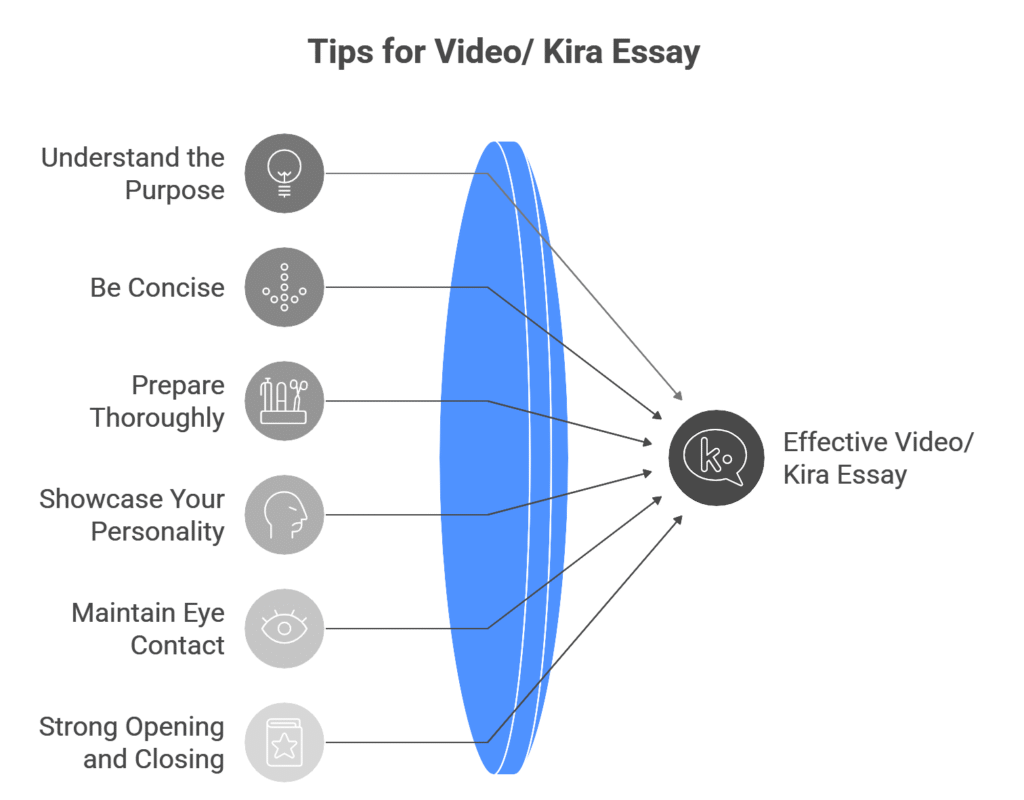
Understand the Purpose
- Pre-Recorded: Pre-recorded video essays often have prompts that allow for structured responses. Understand the specific question and ensure your video essay directly addresses it.
- Impromptu: In impromptu video essays, you may not know the questions in advance. Focus on providing insightful, concise answers to the given prompts.
Be Concise
- Pre-Recorded: Use your allotted time efficiently. Be concise in your response while ensuring you provide a complete and well-structured answer.
- Impromptu: Stay on point and avoid rambling. Use the given preparation time to outline your response and make your points concisely during the recording.
Prepare Thoroughly
- Pre-Recorded: Take time to brainstorm ideas, outline your response, and rehearse multiple times. Ensure your message is clear and compelling.
- Impromptu: Since you may have limited time to prepare, practice answering diverse types of questions to build your ability to think on your feet. Doing Mock Interviews can particularly help.
Showcase Your Personality
- Pre-Recorded: Your video should provide a glimpse of your character and values. Let your authenticity shine through by being yourself.
- Impromptu: Be genuine in your responses. Authenticity is highly valued in impromptu video essays.
Maintain Eye Contact
- Pre-Recorded: Look directly into the camera to establish a connection with the viewer. This creates a sense of engagement and sincerity.
- Impromptu: Even when you don’t know the questions in advance, maintain eye contact with the camera during your responses to appear confident and composed.
Have a Strong Opening and Closing
- Pre-Recorded: Begin with a compelling introduction and end with a memorable conclusion that reinforces your main points.
- Impromptu: Use the initial seconds to frame your response and conclude succinctly by summarizing your key message.
Eliminate Distractions
- Pre-Recorded: Choose a quiet, well-lit location with minimal distractions for your recording. Ensure your background is professional.
- Impromptu: Find a quiet spot where you can focus solely on your response without interruptions.
Manage your Time Well
- Pre-Recorded: Allocate sufficient time for recording, reviewing, and editing if necessary. Avoid rushing the process.
- Impromptu: Manage your time wisely during preparation and response. Stick to the given time limits.
Rehearse Video Recording Technology
- Pre-Recorded: Familiarize yourself with the recording equipment and software. Ensure your audio and video quality are top-notch.
- Impromptu: Check your internet connection, camera, and microphone in advance to avoid technical glitches.
Seek Feedback
- Pre-Recorded: Share your video with mentors, advisors or trusted friends to gather constructive feedback and make improvements.
- Impromptu: After practicing impromptu responses, seek feedback on your communication skills and clarity.
Tip: In both pre-recorded and impromptu MBA video essays, the key is effectively communicating your message while showcasing your suitability for the MBA program. With preparation, practice, and attention to these tips, you can create impressive video essays that enhance your MBA application.
Final Thoughts
In an increasingly competitive MBA admissions landscape, video essays offer you a chance to stand out and convey your unique value to the business school of your choice.
Use this opportunity to not only address the questions asked but also to paint a vivid picture of your aspirations, experiences, and character. It’s a tool that, when used effectively, can elevate your application and set you on the path to success in your MBA journey. So, embrace the challenge, be yourself, and make your video essay a compelling testament to your candidacy.
FAQs – MBA Video Essays
What is an MBA video essay?
An MBA video essay is a recorded response to prompts given by business schools as part of the application process. Unlike written essays, it allows admissions committees to evaluate your communication skills, personality, confidence, and cultural fit. Schools like Kellogg, INSEAD, Yale SOM, and MIT Sloan use video essays or KIRA assessments.
Why do business schools ask for MBA video essays?
Business schools use MBA video essays to assess qualities not visible in written applications- such as clarity of expression, authenticity, leadership presence, and adaptability. They help schools see how applicants think on their feet, communicate under pressure, and align with the program’s values.
Which business schools require MBA video essays?
Top schools such as Northwestern Kellogg, Yale SOM, MIT Sloan, INSEAD, Oxford Saïd, Rotman, IESE, London Business School, Chicago Booth, UC Berkeley Haas, UVA Darden, CMU Tepper, Emory Goizueta, Vanderbilt Owen, and IE Business School include video essays or KIRA interviews in their MBA application process. Each school’s format and question style vary, so reviewing past questions and practicing is crucial.
How can I prepare for MBA video essay questions?
Start by practicing common MBA video essay questions on career goals, leadership challenges, and teamwork. Record yourself to evaluate clarity, tone, and body language. Use the 20–30 seconds prep time wisely to outline answers. Stay authentic, concise, and confident-avoiding memorized scripts.
What are common MBA video essay questions?
Examples include:
> Introduce yourself to the admissions committee.
> Why do you want to pursue an MBA at our school?
> Describe a challenge you faced and how you handled it.
> How will you contribute to the MBA community?
> Schools like Kellogg, INSEAD, and Rotman also provide behavioral and situational prompts.
How important are MBA video essays in the admission process?
While written essays and interviews carry significant weight, MBA video essays are increasingly important. They allow schools to validate your written application, test communication under pressure, and gauge personality fit. Strong video responses can set you apart from equally qualified applicants.
Is the MBA video essay the same as the Kira Talent interview?
Yes. Kira Talent is the software platform most schools use to deliver and record video essays : Kellogg, INSEAD, Yale SOM, Oxford Saïd, LBS, IESE, and Rotman all use it. The terms “video essay,” “Kira interview,” “video interview,” and “video statement” describe the same requirement; schools just use different names for it.
How long is an MBA video essay?
Most responses run 60-90 seconds per question, with 20-45 seconds of prep time beforehand. MIT Sloan’s first video statement is capped at 90 seconds; INSEAD and Rotman give 60-90 seconds per answer. Total time for the full assessment is usually 20-30 minutes, including setup.
Can I use AI to write or practice my MBA video essay answers?
Business schools explicitly discourage it. Yale SOM, for example, states candidates should not use AI-written scripts, since the goal is to hear how you actually think and speak, not a polished, memorized answer. Use AI tools only to brainstorm themes or practice timing, never to script your final response word-for-word.
Not sure if your Video/KIRA essays are making the right impact?
Request a 1:1 consultation with our experts and get personalized feedback before deadlines.