

Apply in the earliest MBA application round in which you can submit a complete, competitive application. For most applicants that means Round 1 (September to early October) or Round 2 (January). Round 3 (March to April) suits only strong profiles with a clear reason to apply late, and Harvard Business School and MIT Sloan don’t offer it. International applicants should aim for Round 1 or Round 2 to protect scholarship and visa timelines.
MBA programs typically follow a structured application process consisting of three rounds: Round 1, Round 2, and Round 3. These rounds generally have application deadlines set in September, January, and April respectively.
When considering applying to an MBA program, applicants often face the question of which application round offers the best chances of admission. However, the answer to this question is not a “one size fits all” approach, and varies depending on individual circumstances.
Each application round presents distinct advantages and disadvantages, necessitating careful consideration of the available options before finalizing a choice. In this blog post, we will delve into the merits and drawbacks of each application round, enabling you to make an informed decision on the most suitable round for your circumstances.
- MBA Application Deadlines 2026-27 at a Glance
- Round 1 vs Round 2 vs Round 3: Side-by-Side Comparison
- How to Choose Your MBA Application Round
- Early Action, Round 4 and Rolling Admissions: How Are They Different?
- In which round should international MBA applicants apply?
- Conclusion : Which MBA application round to apply
- FAQs – MBA Application Rounds
MBA Application Deadlines 2026-27 at a Glance
| Business school | Round 1 | Round 2 | Round 3 |
|---|---|---|---|
| Harvard Business School | Sep 9, 2026 | Jan 5, 2027 | Not offered |
| Stanford GSB | Sep 9, 2026 | Jan 6, 2027 | Apr 7, 2027 |
| Wharton | Sep 8, 2026 | Jan 5, 2027 | Mar 31, 2027 |
| Northwestern Kellogg | Sep 9, 2026 | Jan 6, 2027 | Mar 31, 2027 |
Deadlines differ for every school. Check the Round 1, 2 and 3 deadlines for all major business schools in our guide below:
Round 1 vs Round 2 vs Round 3: Side-by-Side Comparison
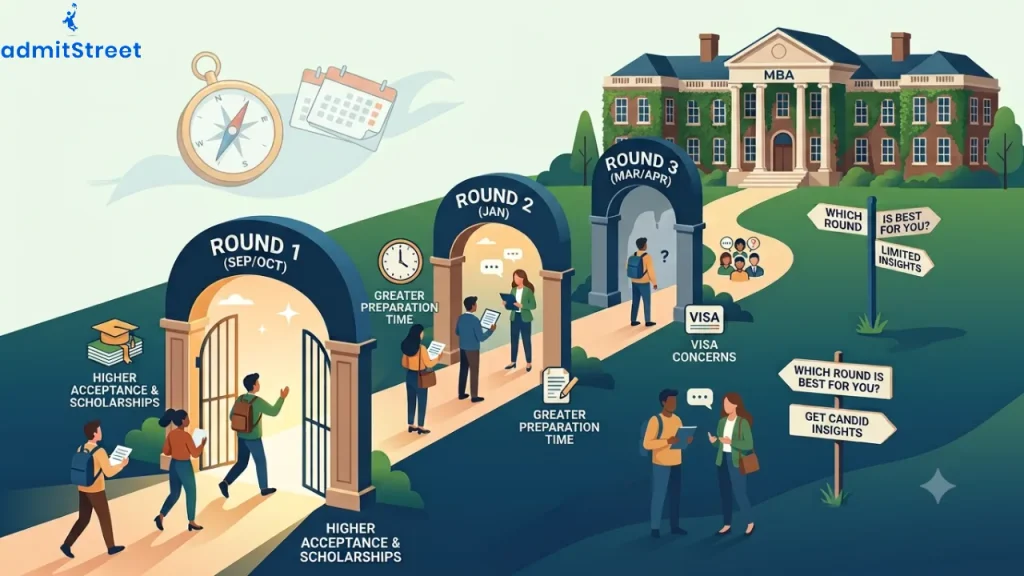
| Round 1 | Round 2 | Round 3 | |
|---|---|---|---|
| Typical deadline | September to early October | January | March to April |
| Decisions released | Mid-December (Harvard: Dec 10, 2026) | March (Harvard: Mar 25, 2027) | Late April to May |
| Seats available | Most seats open | Many seats still open | Fewest seats; class-shaping round |
| Scholarship funding | Fullest pool at many schools | Available, often smaller | Limited at many schools |
| Best for | Applicants whose test score, essays and recommendations are ready | Applicants who need time to improve scores, essays or profile | Strong, finished applications with a clear reason for applying late |
| Main risk | Rushing a half-ready application | Fewer seats and less scholarship money than Round 1 | Tight visa and funding timeline; class mostly filled |
How to Choose Your MBA Application Round
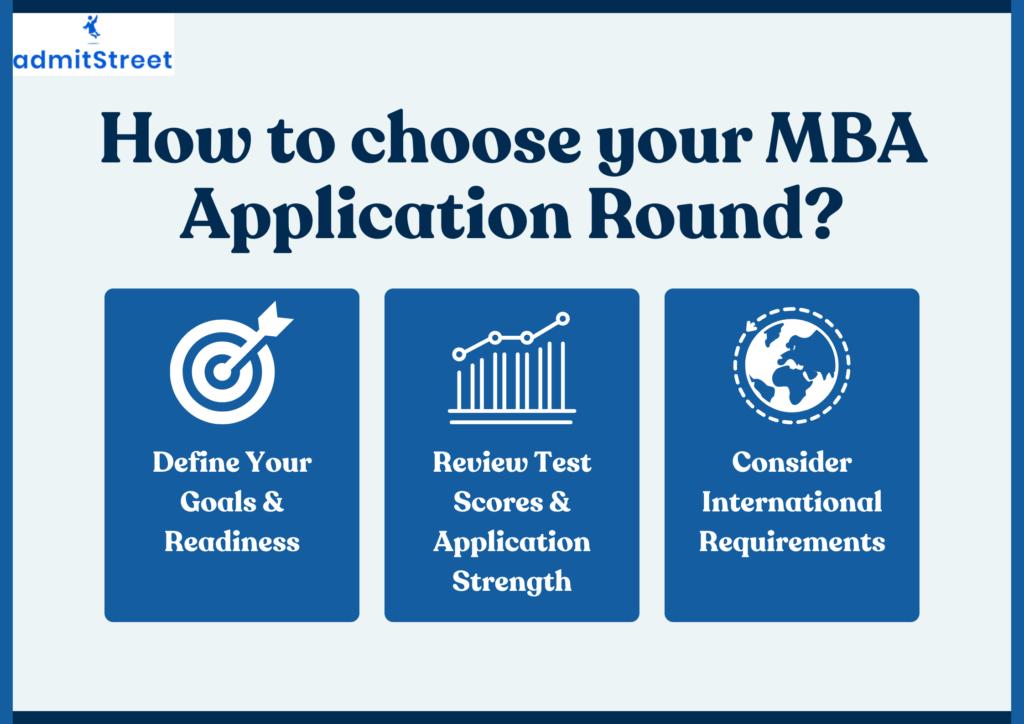
To determine the most suitable MBA application round you need to carefully consider these factors:
- Firstly, it is essential to assess your goals and objectives. Consider whether you are eager to commence your MBA studies at the earliest opportunity or if you require additional time to prepare both financially and professionally.
- Secondly, evaluate your test scores. If you lack confidence in the competitiveness of your GMAT or GRE score, it may be advantageous to wait and apply in a later round when you have an opportunity to improve your scores.
- Furthermore, if you are an international student, you should positively apply in Round 1 or Round 2. These early rounds allow ample time for processing visa-related formalities, ensuring a smoother transition for international students.
Nevertheless, the decision-making process should also account for the advantages and disadvantages associated with each application round. It is crucial to understand how MBA admissions committees evaluate applications in different rounds, as this may influence the outcome of your application.
Taking into consideration these various aspects and thoroughly assessing each factor will assist you in making an informed decision regarding the most suitable MBA application round for your circumstances.
Get a free profile evaluation
If you would like a candid assessment of your profile, book your free profile evaluation session now.
Now, Let’s Discuss the Advantages & Disadvantages of Applying in Each Round:
Applying in MBA Application Round 1
The initial round of MBA applications, commonly referred to as Round 1, typically has a deadline in early September and October, with decisions being announced in mid-December.
Applying during this round presents the greatest opportunity for admission into top-tier MBA programs. This is because MBA admissions committees have a larger number of available spots to fill during Round 1, increasing the likelihood of acceptance.
Advantages and Disadvantages:
Applying in Round 1 of MBA applications offers several advantages and disadvantages that should be taken into consideration.
Advantages of applying in Round 1
- Higher acceptance rates: Business schools generally have more available seats (per number of applicants) in Round 1, which can result in higher acceptance rates compared to subsequent rounds. This may increase your chances of securing admission, provided that your overall profile (i.e. CV, score, essays, interviews) is up to the mark. That said, quality always overrides timing: it’s better to apply in Round 2 with a stronger application than in Round 1 with a rushed or half-baked application.
- More scholarship opportunities: Many schools allocate a significant portion of their scholarship funds during the early rounds. By applying in Round 1, you have a better chance of being considered for scholarships, which can help reduce the financial burden of your MBA program.
- Early planning and preparation: Applying in Round 1 gives you ample time to plan and prepare for your MBA journey. If accepted, you have more time to arrange logistics, such as housing, finances, and potentially resigning from your current job.
- Flexibility for reapplication: In case your application is not successful in Round 1, you have the option to reapply in a later round, allowing you to make necessary improvements based on the feedback received.
Disadvantages of applying in Round 1
- Highly competitive: Round 1 tends to attract a pool of highly qualified applicants, including those who have thoroughly prepared their applications in advance. The competition can be fierce, making it crucial to submit a strong and well-prepared application.
- Limited time for preparation: The early deadline for Round 1 may leave you with less time to complete your GMAT/GRE exam, gather recommendation letters, and refine your essays. If you feel rushed and unprepared, it might be better to wait for a later round.
- Uncertainty about schools’ preferences: Each business school has its own evaluation process and preferences for each round. While some schools may slightly prefer Round 1 applicants, others may have a more balanced approach. Understanding a specific school’s preferences would involve detailed research.
- Potential changes in circumstances: Applying early means making a commitment before fully evaluating potential changes in your personal or professional circumstances. It’s essential to assess whether you have considered all possible factors that may impact your ability to undertake an MBA program successfully.
Considering these advantages and disadvantages, it is important to assess your own profile, readiness, and goals to determine if applying in Round 1 aligns with your individual circumstances and preferences.
Who should apply in Round 1?
If you think that you have enough time to write great essays, get good letters of recommendation, have a good GMAT score, and you’ll be able to submit a solid application then go ahead, and apply in Round 1 without second thoughts.
Applying in MBA Application Round 2
Round 2 MBA applications are typically due in early January and decisions are released in late February or early March. Applying in Round 2 gives you a good chance of getting into MBA programs, but typically not as good as applying in Round 1.
MBA admissions committees have fewer spots to fill in Round 2, so they can be more selective.
Advantages and Disadvantages:
Round 2 of MBA applications offers both advantages and disadvantages for prospective applicants. Let’s explore them in detail:
Advantages of applying in Round 2
- Greater preparation time: The extended timeline between Round 1 and Round 2 provides applicants with more time to refine their application materials, such as essays, recommendations, and test scores. This extra preparation time can result in a more polished and competitive application.
- Enhanced self-awareness: Applicants who apply in Round 2 have the advantage of learning from the outcomes and feedback of Round 1 applicants. This feedback can help them gain insights into the admissions process, identify areas for improvement, and refine their application strategy accordingly.
- Increased flexibility: By applying in Round 2, applicants have the option to reassess their career goals, conduct further research on MBA programs, and potentially visit campuses or attend information sessions. This additional time allows for a more informed and deliberate decision-making process.
Disadvantages of applying in Round 2
- Higher competition: Round 2 attracts a larger applicant pool compared to Round 1. As a result, competition among candidates vying for limited spots becomes more intense. Admissions committees may be more selective during this round, making it slightly more challenging to secure admission.
- Reduced scholarship opportunities: Many MBA programs offer scholarships and financial aid to attract top candidates. However, in Round 2, the availability of scholarships may be more limited as a significant portion of the financial aid budget may have already been allocated to Round 1 applicants. Therefore, Round 2 applicants may have reduced access to scholarship opportunities.
Who should apply in Round 2 ?
If you want to make meaningful improvements to your MBA profile you should consider applying in Round 2. This includes:
- If you are applying to 7 or more B-schools – In that case, you might not have enough time to prepare the application for all B-schools in round 1. Hence, you might have to push a few school applications to round 2.
- Retaking the GMAT – GMAT is an important component of an MBA application and therefore If you have an average GMAT score and want to score high to improve your overall application.
- You have a hectic schedule – You’re working a 50+ hour work week and cannot put in enough time to your application. If you also haven’t researched the target MBA programs thoroughly and want more time to select your target business school, then round 2 is the ideal round for you.
- You’re due for a promotion – If you’re expecting a promotion at work then your application would be stronger if you submit it after it happens. Don’t rush in to submit your application in Round 1 in this case.
Applying in MBA Application Round 3
Round 3 MBA applications are typically due in early March, and decisions are released in late April or early May.
Advantages and Disadvantages :
Let’s discuss the advantages and disadvantages of applying in MBA application round 3:
Advantages of applying in Round 3
One of the key benefits of applying to Tier 2 Business Schools during Round 3 or Round 4 is the higher acceptance rate. If you’re eager to begin your MBA journey without waiting for an additional year, these business schools present a favorable opportunity.
Disadvantages of applying in Round 3
It is important to consider certain drawbacks when applying during Round 3 or Round 4. During this stage, your application will be evaluated in comparison to those of accepted and wait-listed candidates from Rounds 1 and 2.
Consequently, if you belong to a broad and diverse pool of applicants, your application may not stand out as compelling at this particular juncture. Additionally, it is highly unlikely to find admission consultants who would be willing to assist you with your MBA application during these later rounds. However, if you feel you have a strong reason to apply in these rounds, reach out to us at admitstreet.com and we will be happy to hear your story and help you out.
Who should apply in Round 3?
You should consider applying in Round 3 only if:
- You had a personal emergency or exceptional circumstances that prevented you from applying in Round 1 or 2
- You belong to an underrepresented applicant pool
- You are applying to less selective business schools
- You have an extraordinary profile
Early Action, Round 4 and Rolling Admissions: How Are They Different?
Not every school follows the standard three rounds:
- Early Action / Early Decision: Some schools offer a separate, earlier deadline. Duke Fuqua’s Early Action deadline is September 2, 2026 (decisions October 15), and UVA Darden’s is September 9, 2026 (decisions October 28). Terms differ, and some early plans are binding, so read each school’s policy first.
- Rounds 4 and 5: Several schools, including many in Europe, run four or five rounds. INSEAD has four rounds for this intake, and Cambridge Judge and Oxford Saïd have five.
- Rolling admissions: IE Business School reviews applications continuously. Apply early because seats fill as the year goes on.
In which round should international MBA applicants apply?

If you are an international applicant, it is always better to apply in Round 1 or Round 2. Applying in Round 3 gives you limited time to complete visa-related formalities. Moreover, the chance of getting an MBA Scholarship is much more if you apply early. Therefore, it’s always better to apply as early as possible.
Worried about interview prep? We have got you covered with a comprehensive list of MBA interview questions by school. Read our article!
Conclusion : Which MBA application round to apply
So, what’s your round? Applying in Round 1 gives you an advantage because schools have more time to review your application and make a decision.
However, if you know that there are some areas of your application that need improvement, applying in Round 2 may be the better option for you.
No matter when you decide to apply, remember that the most critical part is submitting a well-crafted application.
At admitStreet, we offer a free first consultation so you can get candid insights on your profile and plans.
Need Help Choosing the Right MBA Round?
Our expert will analyze your profile and guide you on when and where to apply.
FAQs – MBA Application Rounds
What are MBA application rounds?
MBA application rounds are fixed admissions deadlines within one intake cycle. Most top US schools run three: Round 1 (September to October), Round 2 (January) and Round 3 (March to April). Some schools run two rounds, others four or five.
Which MBA application round should I apply in?
Apply in the earliest round in which you can submit a complete, competitive application. Choose Round 1 if your test score, essays and recommendations are ready, Round 2 if you need more time, and Round 3 only as a last resort.
Is Round 1 better than Round 2 for MBA admissions?
Not automatically. Round 1 usually offers more open seats and a fuller scholarship pool, but a strong Round 2 application beats a rushed Round 1 application. Choose Round 1 only if your application is genuinely ready.
Is Round 2 too late for an MBA application?
No. Round 2 (deadlines around January 5 to 12, 2027 at most top US schools) is a standard round, not a backup. The trade-off is slightly fewer open seats and, at many schools, less scholarship money.
Is it worth applying in Round 3?
Only in specific cases. Most seats and scholarships are gone by Round 3, so it suits strong, finished applications with a clear reason for applying late. Harvard Business School and MIT Sloan don’t offer Round 3.
When are MBA Round 1 deadlines for 2026-27?
Most top US Round 1 deadlines fall between September 8 and mid-October 2026. Wharton is September 8, Harvard, Stanford, Columbia and Kellogg are September 9, and MIT Sloan is September 29. Always confirm on each school’s site.
Does Harvard Business School have a Round 3?
No. Harvard Business School runs two rounds for 2026-27: Round 1 on September 9, 2026 (decisions December 10) and Round 2 on January 5, 2027 (decisions March 25). Deadlines are at 12 noon Eastern Time.
Which round should international and Indian applicants apply in?
Round 1 or Round 2. Earlier admission leaves more time for visas, education loans and relocation, and scholarship funds are usually fuller early. Round 3 leaves little time to arrange these before classes start.
Are MBA scholarships available in Round 2?
Yes, but often in smaller amounts. Many schools commit a large share of scholarship funds to Round 1 admits, though strong Round 2 candidates still receive awards. Policies vary, so check each school’s scholarship page.
What is MBA Early Action and how is it different from Round 1?
Early Action is a separate, earlier deadline offered by some schools, such as Duke Fuqua (September 2, 2026) and UVA Darden (September 9, 2026). Terms vary and some early plans are binding, so read each school’s policy first.
Can I apply in more than one round, or be reconsidered after a rejection?
No. You can submit only one application per school per cycle. If you’re rejected in Round 1, you generally must reapply next year, though waitlisted candidates stay in contention. You can apply to different schools in different rounds.
I missed Round 1. What should I do?
Aim for Round 2, with deadlines in early January 2027 at most top US schools. Use the extra weeks to retake the GMAT/GRE if needed, finish recommendations and refine essays, and submit at least a week early.
Good insights