


The INSEAD MBA is one of the most prestigious and globally recognized programs (ranked #2 in the world by FT MBA rankings).
The INSEAD MBA offers two distinct entry points: the January (D-batch) and August (J-batch) intakes. While both deliver the same world-class, accelerated curriculum and global network across campuses in France and Singapore, your choice between the 10-month or 12-month journey significantly impacts your career timeline, internship options, and experience.
This definitive guide to the INSEAD MBA January vs August intake breaks down the commonalities, critical differences, and insider insights both from the perspective of an applicant and MBA participant.
Key Takeaways:
- The January (D-batch) intake is a 12-month program that includes a 2-month summer break for an internship, making it ideal for career switchers.
- The August (J-batch) intake is a accelerated 10-month program, suitable for those continuing in their field or with clear post-MBA goals.
- Core curriculum, class profile, and alumni network are identical for both intakes.
- Your choice should hinge on career goals, recruitment needs, and personal readiness.
What is common between the two intakes
1) Curriculum
- For both January and August intakes, the curriculum is divided into 5 periods consisting of core courses and electives.
- Each period lasts eight weeks and concludes with an exam, essay and/or project. The first part of the program is built around 14 core courses, which provide a robust foundation of key management disciplines.
- In the second part, you will be able to choose from over 300 different electives in a variety of subjects.
2) Class size
- Both the class size and composition are similar between the January and August intakes.
- Out of 450 students in each intake, around 330 students start in the France campus and 120 start in the Singapore campus.
3) Alumni network and resources
- Irrespective of which intake you attend, you will be part of the INSEAD alumni network, and the cohort as a whole.
- Access to alumni and other resources of the school are exactly the same.
4) Exchange programs
The exchange between Singapore and France campus and to the partner universities in the US is possible for all the candidates, irrespective of their intake.
There is also a Middle-East trek and a course named “Business in Middle East” for 3 days that happens between the P3-P4 break. In essence, the exchanges available are:
- P1-P2 → Stay in assigned campus (Singapore or France)
- P3-P4-P5 → The following options are available: 2 campuses of INSEAD, Wharton & Kellogg. You have to bid for exchange and clear a minimum threshold of 2.1 CGPA.
(Px refers to “Period x”)
Check out these inspiring INSEAD success stories:
Decide with Confidence: January or August?
Stop guessing. In a free profile evaluation, we will analyze your background and help you choose the optimal intake to maximize your MBA success.
Key differences between the two intakes
The August and January intakes are different in certain aspects that potential candidates should consider when deciding which intake to join.
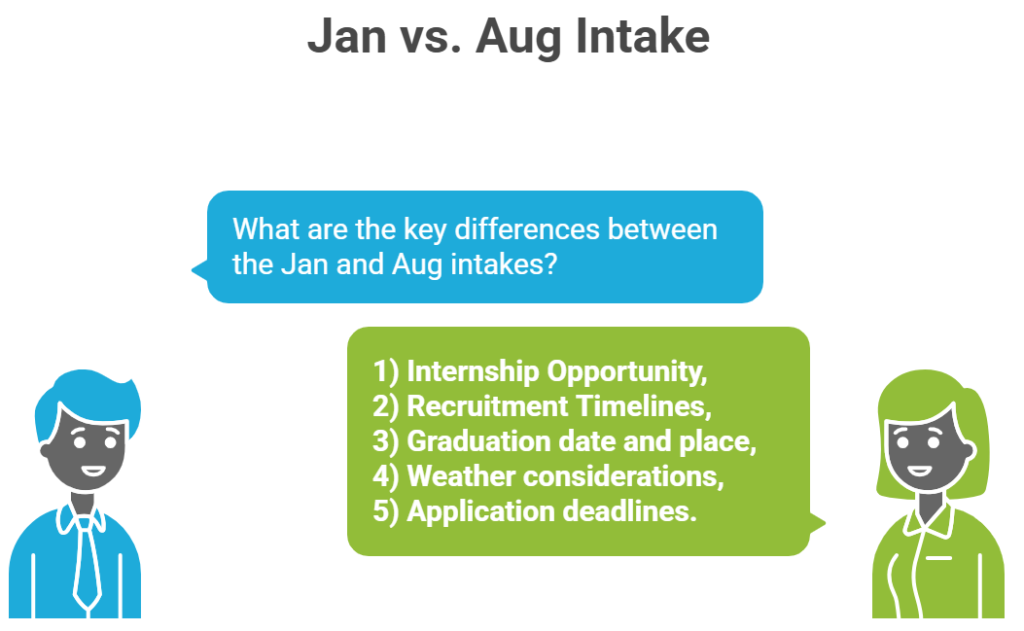
Here’s a breakdown of the key differences:
1) Internship Opportunity
- The primary difference between the two intakes is that if you choose to begin in January (D-batch), you will have a 2-month summer break during which you can pursue an internship or other endeavors. If you begin in August (J-batch), you will complete the MBA in 10 consecutive months.
- An internship is highly recommended for candidates who intend to transition to investment banking and have no prior experience at all. Most investment banking firms hire interns and promote them to a full-time role. This doesn’t mean that it’s not possible to land a job at an investment banking firm for August intake candidates: they may have to join as an intern upon graduation and look to convert to a full-time role.
- Similarly, consulting firms tend to hire interns and ‘test’ the candidates for 2-3 months before offering them a full-time job. This means the January intake can also be more beneficial for candidates looking to transition into consulting. Having said that, since INSEAD is a consulting powerhouse, it should not be difficult to land a consulting job irrespective of the intake. The school does place a good number of consulting hires in the August intake as well.
2) Recruitment Timelines
- For the January intake, recruiting for internships starts almost immediately. If you get an internship, you have a high chance of getting a full-time offer. This means full-time recruiting essentially starts within the first few months of joining.
- For the August intake though, you can take a few months to figure out what you want to do, and start full-time recruiting later in the year. For someone who isn’t sure about consulting (or other career paths) and wants to explore opportunities, or talk to other candidates/ professionals and get to know these career paths better, this could be a benefit.
3) Graduation date and place
Candidates can choose whether to graduate from the Singapore or France campus.
- Generally, candidates (~85%) tend to graduate where most of their cohort is. This means that the January intake graduates in December in Singapore, and the August intake typically graduates in June in France.
- For example, the INSEAD MBA Class of July 2023 graduated on 29th June 2023 in France, and the INSEAD MBA Class of December 2023 will graduate on 15th December 2023 in Singapore.
4) Weather considerations
- If you start in January (D-batch) in France, be prepared to face some really cold weather, which may hinder social activities. Similarly, if you start in August (J-batch) in Singapore, be prepared for really hot weather.
- Some candidates tend to make choices on where to spend the first 2 months of their program based on this parameter, so it’s something to keep in mind.
5) Application deadlines
Given the start dates are different, the application deadlines vary for the January and August intakes. The following are the deadlines for the Aug 2026 and Jan 2027 intakes:
| Application Rounds | Application deadline | Interview decision notification | Final decision notification |
|---|---|---|---|
| Round 1 | 16 September 2025 | 17 October 2025 | 21 November 2025 |
| Round 2 | 04 November 2025 | 05 December 2025 | 16 January 2026 |
| Round 3 | 20 January 2026 | 20 February 2026 | 20 March 2026 |
| Round 4 | 10 March 2026 | 10 April 2026 | 08 May 2026 |
| Application Rounds | Application deadline | Interview decision notification | Final decision notification |
|---|---|---|---|
| Round 1 | 17 March 2026 | 17 April 2026 | 15 May 2026 |
| Round 2 | 21 April 2026 | 29 May 2026 | 26 June 2026 |
| Round 3 | 30 June 2026 | 31 July 2026 | 28 August 2026 |
| Round 4 | 04 August 2026 | 04 September 2026 | 09 October 2026 |
While we hope these pointers give you an indication of the key commonalities and differences between the intakes, consider your goals and priorities to determine which intake suits you best.
Learn from Adhiraj’s insights on his successful INSEAD admit with scholarships to the Jan 2024 intake.
How to Choose: A Practical Checklist
Ask yourself these questions:
- Career Goals: Do I need a formal internship to switch industries or functions?
(Yes → Lean towards January intake). - Readiness: Is my career target well-defined, or do I need more time to explore?
(Need time → Lean towards August intake). - Personal Timeline: Does a 10-month or 12-month program better fit my personal and professional obligations?
To help you decide more effectively, explore our detailed articles on the January Intake and August Intake, which cover everything you need to make the right choice.
Explore More About INSEAD
- INSEAD MBA Program – A Complete Overview
- INSEAD MBA: January vs August intake
- INSEAD’s January 2026 MBA Intake
- INSEAD August 2026 MBA Intake
- INSEAD MBA Essay 2025-2026
- INSEAD MBA Interview: Tips to Excel & Commonly Asked Questions
- Top MBA Programs in Europe 2025
- Top MBA Programs in the World (2025): Rankings, Class Profiles & Career Outcomes
Final Recommendation
Your decision should align with your professional strategy. If an internship is non-negotiable for your career pivot, the January intake is your clear path. If you are seeking a fast-track degree to accelerate an existing path, the August intake offers unparalleled efficiency.
FAQs : INSEAD MBA January vs August intake
What is the main difference between the INSEAD MBA January vs August intakes?
The fundamental difference is program structure and internship opportunity. The January intake (D-batch) is a 12-month program that includes a dedicated 2-month summer break for a formal internship, which is crucial for career switchers. The August intake (J-batch) is an accelerated 10-month program with no summer break, designed for those continuing in their field or with clear post-MBA goals.
Which INSEAD intake is better for a career change into consulting or investment banking?
The January intake is generally recommended for a major career switch into fields like consulting or investment banking, especially if you lack direct prior experience. The structured summer internship provides a critical pathway to secure a full-time offer. However, the August intake also sees strong placement in consulting, as INSEAD is a core recruiting school for top firms.
How do the recruitment timelines differ between the January and August intakes?
Recruitment starts much earlier for the January intake. Candidates begin applying for summer internships almost immediately after the program begins. For the August intake, the timeline for full-time roles is more concentrated in the second half of the program, allowing a few months for career exploration.
Can I participate in campus exchanges in both intakes?
Yes. All students, regardless of intake, have the same opportunities to bid for exchanges between INSEAD’s Fontainebleau (France) and Singapore campuses, as well as with partner schools like Wharton and Kellogg, typically from Period 3 onward.
Does my starting campus (France or Singapore) depend on my chosen intake?
No. Both intakes have cohorts starting simultaneously at both campuses. Your initial campus assignment is based on your preference and availability, not your intake month.
Find Your Ideal INSEAD Intake
Get a free profile evaluation to assess your candidacy and receive expert advice on which intake (January vs. August) best aligns with your profile and goals.