

Stanford Graduate School of Business (GSB) is home to one of the most dynamic MBA programs in the world, bringing together an accomplished and diverse cohort of students.
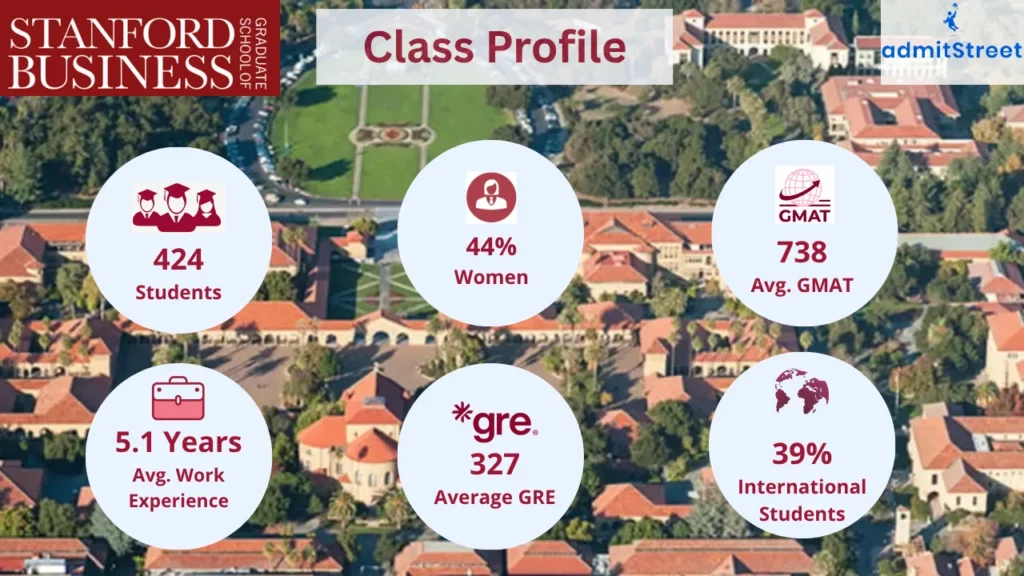
With the Class of 2026 boasting 39% international students from 72 countries, a broad range of academic and professional backgrounds, and an average GPA of 3.75, the program fosters a truly global and collaborative learning environment.
Graduates enjoy unparalleled career opportunities, with median base salaries reaching $185,000 and many pursuing entrepreneurial ventures. This article explores everything you need to know about Stanford GSB – from the class profile and employment outcomes to tuition costs, scholarships, and the admissions process – providing you with actionable insights to craft a standout application.
The Stanford GSB Class Profile 2026
The MBA Class of 2026 at Stanford Graduate School of Business (GSB) represents one of the most diverse and academically accomplished cohorts in the school’s history, selected from a pool of 7,295 applicants. Here’s an in-depth look at the demographics, academic backgrounds, and professional experiences of this outstanding class.
Class Overview
Source: Stanford MBA Class Profile 2026
Geographic Representation
The MBA Class of 2026 is the most international class in Stanford GSB’s history, with students hailing from 72 countries and comprising 39% of the cohort.
Academic Background
| Metric | Details |
|---|---|
| Average GPA | 3.75 (U.S. 4.0 scale) |
| First-Generation Students | 12% |
| Hold Advanced Degrees | 16% |
Source: Stanford MBA Class Profile 2026
Undergraduate Majors
Source: Stanford MBA Class Profile 2026
Educational Institutions Attended
| Metric | Details |
|---|---|
| U.S. Institutions | 78 |
| Non-U.S. Institutions | 97 |
Pre-MBA Industries
Source: Stanford MBA Class Profile 2026
Test Scores
Stanford GSB evaluates applications holistically and accepts both GMAT and GRE scores. There is no preference or minimum required score.
Click on the tabs to see different test scores:
Below is the section wise breakup of the required GRE score.
| Category | Score Range | Average Score |
| Verbal | 152–170 | 163 |
| Quantitative | 153–170 | 164 |
Below is the Score range for the required GMAT score.
| Category | Score Range | Average Score |
| Total | 560–790 | 738 |
For Non-Native English Speakers
| Category | Score Range | Average Score |
| Total | 104–120 | 113 |
Source: Stanford MBA Class Profile 2026
This data demonstrates Stanford GSB’s commitment to fostering a diverse and accomplished cohort, with students excelling academically, professionally, and across various industries. The Class of 2026 embodies the values of leadership, innovation, and global impact that define the Stanford MBA experience.
Q: What does GSB stand for?
GSB stands for the Graduate School of Business, which is the official name of Stanford’s business school.
Q: Why is the Stanford MBA so famous?
It’s famous for its extreme selectivity, location in Silicon Valley, intense focus on entrepreneurship and innovation, and a powerful alumni network that includes founders of companies like Nike, Netflix, and Capital One.
Q: How long is the Stanford MBA program?
It is a full-time, two-year residential program.
Stanford MBA Admissions
Stanford Graduate School of Business (GSB) is known for its collaborative culture and a student body of diverse, driven individuals who aspire to make a difference. The admissions process is designed to evaluate candidates holistically, focusing on their unique qualities, leadership potential, and aspirations. Here’s an overview of what you need to know about applying to the Stanford MBA program.
Deadlines for 2025–2026 Admissions
| Round | Submit By | Decision Notification |
|---|---|---|
| Round 1 | September 9, 2025 | December 10, 2025 |
| Round 2 | January 7, 2026 | April 2, 2026 |
| Round 3 | April 7, 2026 | May 28, 2026 |
Applications must be submitted by 4:00 PM Pacific Time on the deadline date for each round. Late submissions are not guaranteed a review.
What Stanford GSB Looks For
There is no typical Stanford MBA student or ideal checklist to follow. Instead, Stanford evaluates applicants based on three key criteria:
- How You Think: Your curiosity, problem-solving abilities, and contributions to a learning community.
- How You Lead: Evidence of leadership, initiative, and the ability to create positive change.
- How You See the World: Your values, beliefs, and aspirations, and how they shape your perspective and contributions.
Stanford encourages applicants to focus on authenticity, reflecting their true selves in their applications.
Application Process Overview
The Stanford MBA application process is comprehensive and consists of several components, each offering insights into your background, experiences, and aspirations.
| Component | Details |
|---|---|
| Education | Share your academic history, including institutions attended and achievements. |
| Test Scores | Submit either GMAT or GRE scores; TOEFL may be required for non-native English speakers. |
| Personal Information & Awards | Highlight your personal interests, activities, and recognitions. |
| Professional Experience | Include a detailed resume and provide context about your career journey. |
| Letters of Recommendation | Provide two recommendations, preferably from supervisors familiar with your work. |
| Essays | Write essays reflecting on your values, aspirations, and what matters most to you. |
| Optional Short Answer Question | An opportunity to expand on your contributions and meaningful experiences. |
| Application Fee | Pay the $275 fee or apply for a waiver if eligible. |
| Interview | Structured behavioral interviews by invitation only, conducted by alumni or admissions staff. |
Connecting with Stanford GSB
Stanford GSB offers multiple ways to engage with the program and its community:
- Information Sessions: Virtual and in-person sessions led by students, alumni, and staff.
- Panels & Group Chats: Regional and industry-specific discussions.
- Class Visits & Campus Tours: Opportunities to experience the GSB environment firsthand.
The Interview Process
- Purpose: Gain deeper insights into your experiences, actions, and impact.
- Format: Conducted remotely or in person by trained alumni or admissions staff.
- Focus: Behavioral questions about past actions and achievements, rather than hypothetical scenarios.
- Attire: Business attire is recommended.
Interviews are by invitation only and occur during the following timeframes:
- Round 1: Mid-September to late November.
- Round 2: Mid-January to mid-March.
- Round 3: Mid-April to mid-May.
Key Takeaways
- Be authentic and reflect on what truly matters to you in your application.
- Showcase leadership and initiative through specific examples in your essays and recommendations.
- Engage with Stanford GSB events to better understand the program and its culture.
By focusing on who you are and what you aspire to achieve, you can present a compelling case for admission to one of the world’s most prestigious MBA programs.
Q: What is the acceptance rate for the Stanford MBA?
The Stanford MBA acceptance rate is typically around 6%, making it the most selective business school in the world.
Q: Can I get into the Stanford MBA with a low GPA?
While the average GPA is high (~3.8), Stanford practices holistic admissions. An exceptional GMAT/GRE score, standout work experience, powerful essays, and strong recommendations can help compensate for a lower GPA.
Q: What is the most important part of the application?
All parts are crucial, but the essay “What matters most to you and why?” is uniquely important as it reveals your character, values, and motivations beyond your resume.
Q: Who should I ask for my letters of recommendation?
Choose current or former direct supervisors who know your work intimately and can provide specific, detailed anecdotes about your performance, leadership, and impact.
Q: Is an interview required for admission?
Yes, an interview is a mandatory part of the process and is conducted by invitation only after an initial review of your application.
Achieve Your Stanford MBA Dream
Get personalized guidance to craft a standout application, highlight your unique story, and maximize your chances of admission to Stanford GSB.
Stanford MBA Employment Report for the Class of 2024
Stanford GSB’s MBA Class of 2024 showcases a diverse range of career choices and impressive compensation outcomes. The following data highlights employment trends, job timing, industry placements, compensation, and geographic distribution.

Employment Summary
| Category | Number | Percentage |
|---|---|---|
| Total Graduates | 432 | 100% |
| Sought Employment | 249 | 58% |
| Not Seeking Employment | 181 | 42% |
| – Company-Sponsored | 51 | 12% |
| – Continuing Education | 16 | 4% |
| – Starting a New Business | 98 | 23% |
| – Not Seeking for Other Reasons | 13 | 3% |
| – Postponing Job Search | 3 | 1% |
Source: Stanford MBA Employment Report 2024
Observations:
- Nearly half of the class (42%) did not seek traditional employment, with 23% pursuing entrepreneurial ventures.
- Company sponsorship accounts for 12%, reflecting support from employers to develop talent.
- Only 1% postponed their job search, showcasing proactive career planning by most graduates.
Compensation Overview
| Category | Median | Mean | 25th Percentile | 75th Percentile |
|---|---|---|---|---|
| Base Salary | $185,000 | $187,504 | $161,250 | $205,000 |
| Expected Performance Bonus | $50,000 | $100,535 | N/A | N/A |
| Signing Bonus | $30,000 | $33,967 | N/A | N/A |
Source: Stanford MBA Employment Report 2024
Observations:
- A median base salary of $185,000 demonstrates the premium employers place on Stanford GSB graduates.
- Performance bonuses, averaging $100,535, reflect the potential for significant additional compensation.
- Nearly half (49%) of graduates reported receiving signing bonuses, with a median value of $30,000.
Timing of Job Offers and Acceptances
| Metric | By Graduation | By 3 Months Post-Graduation |
|---|---|---|
| Job Offers (Seeking Employment) | 69% | 88% |
| Job Acceptances (Seeking Employment) | 58% | 80% |
Source: Stanford MBA Employment Report 2024
Observations:
- The majority of students (88%) received job offers within three months of graduation.
- A significant proportion (80%) accepted offers within the same period, indicating strong demand for Stanford GSB talent.
Employment by Industry
| Industry | Percent | Median Base Salary | Median Bonus |
|---|---|---|---|
| Consulting | 14% | $190,000 | $40,000 |
| Finance | 37% | $200,000 | $150,000 |
| Technology | 22% | $185,000 | $29,625 |
| Venture Capital | 7% | $200,000 | $50,000 |
| Private Equity | 20% | $200,000 | $175,000 |
| Healthcare | 6% | $160,000 | $29,000 |
Source: Stanford MBA Employment Report 2024
Observations:
- Finance leads with 37% of graduates, offering the highest median base salary ($200,000).
- Technology and consulting remain popular, attracting 22% and 14% of graduates, respectively.
- Venture capital and private equity are lucrative options, offering significant bonuses and base salaries.
Employment by Function
| Function | Percent | Median Base Salary | Median Bonus |
|---|---|---|---|
| Consulting | 16% | $190,000 | $40,000 |
| Finance | 32% | $200,000 | $175,000 |
| General Management | 32% | $175,000 | $32,000 |
| Marketing / Sales | 17% | $172,500 | $30,000 |
| Product Management | 8% | $185,000 | N/A |
Source: Stanford MBA Employment Report 2024
Observations:
- Finance and general management collectively attract 64% of graduates, highlighting their popularity among GSB students.
- Product management roles in technology offer competitive median salaries of $185,000.
- Marketing and sales, while smaller in share, provide attractive compensation packages.
Employment by Location
| Region | Percent | Median Base Salary |
|---|---|---|
| North America | 91% | $190,000 |
| – West (U.S.) | 45% | N/A |
| – Northeast (U.S.) | 31% | N/A |
| Asia, Australia, and Oceania | 2% | $146,500 |
| Latin America, Caribbean, and South America | 5% | N/A |
Source: Stanford MBA Employment Report 2024
Observations:
- North America dominates, with 91% of graduates taking jobs in the region, and the West (45%) being the most popular sub-region.
- International placements (9%) reflect the global appeal of Stanford GSB graduates.
Entrepreneurs and Ventures
| Industry | Percent |
|---|---|
| Technology | 28% |
| Healthcare | 16% |
| Consumer Products | 12% |
| Finance | 4% |
Source: Stanford MBA Employment Report 2024
Observations:
- Entrepreneurship is a significant career path, with 23% of graduates starting their own ventures.
- Technology and healthcare are the leading industries for entrepreneurs, showcasing innovative and impactful ventures.
Stanford GSB’s employment report highlights the program’s ability to place graduates in high-paying, impactful roles across a range of industries and functions, with a strong emphasis on entrepreneurship and leadership.
Q: What is the employment rate after graduation?
Stanford GSB has an exceptionally high employment rate, with over 90% of graduates receiving job offers within three months of graduation.
Q: Which companies hire the most Stanford MBA graduates?
Major recruiters include leading tech companies (Google, Apple, Meta), top consulting firms (McKinsey, BCG, Bain), and premier financial institutions in investing and venture capital.
Q: What is the average Stanford MBA salary?
The median base salary for graduates is approximately $185,000. When adding signing bonuses and other compensation, total first-year packages often exceed $250,000.
Achieve Your Stanford MBA Dream
Get personalized guidance to craft a standout application, highlight your unique story, and maximize your chances of admission to Stanford GSB. Let admitStreet’s experts help you every step of the way.
MBA Cost of Attendance and Scholarships at Stanford GSB
A Stanford MBA is a significant investment in your future, and Stanford GSB is committed to making its program accessible to talented candidates from all financial backgrounds. Financial aid is available to all students who demonstrate need, regardless of citizenship, and is provided through a combination of fellowships and loans. Here’s a detailed breakdown of the cost of attendance and available scholarships.

Cost of Attendance: First-Year MBA 2025–2026
| Category | Single Student | Married Student |
|---|---|---|
| Tuition | $85,755 | $85,755 |
| Living Expenses | $19,464 | $36,072 |
| Housing | $21,507 | $32,055 |
| Medical Insurance | $8,232 | $8,232 |
| Health Fee | $813 | $813 |
| Total | $135,771 | $162,927 |
Source: Stanford MBA Cost of Attendance
What’s Included
- Living Allowance: Covers rent, food, and personal expenses for a moderate lifestyle.
- Medical Insurance: Stanford University’s Cardinal Care is included in the cost for all students, regardless of alternative insurance coverage.
- Additional Allowances: May be made for eligible dependent children.
What’s Not Included
- Global Experience Requirement (GER): Costs range from $4,000 to $6,000. Need-based fellowship recipients may qualify for grants covering up to 40% of one qualifying trip.
Scholarships and Financial Aid
Stanford GSB offers various financial aid options, primarily through need-based fellowships, which are gifts that do not require repayment.
Need-Based Fellowships
| Metric | Details |
|---|---|
| Average Fellowship Award | $47,000 per year ($94,000 total) |
| Eligibility | All students with demonstrated need, regardless of citizenship. |
Types of Fellowships and Support
- Stanford GSB Need-Based Fellowships: Awarded based on demonstrated financial need.
- Stanford GSB BOLD Fellows Fund: Provides additional support for students from underrepresented backgrounds.
- Stanford Knight-Hennessy Scholars Program: Covers full tuition and other expenses for select students demonstrating leadership and innovation potential.
- Summer Stipends: Offered for students pursuing low-paying internships in fields such as social impact.
- External Scholarships: Available from organizations outside Stanford GSB.
- Employer Sponsorship: Financial support provided by employers to help fund MBA studies.
- Military/Yellow Ribbon Program: For eligible U.S. military veterans.
Financial Contribution and Loans
After admission, Stanford calculates an expected financial contribution based on the student’s financial situation. The difference between the cost of attendance and the expected contribution is covered by:
- Stanford GSB Fellowships: Need-based awards.
- Student Loans: Offered with flexible repayment terms.
All students are encouraged to pay off consumer debt before applying for financial aid.
Summary of Financial Support
Stanford GSB’s robust financial aid system ensures accessibility for students from diverse financial situations. With an average fellowship of $94,000 and additional aid options, the program aims to make the MBA a viable investment for all admitted students. By combining financial aid with personal resources and loans, you can confidently pursue your Stanford MBA.
Q: How much does the entire two-year program cost?
The total cost, including tuition, fees, housing, and living expenses, is estimated to be over $250,000 for the two years.
Q: What kind of financial aid is available?
Stanford offers generous need-based fellowships (scholarships) and facilitates federal and private loans. They have a need-blind admissions policy.
Q: Does Stanford GSB offer scholarships for international students?
Yes. All admitted students, regardless of citizenship, are eligible for need-based fellowships. There is no separate application.
Achieve Your Stanford MBA Dream
Get personalized guidance to craft a standout application, highlight your unique story, and maximize your chances of admission to Stanford GSB. Let admitStreet’s experts help you every step of the way.
Stanford MBA Curriculum
Source: Stanford MBA Curriculum
The Stanford MBA curriculum is built to combine rigorous fundamentals with flexibility and global exposure, preparing students to lead confidently in an increasingly complex world.
Click on the tabs below to explore different components of the curriculum :
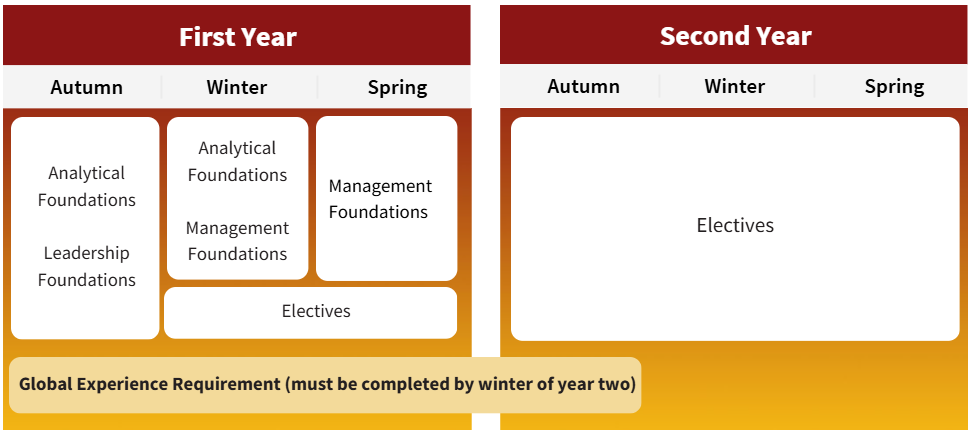
During the first year, students focus on building a strong foundation in business through core courses organized into Analytical, Leadership, and Management Foundations. The analytical component sharpens quantitative and problem-solving skills with subjects such as finance, accounting, microeconomics, data and decisions, and modeling. The leadership segment develops self-awareness and team effectiveness through courses like Leadership Laboratory, Managing Groups and Teams, and Leading with Values. The management foundations broaden exposure to key business functions—marketing, operations, and strategy—helping students think holistically like senior leaders. Stanford also offers multiple course levels within required disciplines, tailoring learning to students’ diverse academic and professional backgrounds.
In the second year, the focus shifts from foundational learning to personalized exploration. Students select all their courses from a wide range of electives spanning fields like strategic management, political economics, organizational behavior, and data analytics. The curriculum evolves continuously, with new electives introduced each year to reflect emerging business trends, faculty research interests, and global developments. This phase challenges students to test their ideas, apply classroom learning to practical situations, and pursue their career goals with purpose and creativity.
Global learning is deeply woven into the Stanford MBA experience. Every student participates in at least one global experience to gain firsthand exposure to international business environments and cultural contexts. Through Global Study Trips (GSTs), small groups of students explore critical issues such as sustainability, demographic shifts, or technological disruption in different regions. The Stanford–Tsinghua Exchange Program (STEP) offers an academic and cultural partnership with students from Tsinghua University in Beijing, where participants collaborate on business projects and exchange visits between campuses. For those seeking greater independence, Stanford also supports self-directed global experiences, enabling students to design customized study projects or internships aligned with their academic and professional aspirations.
Beyond formal programs, the Stanford GSB campus itself fosters a truly international environment. With classmates from around the world, globally focused coursework, and a wide range of student clubs-from the Africa Business Club to the Latin American Student Association-students engage daily in cross-cultural dialogue and global learning.
Together, these elements make the Stanford MBA curriculum a comprehensive and immersive journey – grounded in analytical rigor, enriched by leadership development, and elevated by global perspective – empowering students to define their own path and lead with insight, innovation, and impact.
Q: Can I take classes in other schools at Stanford?
Yes. Stanford MBA students are encouraged to cross-register for courses in other top-ranked schools within the university, such as Engineering, Law, or Medicine.
Q:What is the Global Management Immersion Experience (GMIX)?
The GMIX is a required first-year program where students work with a company or organization abroad on a focused project, gaining hands-on global business experience.
Q: What is the main teaching method at Stanford GSB?
Stanford uses a blend of teaching methods, including case studies, lectures, simulations, and a significant emphasis on experiential learning through global trips and real-world projects.
More MBA Guides & Insights
- How to get into Stanford GSB MBA Program: 5-Step Guide
- Stanford MBA interview guide
- Stanford MBA Essay Tips, Analysis, Framework for 2026 Intake
- Who are M7 Business Schools: An In Depth Guide on M7 MBA in 2025
- MBA Cost in USA: Latest Tuition Fee and Living Costs Revealed
- Round 1 vs. Round 2 vs. Round 3 Apply in this MBA application round
- MBA Abroad: A Complete Guide
- Top MBA Programs in Europe 2025
- Top MBA Programs in the World (2025)
- Financial Times 2025 MBA Rankings: Key Takeaways and Surprising Trends
- MBA Application Fee and Application Fee Waivers at US and European Business Schools
Final Thoughts
Stanford Graduate School of Business (GSB) offers a transformative MBA experience for those ready to lead with purpose and make a lasting impact.
With its diverse and accomplished Class of 2026, impressive employment outcomes including median salaries of $185,000, and a strong emphasis on entrepreneurship, Stanford GSB stands as a beacon for aspiring global leaders. The program’s holistic admissions process evaluates how you think, lead, and see the world, encouraging you to showcase your authentic self.
Generous financial aid, including need-based fellowships averaging $94,000 over two years, ensures that the program remains accessible to talented candidates from all backgrounds. Whether you’re driven by a desire to innovate, shape industries, or solve pressing global challenges, Stanford GSB provides the platform to turn your ambitions into reality. As you prepare your application, remember that there is no “typical” Stanford MBA student your unique story is your strength.
Are you ready to take the first step toward joining one of the world’s most prestigious MBA programs? Stanford GSB awaits you.
Achieve Your Stanford MBA Dream
Get personalized guidance to craft a standout application, highlight your unique story, and maximize your chances of admission to Stanford GSB. Let admitStreet’s experts help you every step of the way.