


An MBA in the USA is one of the most sought-after degrees globally, offering access to world-renowned faculty, extensive alumni networks, and unparalleled career opportunities.
However, pursuing an MBA from a top U.S. business school comes with a significant financial investment. The total cost encompasses tuition fees, living expenses, health insurance, books, and other associated costs.
This comprehensive guide breaks down the components of MBA cost in USA, highlights tuition fees at leading business schools, living expenses by location, and explores financing options to help you make an informed decision.
Key Highlights
| Category | Key Data Points | Details & Examples |
|---|---|---|
| Tuition Fees | Range: $55,695 – $91,172 5-Year Trend: +2% to +20% increase | Highest: Columbia Business School ($91,172) Lowest: Indiana Kelley ($55,695) |
| Living Expenses | Annual Range: $24,000 – $51,000 | Highest: MIT Sloan (~$39,888) Lowest: Texas McCombs (~$24,675) Varies significantly by location and lifestyle. |
| Total Program Cost | Estimated 2-Year Cost: $170,000 – $270,000+ | Includes tuition and living expenses for the full program. |
| City-Wise Variation | High-Cost Cities: New York, San Francisco, Boston Lower-Cost Areas: Indiana, North Carolina, Texas | Living costs are significantly higher in major urban centers. |
| Financing Options | Scholarships, Federal/Private Loans, Graduate Assistantships, Employer Sponsorships | Various methods are available to help manage the financial burden. |
Don’t Let Finances Delay Your MBA Dream
Smart planning can get you fee waivers, let AdmitStreet’s strategic guidance get you acceptances. We’re with you all the way.
Components of the MBA Program Cost in the USA
Pursuing an MBA in the USA is a substantial financial commitment, and understanding the various cost components can help you plan effectively. Here’s a breakdown of the key components of the MBA program cost:

1. Tuition Fees
Tuition fees are the most significant component of the cost of an MBA in the USA. They vary significantly depending on the business school’s reputation, ranking, and program length. For 2025-2026 academic year, tuition fees range from $55,695 (Indiana Kelley) to $91,172 (Columbia Business School). Elite schools such as Harvard, Stanford, and Wharton have tuition fees averaging around $78,000 to $88,000 per year.
Factors Affecting Tuition Fees:
- School Prestige: Top-ranked schools generally have higher tuition fees.
- Program Duration: Most full-time MBA programs are two years long, doubling the total tuition cost.
- Specializations: Some specialized MBA programs may have additional costs.
2. Living Expenses
Living expenses cover accommodation, utilities, transportation, groceries, health insurance, and personal costs. These expenses vary based on the location of the business school, with urban areas like New York, Boston, and San Francisco having higher costs than smaller cities or towns.
Average Annual Living Expenses:
- High Cost: MIT Sloan – $51,360, Stanford GSB – $50,016
- Moderate Cost: Cornell Johnson – $33,288, Yale SOM – $35,636
- Low Cost: Texas McCombs – $24,675, Indiana Kelley – $25,822
Key Elements of Living Expenses:
- Rent: On-campus housing may be cheaper but limited. Off-campus rent varies based on location.
- Utilities and Groceries: Costs depend on lifestyle and local prices.
- Transportation: Public transport is common in cities; car ownership increases costs in rural areas.
3. Health Insurance
Health insurance is mandatory for all students, especially international students. U.S. healthcare can be expensive, making insurance essential. Annual health insurance premiums typically range from $2,000 to $6,000.
- Examples:
- Harvard Business School: Approx. $4,308 per year
- MIT Sloan: Approx. $5,367 per year
- UNC Kenan Flagler: $2,950 per year
4. Books and Course Materials
MBA programs require textbooks, case studies, and other learning materials. On average, students spend between $1,000 to $3,000 annually on books and materials. Some schools offer digital resources, but these may come at an additional cost.
5. Miscellaneous Fees
Business schools often charge additional fees, which can include:
- Technology Fees: Access to software, digital tools, and tech support.
- Student Activity Fees: Covers participation in student clubs, events, and conferences.
- Graduation Fees: Charges associated with graduation ceremonies and related activities.
These fees can range from $1,000 to $3,000 per year, depending on the school.
6. Travel and Networking Costs
MBA students often travel for:
- Networking Events: Conferences, industry treks, and corporate visits.
- International Study Trips: Global immersion programs and exchange opportunities.
- Recruitment Travel: Trips for job interviews and career fairs.
Annual travel expenses can range from $2,000 to $5,000, depending on the program and activities.
Summary of MBA Cost Components
| Cost Component | Estimated Annual Cost |
|---|---|
| Tuition Fees | $55,000 to $91,000 |
| Housing Expenses | $16,000 to $30,000 |
| Health Insurance | $2,000 to $5,000 |
| Books and Materials | $1,000 to $3,000 |
| Miscellaneous Fees | $1,000 to $3,000 |
| Travel and Networking | $2,000 to $5,000 |
Understanding these components will help you budget more accurately and explore financing options to manage your MBA investment effectively.
Like Dhruv & Anirudh, you can get into a top US B-school with a scholarship. Get inspired by their journeys!
Tuition Fee and Cost of Living at Top US Business Schools
When considering an MBA in the USA, it is essential to evaluate not just tuition fees but also living expenses, as these combined costs significantly impact your overall investment.
Below is a table providing a snapshot of 2025 tuition fees and estimated living expenses (Incudes only housing and food) at top US business schools.
| Business School | 2026 Tuition Fee | 2026 Living Expenses | Total Cost of Attendance (includes tuition, living expenses & any other costs) |
|---|---|---|---|
| Columbia Business School | $91,172 | $37,353 | $137,571 |
| MIT (Sloan) | $89,000 | $51,360 | $138,310 |
| Yale SOM | $87,800 | $35,636 | $123,936 |
| Pennsylvania (Wharton) | $87,970 | $39,584 | $132,404 |
| Chicago (Booth) | $87,354 | $35,759 | $129,403 |
| New York (Stern) | $89,524 | $44,316 | $135,840 |
| Northwestern (Kellogg) | $86,370 | $45,392 | $128,852 |
| Cornell (Johnson) | $86,596 | $33,288 | $119,994 |
| Stanford GSB | $85,755 | $50,016 | $135,771 |
| UC-Berkeley (Haas) | $89,033 | $44,622 | $133,655 |
| Virginia (Darden) | $84,838 | $33,359 | $121,097 |
| Dartmouth (Tuck) | $84,250 | $45,236 | $135,329 |
| Carnegie Mellon (Tepper) | $81,340 | $32,864 | $116,428 |
| UCLA (Anderson) | $79,452 | $50,365 | $131,669 |
| Duke (Fuqua) | $81,000 | $30,265 | $114,952 |
| Harvard Business School | $78,700 | $45,036 | $126,536 |
| Michigan (Ross) | $81,152 | $30,332 | $112,225 |
| Emory (Goizueta) | $80,935 | $34,788 | $115,722 |
| Rice (Jones) | $76,073 | $26,029* | $85,581 |
| North Carolina (Kenan-Flagler) | $74,138 | $28,822 | $102,960 |
| Vanderbilt (Owen) | $74,500 | $32,513 | $111,112 |
| Washington (Olin) | $70,250 | $26,010* | $94,210* |
| Georgetown (McDonough) | $70,108 | $36,702 | $111,487 |
| Texas-Austin (McCombs) | $61,214 | $24,675 | $85,889 |
| Washington (Foster) | $59,574 | $39,820 | $100,044 |
| Indiana (Kelley) | $55,695 | $25,822 | $83,940 |
*Latest data is not available on the website.
Context and Considerations
This table highlights that the total estimated annual cost for an MBA at a top US business school can range from $71,867 (Indiana Kelley) to over $122,343 (Stanford GSB). Costs can vary based on factors such as:
- Location: Urban areas like New York, Boston, and the Bay Area tend to have higher living expenses compared to smaller cities.
- School Ranking: Top-tier schools often command higher tuition fees due to their prestige, faculty, and career placement rates.
- Duration: Most full-time MBA programs span two years, effectively doubling these costs.
Financing your MBA in USA
Financing an MBA in the USA requires strategic planning and a thorough understanding of available resources. Here are the primary financing options:
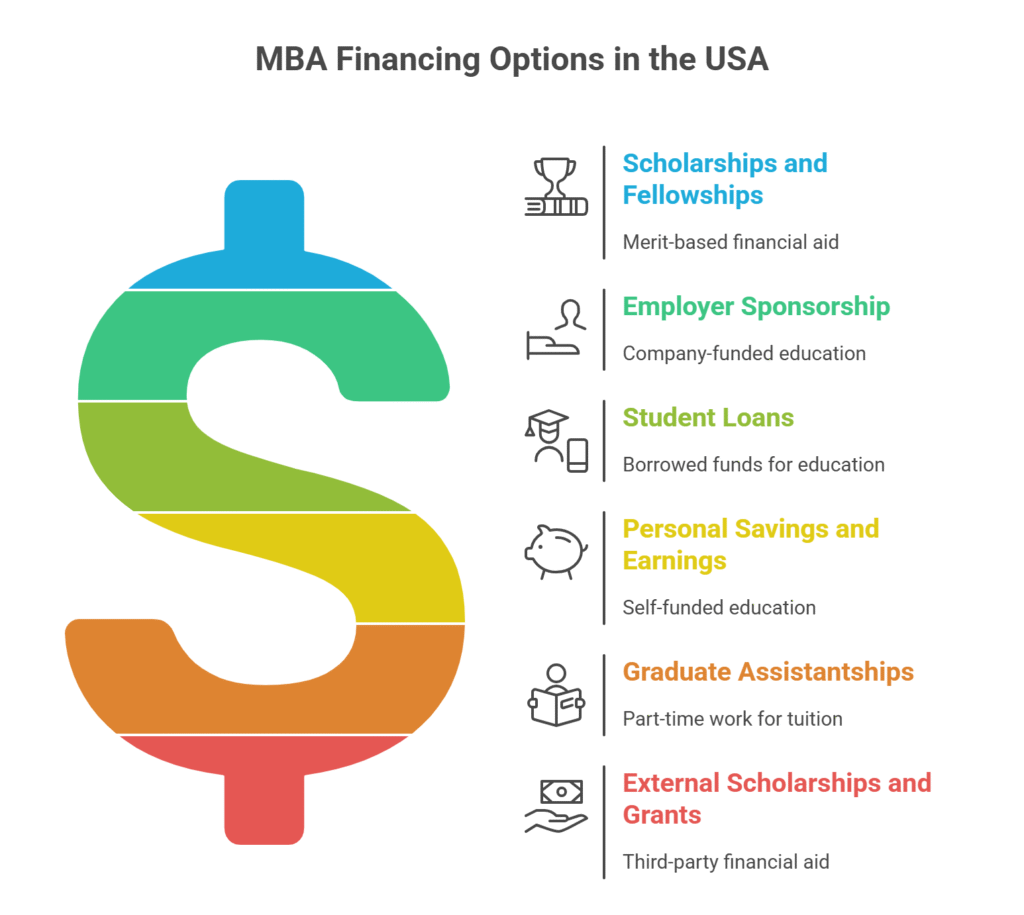
1. Scholarships and Fellowships
Many business schools offer scholarships and fellowships based on merit, need, or specific criteria. These awards do not require repayment and can significantly reduce the financial burden.
Examples:
- Harvard Business School (HBS): Approximately 50% of MBA students receive need-based scholarships, with awards ranging from $2,000 to $87,000 per year. The average annual scholarship is about $50,000, totaling 100,000 over two years.
- Stanford Graduate School of Business (GSB): All MBA students demonstrating financial need are eligible for fellowships. The average Stanford GSB fellowship was approximately $47,000 per year, amounting to $94,000 over two years.
2. Employer Sponsorship
Some employers offer financial support for employees pursuing an MBA, often in exchange for a commitment to return to the company post-graduation. This can cover partial or full tuition costs.
3. Student Loans
Loans are a common method to finance an MBA. Options include federal loans for U.S. citizens and private loans available to both domestic and international students.
- Federal Loans: Offer flexible repayment terms and are generally safer due to protections like income-driven repayment plans.
- Private Loans: May offer competitive interest rates, especially for those with strong credit. International students often require a U.S. co-signer, though some lenders cater specifically to international applicants.
4. Personal Savings and Earnings
Utilizing personal savings or income can reduce reliance on loans and scholarships. Some students work part-time during their studies to support themselves, though this requires careful time management.
5. Graduate Assistantships
Some universities offer teaching or research assistantships that provide stipends or tuition waivers in exchange for work. These positions can also offer valuable experience and networking opportunities.
6. External Scholarships and Grants
Various organizations and foundations offer scholarships based on merit, background, or field of study. Researching and applying to these can provide additional funding sources.
Key Considerations:
- Application Deadlines: Scholarship and financial aid deadlines often precede admission deadlines.
- Eligibility Criteria: Each funding source has specific requirements; ensure you meet them before applying.
- Financial Planning: Assess the total cost of the MBA program, including tuition, living expenses, and other fees, to determine the necessary funding.
More MBA Guides & Insights
- How to Finance Your MBA : A Comprehensive Guide for 2025
- 10 MBA Interview Tips from an Admissions Interviewer
- 10 MBA Essay Tips and Step-Wise Essay Writing Guide [2025]
- MBA after 30 – Is It Worth the Investment?
- Round 1 vs. Round 2 vs. Round 3 Apply in this MBA application round
- MBA Abroad: A Complete Guide
- Who are M7 Business Schools: An In Depth Guide on M7 MBA in 2025
- Top MBA Programs in Europe 2025
- Top MBA Programs in the World (2025)
- MBA Resume: Format, Examples & 10 Tips to Impress the Admissions Committee
FAQs : MBA Cost in USA
1. What is the average cost of an MBA in the USA?
The average cost of a two-year MBA program in the USA, including tuition and living expenses, ranges from $166,000 to over $276,000 depending on the business school and location.
2. Which business school has the highest tuition fee in the USA?
Columbia Business School has the highest annual tuition fee at $91,172.
3. How can international students finance an MBA in the USA?
International students can finance their MBA through scholarships, private loans (often requiring a U.S.-based co-signer), graduate assistantships, and external grants. Some lenders, such as Prodigy Finance and MPower Financing, specialize in loans for international students without a co-signer.
4. What percentage of students receive scholarships at top business schools?
Harvard Business School: Approximately 50% of students receive need-based scholarships.
Stanford GSB: Fellowships are awarded based on need, with many students receiving substantial funding to cover tuition.
5. Are there affordable MBA programs in the USA?
Yes, schools like Indiana Kelley ($55,695 tuition) and Washington Foster ($59,574 tuition) offer more affordable MBA programs compared to Ivy League institutions while maintaining strong reputations.
6. Can I work while pursuing a full-time MBA?
While full-time MBA programs are intensive, many schools offer on-campus jobs, internships, or graduate assistantships to help students offset living costs. However, international students should check visa regulations regarding work eligibility.
7. What are some of the most common financing options for MBA students?
The most common options include scholarships, federal and private loans, employer sponsorship, graduate assistantships, and personal savings.
Final Thoughts : MBA Cost in USA

Pursuing an MBA in the USA is a transformative investment that can open doors to unparalleled career opportunities, expand your professional network, and enhance your leadership skills.
While the cost of an MBA program may seem daunting, careful financial planning and the use of available scholarships, loans, and employer support can make this goal achievable.
Understanding the various cost components, tuition fees at top business schools, and the living expenses associated with different locations will help you make an informed decision and embark on your MBA journey with confidence.
Remember, an MBA is not just a financial investment but also an investment in your future potential. With the right strategy and support, you can make this rewarding experience both feasible and worthwhile.
Don’t Let Finances Delay Your MBA Dream
Smart planning can get you fee waivers, let AdmitStreet’s strategic guidance get you acceptances. We’re with you all the way.