

[Intro by Arvind Kumar]
Getting an admit to one top-tier MBA program feels great.
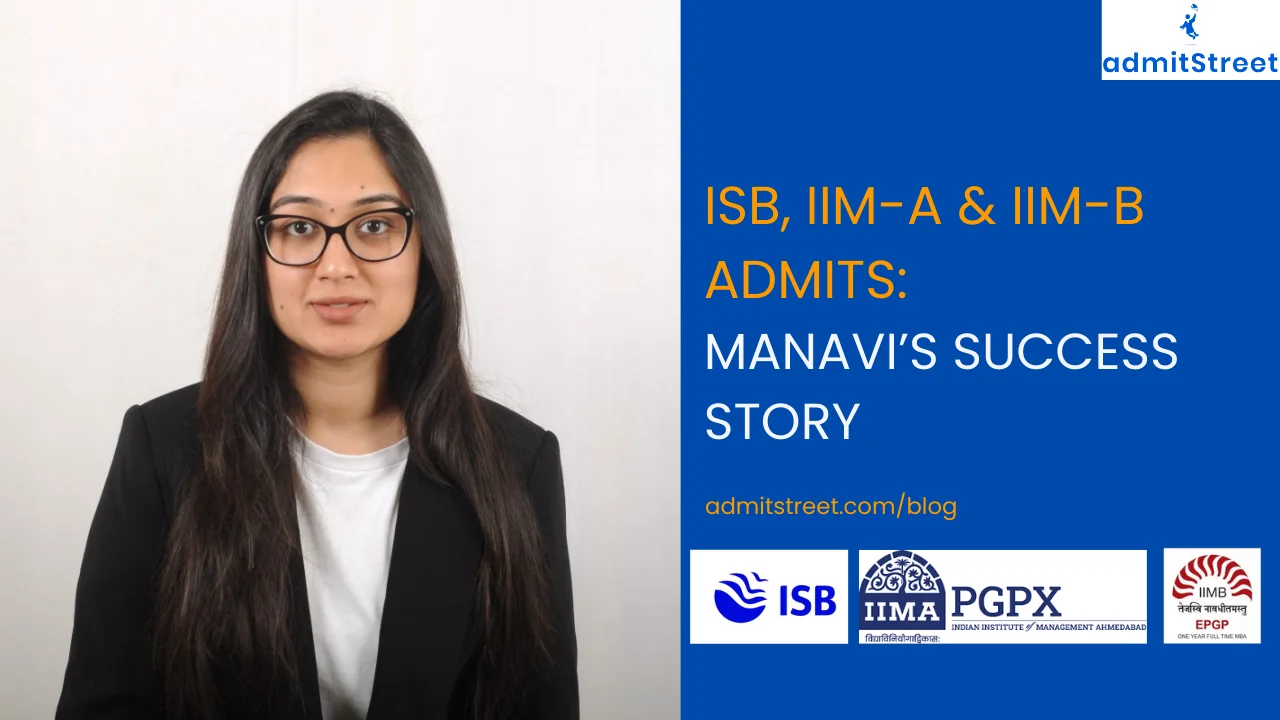
But how about holding admits from the Holy Trinity of Indian B-schools: Indian School of Business (PGP), Indian Institute of Management Ahmedabad (PGPX), and Indian Institute of Management Bangalore (EPGP)?
Just ask Manavi Ahluwalia!
Hailing from the picturesque hill town of Shimla, Manavi built her technical foundation at Manipal Institute of Technology before starting her career as a QA Engineer at Deloitte.
Over five years, she became a trusted bridge between clients and developers, guiding complex tech solutions across healthcare and ESG.
She also served on her firm’s Rewards and Recognition Committee, where she discovered her passion for shaping team culture.
Eager to pivot toward driving product strategy and understanding market dynamics, Manavi knew an MBA was the necessary next step to fill those knowledge gaps.
With a strong desire to stay in India, she set her sights on the premier 1-year programs.
We began with deep introspection, leveraging the admitStreet ‘StreetMap’ questionnaire and brainstorming sessions to bridge her technical background and personal narrative.
From transforming an exhaustive three-page CV into a crisp one-page resume, to crafting essays that balanced her analytical mind with genuine emotion, we focused on presenting the complete, authentic version of Manavi.
Through our structured mock interviews (including with an ISB alum), we focused on her storytelling so the AdComs met the person behind the resume.
Walking away with offers from all 3 schools is a truly well-deserved outcome for the months of focus and dedication Manavi poured into her applications.
Curious to learn more about her background, her application strategy, and her interview experience at ISB and the IIMs?
Check out the full success story below!
Personal & Professional Background
Arvind (admitStreet): Let’s start with your background. Talk about where you’re from, your upbringing/ experiences, and what you do.
Manavi: I’m originally from Shimla, Himachal Pradesh, and I completed my degree in Information Technology at MIT Manipal. Since graduating, I’ve been with Deloitte USI within their Tech Consulting division. Specifically, I work as a Quality Assurance Engineer. My main goal is to ensure that every product we develop and every technical solution the team creates aligns perfectly with our clients’ business requirements.
Arvind (admitStreet): Could you talk a bit more about your role – it seems like a mix of tech and consulting? What kind of projects do you work on, and who do you typically work with?
Manavi: Right. Primarily, our projects span multiple domains. For instance, I’ve been involved in products for the US state-based healthcare system, where our clients included different state governments, as well as the US Postal Service. I’ve also worked on products for various Canadian companies, specifically an ESG product focused on helping them reduce their carbon footprint. These roles have given me the opportunity to interact with clients across different geographies and truly understand their unique requirements.
My role is to translate those requirements into actionable user stories for the software development team to transform into final technical solutions. You could say I’m involved at both ends: indirectly on the requirement gathering side and more directly on the technical execution of the solutions.
Arvind (admitStreet): Besides your core role, you’ve also been involved in the Rewards and Recognition Committee at Deloitte?
Manavi: Right. Apart from my technical work, I served on the Rewards and Recognition Committee at Deloitte for about 2 – 2.5 years. The core intent was to ensure that everyone felt involved and rewarded for the efforts they were putting in. I noticed a remarkable difference in people’s confidence, even those who weren’t very self-assured initially, once they were recognized by their managers or peers. It didn’t always have to be a formal award; sometimes, just a simple shout-out made the impact. I truly loved being part of that committee. It showed me a different side of corporate life. While it’s technically an ‘extracurricular’ since it isn’t part of my primary role, it blends professional development with the personal side of workplace culture.
Motivation for an MBA

Arvind (admitStreet): When did the thought of an MBA first come to you? And why did you want to pursue an MBA?
Manavi: At Deloitte, being involved indirectly in requirement gathering and more directly in technical implementation, I found myself increasingly drawn to the decision-making side of the process. I realized I was becoming more interested in driving the product, identifying which features are most valuable to our users and why they should be prioritized. That was my initial motivation.
Over time, I understood that there are different pieces to the puzzle that I’m not yet aware of. For example, why a certain feature is essential right now to give us a competitive edge in the market. This introduced the marketing and strategy angles, understanding market dynamics to inform product development. I realized that while I’m deeply interested in this side of the business, I have gaps to fill and more to learn. That’s when I knew an MBA would be the right next step for me.
Planning your MBA journey?
With 1:1 mentorship and strategic support, we’ve helped candidates turn uncertainty into admits and scholarships. Ready to begin?
GRE Prep & School Selection
Arvind (admitStreet): How did you decide between the GMAT and GRE? And what was your preparation process like?
Manavi: Honestly, I felt the GRE had a stronger focus on vocabulary and reading comprehension. I’ve always been inclined toward reading fiction, and since reading quickly comes naturally to me, I decided to play to my strengths. Working a full-time job meant I had limited time to prepare, so I chose the path where I could leverage my existing skills rather than develop entirely new ones from scratch.
I started my preparation in January 2024 and ultimately took three attempts to reach my target score. For my first attempt, I relied on popular books and free YouTube videos, specifically the Barron’s 800-word list and the Manhattan 5 lb. book.
However, after that first attempt, I realized that simply memorizing vocabulary wasn’t enough; I needed to improve my actual implementation and speed in Quants. That’s when I started using GregMat. The Reddit community for GregMat was also incredibly helpful. If I didn’t understand a particular lecture, I would post a question, and people from all over the world would jump in to help. It kept me from getting stuck on a single doubt while studying alone at home. In the end, a combination of mini-mocks and consistent practice helped me secure my score.
Arvind (admitStreet): You ended up with a very strong score of 336, which is great. Contrary to what some believe, the score is a vital part of the process. It doesn’t guarantee everything, but it certainly increases your odds in a competitive pool.
Manavi: I agree. By my second attempt, I had a 326, which many websites suggested was the average for schools like ISB. It was a score I could probably count on for an interview invite, but I wanted to be certain. I felt that I might be lacking in some extracurricular areas compared to other candidates, and I realized I couldn’t go back in time to change my college or school record. I decided to strengthen what was within my control right now, and that was my GRE score.
Arvind (admitStreet): Let’s talk about your school selection. You were very clear from the start about targeting ISB and the IIMs.
Manavi: By the time I decided to pursue an MBA in 2024, I already had four years of work experience. Because of that, I was certain I wanted a one-year MBA rather than a traditional two-year program. While there are many one-year options abroad, I looked at the current geopolitical scenario and the overall ROI. I chose to stay in India because I wanted to remain close to my friends and family, and I believe we have world-class institutions right here.
At this point in my life, taking the risk of going abroad didn’t seem to make sense when I could receive a comparable education while staying connected to my support system. Within India, I focused on the top-tier schools for one-year programs: ISB, IIM Ahmedabad, and IIM Bangalore. Since I had a GRE score rather than a GMAT, I didn’t pursue IIM Calcutta, as they specifically require the GMAT. That’s how I narrowed my focus down to these three.
Application Strategy & Introspection
Arvind (admitStreet): Let’s talk broadly about your profile and application strategy. What aspects of your academics or work experience do you feel helped you stand out to these schools?
Manavi: I believe working across multiple domains allowed me to showcase my transferable skills. In my applications, I expressed an interest in branching into strategy consulting or alternatively, product management. My experience working on various projects across different sectors helped demonstrate my ability to understand a wide range of problems and maintain a strong problem-solving mindset.
Beyond the professional side, I think the anecdotes I shared played a significant role. Whether I was discussing a personal challenge like my father’s loss of his business or my own health issues, I made sure everything I wrote came truly from the heart. I didn’t just write what I thought an essay prompt wanted to hear; I shared stories that were authentic to me. I believe that sincerity is what made my essays feel unique.
Arvind (admitStreet): That’s a very valid point. Especially for ISB, but also for the IIMs, essay and interview prompts have become very similar to those of global B-schools. They are much more introspective, focusing on their strengths, weaknesses, and leadership abilities. They want to see the ‘why’ behind your MBA through those personal anecdotes.
Mentorship at admitStreet
Arvind (admitStreet): Could you describe our working process? What were our iterations like, and what really worked for you?
Manavi: Even before we touched the CV or the essay prompts, I have to mention the StreetMap questionnaire you shared. I remember reaching out via email, and the moment I opened that document, I realized the level of personalized attention I was going to receive. The questions covering everything from school choice and career achievements to my core strengths and weaknesses were so in-depth that it took me over a day to answer them. That process truly laid the foundation for all our work. I referred back to those answers constantly. Even later, when I felt overwhelmed during interview prep, I’d return to that document to ground myself.
Following that, we had a personalized call before starting the CV. We discussed my background and key life events, both personal and professional, which really eased our communication moving forward. It allowed us to truly get to know each other, so you could help me translate my story into effective SOPs and essays.
The CV was actually the part I feared most. I hadn’t updated mine since college because I hadn’t been actively job-hunting, and I was worried about compressing five years of experience into a single page without losing my key achievements. The transformation after multiple iterations was unbelievable. We went from a three-page document filled with haphazard points and long paragraphs to a crisp, precise, and professional one-page CV.
When it came to the essays, ISB was my first application, and I had so many questions: How do I start? How do I transition between points? How do I stay within the word limit while balancing formal English with a natural, authentic tone? We spent a significant amount of time on the second ISB essay in particular, and your guidance through those iterations was invaluable. Once that application was submitted, the IIMB and IIMA essays felt much more manageable. The major groundwork was already done, and translating those final SOPs was a very smooth process.
Planning your MBA journey?
With 1:1 mentorship and strategic support, we’ve helped candidates turn uncertainty into admits and scholarships. Ready to begin?
Interview Experience

Arvind (admitStreet): Let’s talk about the interview process. You were shortlisted for all three schools, and each has its own approach. ISB has a panel interview, while the IIMs have their own specific styles. Can you talk about your experience interviewing at these schools?
Manavi: Since I applied in Round 1, ISB was my first interview. I felt well-prepared because ISB tends to ask certain fundamental questions. With your (admitStreet’s) help, I had already mastered the basics: walking through my CV, explaining my post-MBA goals, and discussing my backup plans. However, a significant portion of the ISB interview, more than 50%, focused unexpectedly on AI. In my application, I had mentioned a Proof of Concept (POC) I worked on regarding how AI can assist in Quality Assurance and where its shortcomings lie. We had a very deep, long discussion about whether AI could replace my current role and, if so, how I planned to remain relevant. While I was prepared because it’s part of my job, the sheer depth and time allotted to it were a surprise. The key to ISB was being absolutely true to what I had written. Seasoned professionals can easily spot if you’ve exaggerated your achievements, so being honest about exactly what I had done really worked in my favor.
For IIM Bangalore, the discussion revolved heavily around my specific domain. Since I work on US state-based healthcare products, the interviewers wanted to discuss the changing landscape of US healthcare and my views on universal healthcare versus the UK system. They weren’t just looking for facts; they wanted to test my logical reasoning. They questioned almost everything I said to see if I could defend my points rationally while still acknowledging their differing opinions.
IIM Ahmedabad began with an extempore, followed by intense cross-questioning on my stance. The rest of the interview was almost like ‘defending’ my job. They challenged the necessity of my role as a QA, suggesting it might be redundant if the client side also performs testing. I had to explain why my position on the solution side was vital and how I ensured I remained unbiased. For the extempore, they allow you to pick two chits; you can pass on the first, but you must speak on the second. My first topic was quite political, so I passed. The second topic was: ‘Is real estate the biggest market for black money in India?’ I took the stance that it is, which led to a sprawling discussion on the definition of black money and the various directions that capital flows in India.
Arvind (admitStreet): Let’s talk a bit about the mock interview process. We did three mocks, including one with an ISB mentor. How did that process help you?
Manavi: The mock interviews were incredibly helpful. I remember during the first mock, I was very nervous and didn’t have a clear structure for my answers. Even when I knew the crux of what I wanted to say, it didn’t come out in a structured manner. The feedback you provided was essential. I still have the document from our shared Google folder where I noted everything down, and I revised my answers based on those suggestions. By the second mock, I had incorporated those points and was able to structure my responses properly.
Sounding robotic is a major red flag. For people like me who tend to get tense, I found that writing down the feedback and then practicing in front of a mirror or a webcam really helped. It ensured my delivery wasn’t robotic, but it gave me a solid mental structure. Even though an interview can go in a thousand different directions, we covered so many situational questions, shortcomings, strengths, and weaknesses that I was able to adapt those prepared answers to whatever came up during the actual interviews.
Tips / Advice for Future Applicants
Arvind (admitStreet): Let’s wrap it up. What are your tips or advice for candidates targeting business schools like ISB, IIMA, or IIMB?
Manavi: I would say it is incredibly important to take a sufficient amount of time for the process. In my case, I didn’t apply the same year I got my score. I wanted to take time for introspection, and I think that really helped. Rushing into applications the moment you get your score might not be the best path for everyone. If you are already certain about your ‘Why MBA’ and your post-MBA goals, then you might be ready. But if you need more clarity, it’s best to spend a few months thinking things through.
It’s vital to be sure of what you want to do. Even if you start the process feeling a bit unsure, as I did, tools like the ‘Street Map’ questionnaire and getting in touch with a mentor can help you find that certainty. My advice is to avoid rushing and, above all, stay true to your actual experiences. Don’t exaggerate your achievements in your essays or CV. Authenticity is very important.
Thank you so much, Arvind, for all your help throughout this journey. None of this would have been possible without you.
Arvind (admitStreet): It was my pleasure. Thank you for your time, and all the best for your journey ahead!
Manavi: Thanks, Arvind!
More MBA Guides & Insights
- STAR Approach for Admissions Essay Writing and Interviews
- Who are M7 Business Schools
- MBA Cost in USA: Latest Tuition Fee and Living Costs Revealed
- Round 1 vs. Round 2 vs. Round 3 Apply in this MBA application round
- MBA Abroad: A Complete Guide
- Top MBA Programs in Europe 2025
- Top MBA Programs in the World (2025)
- Financial Times 2025 MBA Rankings: Key Takeaways and Surprising Trends
- MBA Application Fee and Application Fee Waivers at US and European Business Schools