

A well-crafted resume is a crucial element of your MBA application package. As MBA admissions have become increasingly competitive, your MBA resume serves as an opportunity to make a strong first impression and highlight your unique qualifications and achievements.
In this comprehensive guide, we’ll explore why MBA resumes are important, the key differences between an MBA resume and a job resume, MBA resume layout with a sample template, top tips for creating an effective MBA resume, and common mistakes to avoid.
Before moving on to the expert tips that make any MBA resume great, let’s take a look at why MBA resumes are important and what makes them an important component of the MBA application.
Why Are MBA Resumes Important?
Resumes hold significant importance in the MBA admissions process, serving as a key component of your application package. MBA admissions committees place a high value on resumes because they provide valuable insights into your qualifications, experiences, and potential contributions to the program.
Here’s why resumes matter and the specific value admissions committees place on them:
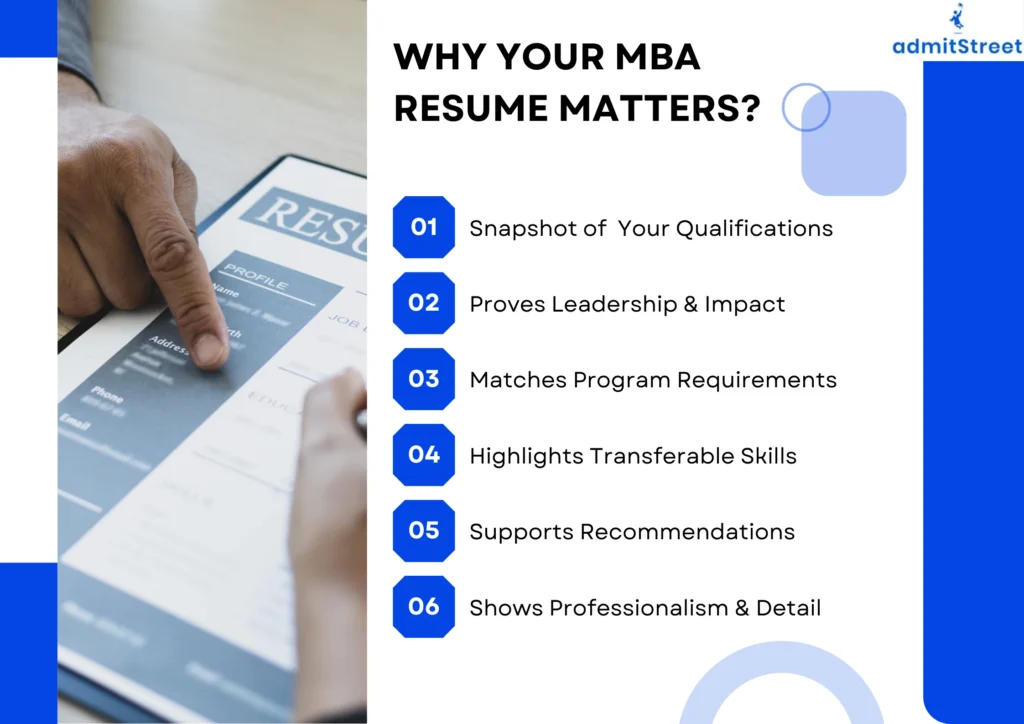
- Snapshot of Your Qualifications
Your resume gives admissions a quick view of your academics, work experience, leadership, and extracurriculars, helping them gauge your readiness for an MBA program. - Demonstration of Leadership and Impact
Top MBA programs want candidates who have led teams, initiated projects, earned promotions, and driven organizational growth. Your resume is the place to showcase that impact. - Alignment with Program Goals
A well‑crafted resume shows how your background and aspirations align with the mission and values of the specific MBA program. - Evidence of Transferable Skills
Resumes provide proof of skills that transfer across industries—problem‑solving, strategic thinking, and effective communication. - Context for Letters of Recommendation
Your resume helps recommenders understand your experiences, strengths, and growth areas, giving their letters meaningful context. - Post‑MBA Goals
Clearly stating your career goals on your resume helps the committee assess how well the program aligns with your trajectory. - Attention to Detail and Presentation
A polished, error‑free resume demonstrates professionalism, attention to detail, and your commitment to the application process.
Is Your Resume MBA-Ready?
Leadership, impact, and clarity – these are what top B-schools look for. Let’s make your resume stand out. Get a free profile evaluation.
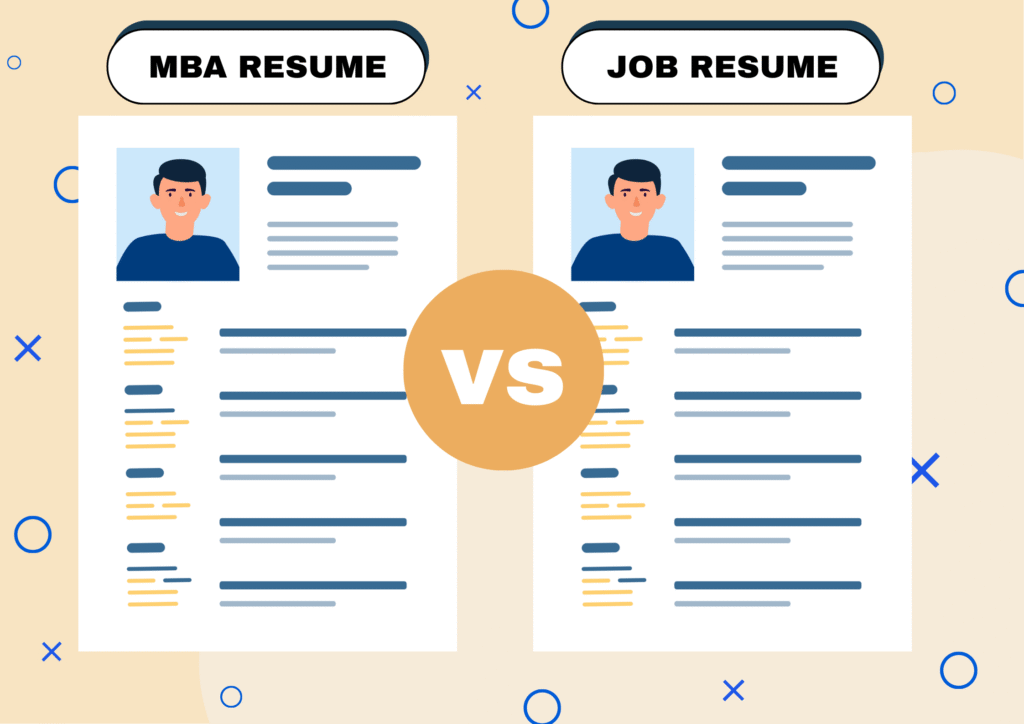
MBA Resume vs Job Resume
Many applicants mistakenly submit the same resume they used for job applications.
Here are the key differences.
| Aspect | MBA Resume | Job Resume |
|---|---|---|
| Focus and Emphasis | Emphasizes leadership, teamwork, and management skills. Highlights leadership roles, team projects, and significant impact to showcase potential as a future business leader. | Focuses on specific skills, qualifications, and experiences directly related to the job. Highlights how you meet the requirements of a particular position. |
| Education and Qualifications | Education is given more prominence if you have less work experience. For applicants with 4‑5 years of experience, work experience is more prominent. Includes academic qualifications, relevant coursework, and achievements. | Education section is typically shorter, focusing on degree, institution, and graduation date. Less detailed compared to an MBA resume. |
| Extracurricular Activities | Plays a significant role to demonstrate well‑roundedness, leadership in non‑professional settings, and ability to contribute to the MBA community. | May add value but is not as prominently featured unless directly related to the job or relevant skills. |
| Career Goals and Objectives | Often includes an objective or summary statement that clearly articulates career goals and how the MBA program aligns with them. | May include a career objective, but the focus is more on matching skills and experience to the specific role. |
Know how to create an impactful MBA essay which includes the 10 tips to follow and 10 mistakes to avoid.
What Is the Best MBA Resume Format?
When it comes to your MBA application resume, clarity and simplicity are key. You want the admissions committees to easily grasp your information.
One‑Page Rule: How to Keep It Concise
- Why one page? Admissions officers review thousands of applications. A two‑page resume suggests poor editing.
- How to achieve it:
- Use 0.5‑inch margins (minimum 0.4‑inch).
- Font size 10‑12 for body text (11 is ideal).
- Limit work experience to 3‑5 bullet points per role, focusing on achievements, not tasks.
- Remove “References available upon request” and old high school achievements.
Reverse‑Chronological vs. Functional Format
- Reverse‑chronological (recommended): List your most recent experience first. This is what schools expect.
- Functional: Groups skills by theme (e.g., “Leadership,” “Analytics”). Avoid this- it hides your career timeline and looks suspicious to admissions committees.
Step‑by‑Step: How to Write an MBA Resume
Here’s a straightforward structure with some guidelines for your MBA resume, starting with the basics and building up to the finer points.
- Experience Section: About half to three fourth of your resume.
- Education: About a quarter or less of your resume.
- Extracurricular Activities: About a quarter or less of your resume.
You’ll typically begin your MBA resume with basic information like your name, phone number, address, and email. To make your name stand out, you can use a different font or style.
You can also add a Summary section if you’d like. This is a short 2-3 sentence introduction that highlights your most valuable skills. Write it in a descriptive way (like, “Forward-thinking Product Manager who…”) instead of using “I”. Think of it as a brief bio.
Another option is a Highlights section. This is a list of 8-12 qualities or areas where you excel. These might include work-related skills (like scheduling or budgeting) or personal traits (like being creative or analytical) that you bring to your role.
After that, get into your Work Experience.
Work Experience Section
Crafting the work experience section of your MBA application resume is crucial as it showcases your professional growth, achievements, and relevance to the program.
Here’s a step-by-step guide to creating an effective work experience section:
- Prioritize Relevance: Select your most recent and relevant job experiences that align with your MBA goals. Emphasize positions where you demonstrated leadership, management, teamwork, and skills applicable to business school.
- Layout and Format: Aim to follow some guidelines –
- Start with your job title, company name, and dates of employment.
- Use bullet points for each job to present your responsibilities and accomplishments clearly.
- Use action verbs for each bullet point to showcase impact. Start with the result and then use the action verb. (e.g., “Led,” “Managed,” “Initiated”). For example “Increased sales by x% by leading a team of 5 associates”
- Keep the format consistent throughout the section.
- Focus on Achievements: Rather than just listing tasks, emphasize your achievements and impacts in each role. Showcase your leadership, innovation, and contributions that made a difference.
- Quantify Results: Whenever possible, include quantifiable metrics to highlight your accomplishments. Numbers provide concrete evidence of your contributions. For instance, mention how you increased sales, saved costs, or improved processes.
- Tailor to MBA Goals: Highlight aspects of your work experience that directly relate to your MBA aspirations. Showcase skills, accomplishments, and responsibilities that demonstrate your readiness for business school.
- Use the CAR Method:
- Context: Describe a challenge or situation you faced in the role.
- Action: Explain the actions you took to address the challenge.
- Result: Share the positive outcome or impact of your actions.
- Highlight Leadership Roles: If you held leadership positions or managed teams, highlight these experiences. Leadership is highly valued in MBA programs.
- Prioritize achievements in every role: For each role you have worked in your total experience prioritize the most impactful and relevant achievements. Let’s say you have held 2 jobs in your professional experience. For each job, prioritize the achievements that created the most impact and list them on top.
- Industry-Specific Language: Use industry-specific terminology and keywords related to your field. It shows your familiarity with your industry and may resonate with MBA admissions committees.
- Keep It Concise: Be succinct but comprehensive. Aim for about 3-5 bullet points per job, focusing on the most impactful aspects.
Next comes your Education history.
Education Section
Just include your bachelor’s degree and master’s degree if you have one. You can talk more about your education in your essays if it’s important for your application.
If you believe your work experience isn’t as strong as you’d like, make sure to highlight your education at the forefront of your MBA application resume. Begin by incorporating the following information:
- Institution
- Degree
- Major or area of focus
- Any minors you pursued (if relevant)
- Date of graduation
- GPA
- Achievements or recognitions received (if applicable)
Extracurricular Activities
Lastly, if it fits, add one or two Extracurricular activities that highlight your interests and achievements outside of work. This gives a glimpse of your personality and character while keeping your resume professional.
Confused about which MBA programs are truly top-ranked? Check out our in-depth guide on the best MBA programs and global rankings.
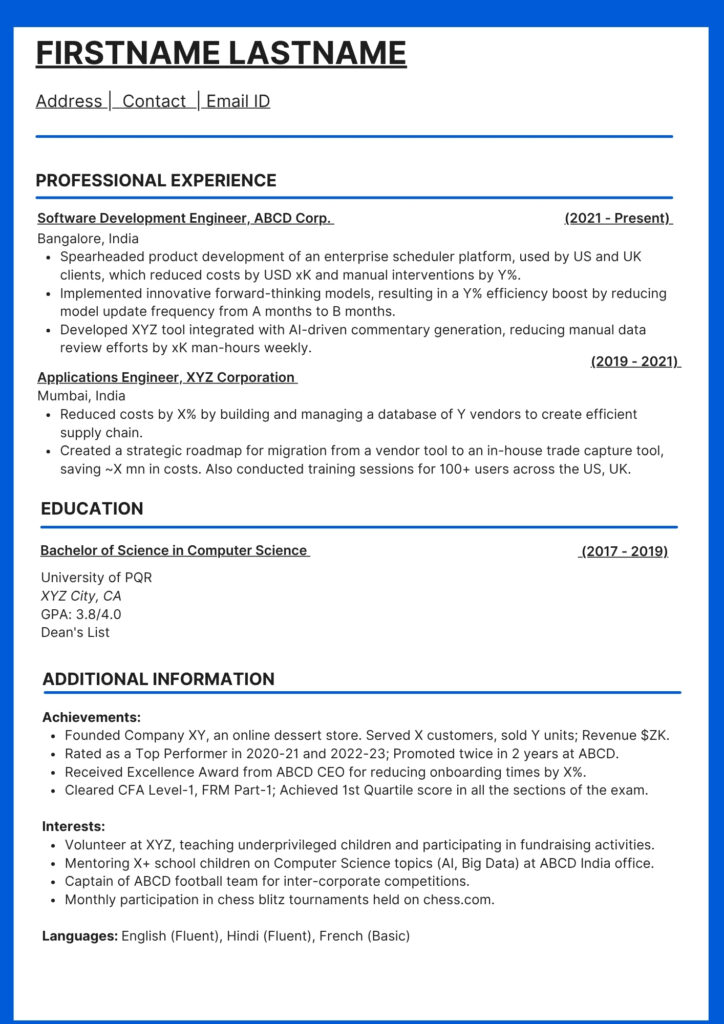
Sample Resume for MBA Admissions
Worried about interview prep? We have got you covered with a comprehensive list of MBA interview questions by school. Read our article!
Dos and Don’ts of an MBA Resume
Creating a standout MBA resume requires attention to detail and a clear focus on your qualifications and goals.

Here are the top must-haves and common mistakes to avoid when crafting your MBA resume:
Top Must-Haves
- Clear Objective: Include a concise objective or summary statement at the beginning that highlights your career goals and how an MBA aligns with them.
- Relevant Work Experience: Emphasize your most relevant work experiences that showcase leadership, teamwork, and skills applicable to your MBA goals.
- Quantifiable Achievements: Use numbers and metrics to highlight your accomplishments. Quantifiable results provide concrete evidence of your impact.
- Leadership Roles: Highlight leadership experiences, whether at work, in extracurricular activities, or in community initiatives. MBA programs value leadership potential.
- Education: Clearly list your educational background, including the degrees earned, institutions attended, and graduation dates.
- Extracurricular Activities: Showcase involvement in clubs, organizations, volunteer work, or any initiatives that demonstrate your interests and skills beyond work.
- Skills: Highlight relevant skills that align with your MBA and career aspirations. Include technical and soft skills.
- Consistency: Maintain consistent formatting, font, and spacing throughout the resume. Consistency enhances readability.
- Customization: Tailor your resume for each MBA program you apply to. Highlight experiences and skills that match the program’s values and goals.
- Proofreading: Thoroughly proofread your resume for grammatical errors and typos. A polished resume reflects your attention to detail.
Top Mistakes to Avoid
- Irrelevant Information: Avoid including experiences or details that don’t relate to your MBA goals. Focus on what’s most pertinent.
- Overwhelming Length: Keep your resume to one or two pages. MBA resumes should be concise and focused on the most impactful information.
- Vague Language: Be specific about your responsibilities and accomplishments. Avoid using generic terms that don’t provide clear insights.
- Lack of Results: Don’t just list tasks; emphasize the outcomes and results you achieved in each role.
- Excessive Jargon: While industry-specific language can be helpful, avoid using excessive jargon that might not be understood by everyone.
- Excessive Detail: While it’s important to provide details, avoid overwhelming the reader with too much information. Stick to key points.
- Lack of Focus: Ensure that your resume is targeted and focused. Every section should contribute to your overall narrative.
- Inconsistent Formatting: Inconsistent fonts, spacing, or formatting can make your resume appear unprofessional. Maintain a uniform style.
- Neglecting Extracurriculars: Don’t overlook your involvement in extracurricular activities. These can demonstrate well-roundedness and leadership skills.
- Forgetting to Tailor: Each MBA program has its unique strengths and goals. Don’t submit a generic resume; customize it for each school.
MBA Resume Skills Checklist
Use this checklist before submitting your application:
- One page exactly (or two pages only if you have 10+ years of WE, but rare).
- Margins ≥ 0.5 inch, font size 10‑12, consistent formatting.
- Professional summary includes career goal.
- Each work bullet point follows CAR (Context‑Action‑Result).
- At least 80% of bullets are achievement‑focused, not duty‑focused.
- Education section includes GPA (if ≥3.5) and honors.
- Skills section lists both hard and soft skills.
- Extracurriculars or community involvement shown.
- No typos, no “I” statements, no personal photos.
- PDF filename =
YourName_MBA_Resume.pdf.
More MBA Guides & Insights
- MBA Scholarship Guide 2026
- How to Finance Your MBA : A Comprehensive Guide for 2025
- 10 MBA Interview Tips from an Admissions Interviewer
- 10 MBA Essay Tips and Step-Wise Essay Writing Guide
- MBA after 30 – Is It Worth the Investment?
- Round 1 vs. Round 2 vs. Round 3 Apply in this MBA application round
- MBA Abroad: A Complete Guide
- Who are M7 Business Schools: An In Depth Guide on M7 MBA in 2025
- Top MBA Programs in Europe 2025
- Top MBA Programs in the World (2025)
- MBA Resume: Format, Examples & 10 Tips to Impress the Admissions Committee
Final Thoughts
Crafting a winning MBA resume is an essential step toward securing your spot in a competitive business school. Your MBA resume serves as a bridge between your past achievements and your future aspirations.
By understanding the unique features of MBA resumes, tailoring them to your goals, and avoiding common pitfalls, you can present a compelling case to admissions committees.
Remember, your resume is not just a list of experiences, but a strategic tool to showcase your leadership potential, accomplishments, and readiness for the transformative journey an MBA offers.
FAQs – MBA Resume
How do you write an MBA resume?
Start with a clean format and strong action verbs. Highlight leadership, quantifiable results, and career growth. Keep it concise, impactful, and aligned with your post-MBA goal
How is an MBA resume different from a job resume?
Unlike a job resume, which focuses on specific skills for a role, an MBA resume highlights leadership, impact, teamwork, career trajectory and transferable skills. It’s designed to show admissions committees your fit for their academic and community environment.
What should be included in an MBA resume?
Your MBA resume should include:
1) A brief summary or objective (optional)
2) Education and academic achievements
3) Professional experience with measurable impact
4) Leadership roles (both work and extracurricular)
5) Community involvement
6) Skills and certifications
How long should an MBA resume be?
Most business schools expect a one-page resume, even if you have extensive experience. Focus on quality, relevance, and clarity rather than length.
How much work experience should I show on an MBA resume?
Focus on quality over quantity. Most applicants have 3–5 years of experience, but what’s more important is showcasing impact, progression, and leadership in your roles.
Can I use the same resume for MBA applications and job applications?
It’s not recommended. An MBA resume should highlight broader themes like leadership potential and strategic thinking, while a job resume is more role-specific and technical.
What if I have a gap in employment?
Be honest. If the gap was for travel, family, or further education, mention it briefly in the optional essay. Do not hide it on the resume.
Can I send the same resume to all schools?
You can, but you should customize the professional summary and possibly reorder bullet points to align with each school’s strengths (e.g., emphasize tech if applying to Sloan).
Get a free profile evaluation
If you would like a candid assessment of your profile, book your free profile evaluation session now.