

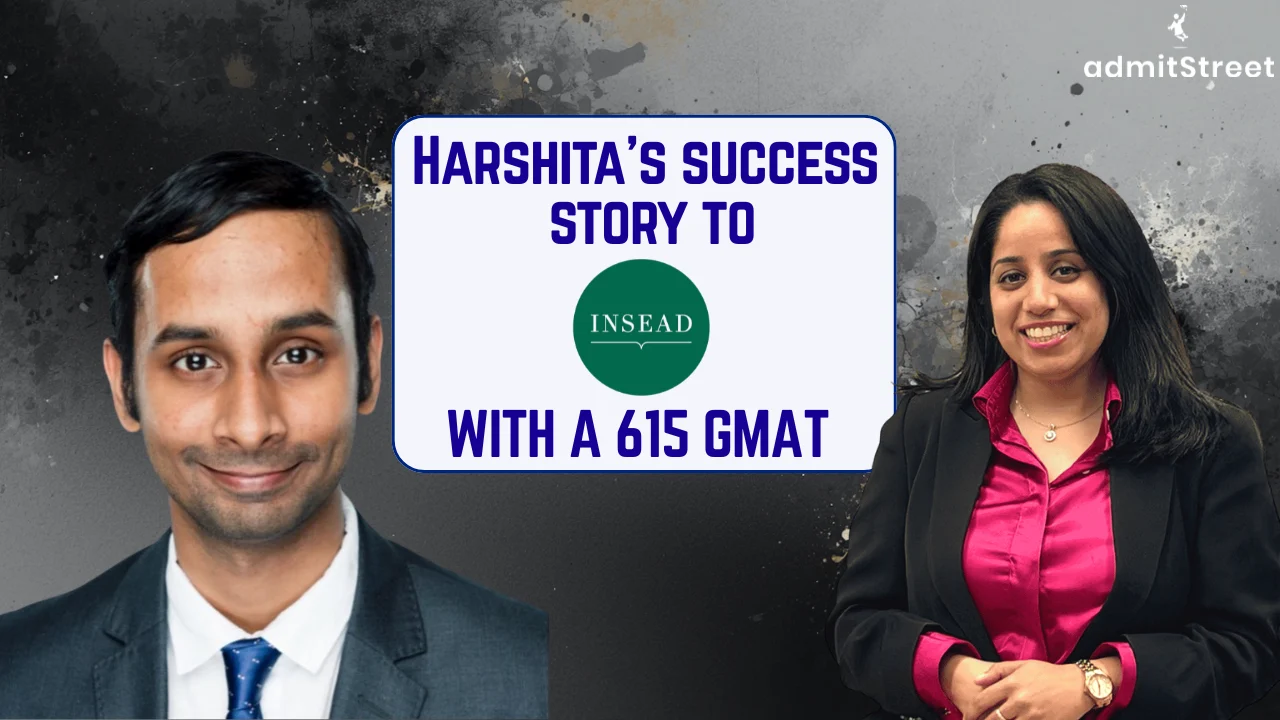
[Intro by Arvind Kumar]
Harshita is undoubtedly one of the most resilient candidates I’ve mentored.
She graduated in textile design from NIFT, worked with European mass-market retailers like Carrefour and Tesco, and then made an unusual leap to BCG as a design strategist. But she soon felt the gap in her business toolkit and set her sights on a global MBA.
The GMAT became her biggest hurdle. She took the test nine times, climbing from a 460 to a 615 on the GFE (680 equivalent).
Despite balancing a hectic job and recurring setbacks – the kind that would lead most people to give up – she never lost sight of her goal.
She was focused on INSEAD, recognizing it as the consulting powerhouse that could bridge her design expertise with world-class business leadership.
Outside work, Harshita incubated three startup ideas, conquered multiple high-altitude treks, and recently earned her scuba certification – a hobby that turned into a genuine connection when both her INSEAD interviewers turned out to be divers too.
Our work together focused on connecting her professional dots, articulating her impact at work, refining her post-MBA goals, and building a narrative that showcased her innate ability to thrive in challenging environments.
We also tailored her mock interview sessions, where we worked on translating her non-traditional narrative into the business language INSEAD seeks, without losing her authentic voice.
The result was a well-deserved testament to her grit: INSEAD admit with a €25,000 scholarship.
Harshita’s journey is a powerful reminder that while scores matter, it is the person behind the numbers (and their relentless persistence) that truly wins over an admissions committee.
Personal & Professional Background
Arvind (admitStreet): Can you share about your background and professional experience before applying to business school?
Harshita: I’ve been a creative person throughout. I studied design and majored in textiles at one of the foremost fashion schools in India. Post that, I worked with a home textile company, catering to mass-market retailers in Europe, including Carrefour, Tesco, and Home Centre.
Later, I decided to merge my problem-solving skills, keeping design at the core, and moved to BCG as a design strategist. Now, I still design, but I cater to much wider practice areas, solving GTM strategies for brands and creating identities. It’s been over six years of studying and working in the design industry, and that’s my background.
Arvind (admitStreet): You made a transition to BCG in the design world without an MBA, which is unusual for most folks. Can you talk a bit about that journey? Was it difficult, and what did you learn when you made that transition?
Harshita: Yeah, I mean, at the core of it, I am still a designer, but I’m leveraging the creative thinking skills that I feel most consultants also practice, just from a business lens instead. I strategize on problems that are not generally solved by keeping finance or ops at the core, but rather, just design.
Of course, the transition was interesting. I never expected myself to end up in the consulting space as a designer, but it’s been a solid learning curve because now I get to do all the creative bits for brands by exploring very diverse practice areas.
Arvind (admitStreet): So, when did the thought of an MBA come to mind? And why did you want to do an MBA?
Harshita: I think I’ve been pondering it for quite a few years, but I actually remember the moment I knew it had to happen. As a core design professional, it was very hard for me to contribute to business problems, be it at Welspun or even at BCG, because I lacked theoretical knowledge.
I’ve always wanted to solve for consumers. I’ve been doing that for many years, but it has always been restricted to design. Even here, there is only so much I can do as a design strategist. Now, for me to move into more core consulting roles and beyond, I definitely need a bird’s-eye view of everything from finance and ops to marketing and strategy.
An MBA from INSEAD fits perfectly here. I’m looking to gain niche theoretical learnings, while keeping design in the background, with a cohort as diverse as my own background. That is why I chose INSEAD.
Profile: Strengths & Challenges
Arvind (admitStreet): Talk a bit about your GMAT journey. You have been one of the most persistent candidates, but it can get tough between those retakes. What kept you going?
Harshita: I think the GMAT has been a pain point for me for as long as I can recall. Undeniably, it’s been the most significant part of my MBA prep and application journey. That being said, I gave my first attempt back in 2022, which was six or seven years after I had last been in the habit of sitting down to take an exam.
My first attempt was extremely disappointing. It was literally a display of everything you read on GMAT Club regarding what can go wrong on test day. I experienced it all and ended up with a 460. But going from a 460 to now a 615, I did not settle for my score until I at least had a foot in the door.
The only reason for that, and I give part credit to you for this, Arvind, is that I realized the GMAT was the only aspect of my application I could truly control. Even though it was painful, with long nights and a lot of workload management, it was the one area I could possibly improve upon. The more effort I put in over the years, the more the improvement curve was reflective of that work. And yeah, I think that is how my GMAT journey has been.
Arvind (admitStreet): I’d say you are one of the most persistent candidates I’ve worked with. You took the test even just a couple of weeks before the INSEAD deadline. It’s worth adding that schools like INSEAD ask for your full testing history: you aren’t just giving them one score, you’re showing them a trajectory. Showing that you can move from A to B to C is a strength. Even if you don’t hit your target on the first attempt, reaching it eventually shows perseverance, especially when balancing a job, the application, and retakes. Schools understand there is no “magic score”; it depends on your overall profile and fit. That’s a key point for INSEAD specifically.
Harshita: Yes, absolutely, spot on. I actually ended up taking the GMAT nine times. I remember the application deadline was September 16, and on September 5, I was back at the test center for one last attempt, hoping for an improvement. I even discussed this journey in my application. Even though I didn’t hit the “ideal” target score for the school, it reflected my willingness to put in the effort. INSEAD is a school that appreciates that, which is why my overall application managed to outweigh the GMAT score itself.
Arvind (admitStreet): INSEAD was your number one priority school? What criteria did you consider before making that decision?
Harshita: Yeah, INSEAD was my dream school from the very beginning for reasons that felt very personal rather than just aspirational. Practically speaking, the 10-month duration was, and still is, a bonus. It’s a very focused curriculum that allows me to get back into the professional space quickly, which made sense for my goals.
But the biggest pull was the network. I’ve always believed that when I eventually did an MBA, it should provide the opportunity to meet my “future board of directors.” By that, I mean being around people who challenge you, open doors for you, and constantly guide you through the process. INSEAD, with its international cohort, felt like the right place to be.
That said, I wasn’t willing to put all my eggs in one basket, so I also intended to apply to HEC, which shares many similar values. Ultimately, what made me certain about INSEAD is that it is filled with diverse folks from backgrounds as unique as my own. Having worked in European geography for several years within the consumer-centric space, I knew I’d love to study in that territory. Now that I’m at BCG, I’m looking after APAC, so having that blend, being able to study in both APAC and Europe, was a significant bonus.
Arvind (admitStreet): You spoke to a lot of people, students and alumni. Were there any specific conversations or insights that really stood out to you about INSEAD?
Harshita: Ever since I started researching the school, I knew it had a diverse cohort, but the more I spoke to people, both during my application journey and now as I’m getting to know my classmates, the more I realized how true that is in essence. For example, looking at the people I’ve spoken to, there’s a math scholar who is also a certified ski instructor. There’s a data analyst who is part of the German cricket team.
Just recently, I was speaking to someone in robotics who works for a science company, but he has also been producing music for the past ten years. I think this really shows how diverse the cohort actually is and how much INSEAD values more than just professional excellence. They want you to have a solid hobby or a passion you’re willing to pursue. That was something that really attracted me, being in a place where I’m alongside finance students, dentists, engineers, doctors, and designers alike. That really stood out for me.
Arvind (admitStreet): Can you talk about your extracurriculars? Were there aspects outside of work that you felt helped you in the application process, whether in the essays or the interviews?
Harshita: Quite a few, actually. Back in college, I worked closely on three startup ideas, one in edtech, one in fintech, and one focused on building a community. They were incubated in various colleges, and we even managed to raise funding. Those were all part of my extracurricular experiences, me trying to pursue things beyond design. I am also a very passionate high-altitude trekker, and recently, I got my scuba certification.
Initially, I didn’t think these aspects held much value because I thought they were just things I was passionate about outside of work. However, they were points that were actively discussed in my interviews. They weren’t just generic questions: the interviewers dove into very specific insights. It helped me understand that the school truly values your ability to bring more to the table than just academic learning.
In my interview, it just so happened that both of my interviewers were also scuba divers! We spoke about it at great length, and I realized that the school really focuses on that balance between multiple pursuits. There is even an essay specifically dedicated to extracurriculars, which gives you the perfect data point to expand on those experiences.
Arvind (admitStreet): It’s a very competitive pool, especially from the Indian demographic. What do you believe were the key factors that made your application stand out?
Harshita: I’d like to believe that my differentiator was stemming from a creative background, bringing in a perspective that was more design-centric than strictly business-oriented. I have been creating product offerings that are lucrative to consumers at the final stage, while other folks are often part of the process before that. I think that’s a strong influence I bring to the class, which acted as my USP of sorts.
I think this is also attested to by the fact that I was granted the INSEAD Alumni Fund for Diversity scholarship. There’s no other way I would have gotten that had I not been catering to the fact that I stem from a fairly diverse, creatively oriented background.
Arvind (admitStreet): I think that’s a great point. Sometimes I hear from candidates that INSEAD only takes consultants or math-oriented strategy consultants, which they do. But there are all these other personas, including yours, which actually add to the variety of the class. If you’re surrounded only by a certain persona, which sometimes happens in the Indian education system, where you’re surrounded by “math geeks” or quant-heavy people, you miss out. In a class like this, you get to learn from people who view the world from very different vantage points.
Arvind (admitStreet): What were some of the obstacles or challenges that you felt you had to face, and how did you sort of work through the process?
Harshita: I think, as mentioned earlier, I really did feel that the biggest challenge for me was being able to ace the GMAT. And I cannot emphasize this enough: the GMAT was undeniably the only aspect of the application that felt under control, even though it felt extremely painful to sail through. My extracurriculars and job experiences were set, but the GMAT was something I could still work upon.
That was the problem statement. How I worked on it was actually by signing up for GMAT Club sectionals towards the end of it. I remember for my last three attempts, I signed up for the GMAT Club mocks; I used to do a sectional every day to ensure my strategy was set in stone so that nothing changed on “D-day,” regardless of the kind of questions I got. I did leverage the library of multiple questions as well. So, how I managed to overcome my GMAT was to be very rigorous with prep and be dedicated to just one source. That is actually the source I’d recommend everyone leverage. GMAT Club is a great community where you can constantly ask questions and get your basics right. And it truly does pay off.
Application Process
Arvind (admitStreet): Talking about the INSEAD application, it is probably the most exhaustive of any business school out there. Let’s start with the CV. It is a calling card. Any insights or tips on how you transformed your CV from what you had earlier?
Harshita: And before I actually dive into that answer, I think major credit for that goes to you. I remember when you and I worked together on my first draft; it was so bad, I now laugh at it! But you were extremely polite about it. That is where my learning curve on actually creating a good CV started.
The CV that we create for our job applications is very, very different from what we submit for an MBA application, and that was the foremost important realization to have. As a designer, I have probably not learned to quantify my work as much, because there’s only so much quantification you can bring to aesthetics and creativity. But that was my learning when I was creating my CV for the MBA admit: I learned how I can put various metrics into quantifiable pointers and how I could actually portray them better for a layman to understand, without using very niche, industry-specific jargon. You played a major role in that, and that has hands down been my major learning: how to write a CV for an MBA application that is different from a job application.
Arvind (admitStreet): INSEAD has several essays, motivation essays, career essays, extracurriculars, etc. It’s not only about your work experience; it’s also about who you are as a person, your strengths, and how you handle stressful situations. Can you talk about the process we followed?
Harshita: Yeah, the INSEAD application was extremely, extremely rigorous in the sense that there were six essays. Those six essays had to be combined together to create a very cohesive story. Honestly, I couldn’t have managed to have six separate segments that collectively portrayed my personality in its entirety on my own. That is where you came into the picture.
Even the Streetmap questionnaire that we are initially supposed to fill, I remember taking a solid week to fill that out. It was worth every effort because everything I managed to brainstorm in that week, courtesy of it being very extensive, allowed me to pick up stories and anecdotes for my essays later. Had I not done that activity seriously, I possibly would not have been able to draft the right essays, which need to be mutually exclusive but also connect together.
Again, I give you credit for that, because the process felt like a lot of self-reflection. In the end, those six essays did come together as a cohesive story. I’ll also be honest: I was possibly not the easiest candidate to work with logistically because of my 14-hour workdays and GMAT prep, which meant I wasn’t always as responsive as I’d have liked. But your proactiveness compensated for that. Your availability kept the process moving even when I couldn’t. From the first step to the last, the KIRA review and the mocks, I couldn’t have asked for more.
Interview Experience
Arvind (admitStreet): Can you share your experience with the admissions interview for INSEAD? Any unexpected questions or insights gained from the interview process?
Harshita: Honestly, in hindsight, the interview experience was one that I didn’t expect to enjoy as much as I did, even though it was very, very stressful at the moment. I was interviewed by two people, and both stemmed from very different industry backgrounds. But interestingly, they had soft overlaps with my own trajectory: they were in the same space I am hoping to be, just from a different industry.
From the start, what struck me was that those conversations didn’t feel transactional. They felt like conversations with people who genuinely wanted to know my story, not just “tick boxes” because it had to be done. The moment that stayed with me was when one interviewer asked me about INSEAD’s tagline, “Business for Good.” Honestly, it’s not something I had pondered upon, so I gave the most blunt, unfiltered answer I could manage. It opened up into this very wide, free-flowing conversation where we were exchanging ideas like people who are genuinely interested in a topic together. I wasn’t performing an answer anymore.
The second interview, I think, was a typical case of “good cop, bad cop.” I was deeply questioned on why an MBA and why I am doing XYZ things, which I think was also great. Post-interview, I was even more stern in my thoughts because it instigated and rooted those ideas even deeper. I also did my research on both interviewers, and I cannot stress how important that was to be able to start a warm, personal conversation. As I mentioned, they both happened to be scuba divers too. We ended up talking about scuba at length; that deeper connection was so much better than just two folks conducting an MBA interview.
Arvind (admitStreet): I think that’s unique about INSEAD. They have alumni interview you because they have a feel for what kind of candidates they want in the classroom. The broader question is: “Can I see myself having coffee or being on a trek with this person?” You should prepare, but you cannot script it, or it sounds rehearsed.
Harshita: Yeah, I think it was that mindset shift that helped me stop thinking of them as evaluators and actually think of them as the school’s biggest advocates. They knew exactly the kind of cohort there is. That took a lot of pressure off me, because it made me feel like I was just supposed to portray my best story possible, and they would be the ideal judge for it.
Arvind (admitStreet): How was your interview preparation process? Can you talk a bit about the mock interviews that you did? How did you evolve your interview preparation?
Harshita: I think I prepared for my interviews in a fairly structured, detailed manner. I started off by compiling questions that had been asked in the past by INSEAD alums, courtesy of you as well, where you allowed me to get access to a whole library of questions that INSEADers were asking in that particular round. I ensured that I created an anecdote library, all structured in STAR format.
I remember I did some 30-40 different anecdotes from various parts of my life to be able to relate them to each and every possible instance. I’m actually glad I did that because, one, backing answers with proven stories is always more fruitful than just talking about things. And secondly, this worked perfectly for one of my interviews, because my interviewer said they wanted me to share stories for every question they asked, and they could not be related to or overlap with my application at all. Honestly, had I not done the anecdote library, I would have crumbled right there in front of my interviewer. Luckily, that did not happen.
I also attended a few mock interviews. You allowed me to get in touch with quite a few INSEAD alums, and they conducted my mocks. Their insights were absolutely spot on, and they actually shaped me to be able to give a solid, INSEAD-level performance.
Arvind (admitStreet): Can you talk a bit about the scholarship process? INSEAD has a separate mechanism by which you pick the scholarships you apply for. Any insights or tips for people eyeing those scholarships?
Harshita: Yeah, of course. I mean, there are multiple scholarships that INSEAD offers, and you can go about it in two ways. One, you apply for each and every scholarship and tailor your story to each one. Or, you are very certain about where your profile fits and what scholarship you can possibly leverage. Since most of the funds are provided by INSEAD alums, you need to keep in mind that there is only so much funding INSEAD has to offer.
I was in the second category: I did not choose to apply to every scholarship available. I knew I was a diversity student and I knew the background I was coming from, so I targeted those specific scholarships. I think what also helped was being very, very honest about my own journey. For the school to give you financial aid, they want to see an authentic version of you, rather than just somebody trying to get a waiver on their tuition fees. That helped in my case. I remember I even got on a call with the finance officer, and I managed to get in touch with my admissions officer to share my story personally, how my journey has been, where I’d like to go forward, and how being in a design-centric space allows me to leverage the diversity scholarship.
Arvind (admitStreet): Yeah, and INSEAD is highly selective about scholarships. It’s not like some of the US schools where the volume and dollar value tend to be higher. They are pretty selective about who they offer them to, which category, and the amount. So yeah, it’s no easy feat to achieve what you achieved.
Working Process & Mentorship at admitStreet
Arvind (admitStreet): How was your experience working with Arvind/ admitStreet?
Harshita: There’s only one right answer to this: it’s been a spectacular experience. Having worked on the applications now, I can vouch for how much value deep self-reflection and absolute authenticity bring to a profile. Arvind, you truly helped me achieve that.
In 2024, when I first thought about applying, I spoke to multiple consultants all across the globe. Everyone had positive things to say, which mostly felt like a tactic for me to pay their bills. But when you spoke to me, you were brutally honest. There was no sugar-coating: just a plan for execution. That stood out for me. I was hoping to work with a mentor who was both honest and supportive.
When I started the process in 2025, I reached out to you with no second thoughts. From our very first diagnostic call, you helped me deeply reflect on my journey and brought out elements I couldn’t have possibly tapped into myself. It was never about fabricating a story, but truly writing my own journey and making me believe in the impact it had.
You played both roles throughout: the devil’s advocate when I needed a push, and a genuine supporter through all the anxious emails and late calls. I remember we iterated almost six times on one essay alone because there were so many directions I could’ve taken. Through it all, you were incredibly patient. For someone going through this process – which is genuinely stressful – that patience meant everything.
Arvind (admitStreet): How was the value-add specific to the INSEAD admissions process?
Harshita: INSEAD’s process is frankly in a league of its own. Six essays, each demanding different dimensions of self-awareness and clarity. It’s a lot. Without the right guidance, it felt overwhelming to avoid being repetitive and to craft a cohesive narrative.
That’s where your value was most visible: making sure each essay reflected a different dimension of my personality while staying true to the same core story. I absolutely could not have managed that strategic oversight on my own. Beyond the essays, the LOR strategy was something I hadn’t even thought to plan. Arvind helped me think through not just who to ask, but what each recommender should ideally speak about so that the letters complemented the application. Moreover, connecting me with the right alumni added a layer of genuine connection. The value wasn’t just tactical; it was knowing someone who understood INSEAD specifically was in my corner.
Tips / Advice for Future Applicants
Arvind (admitStreet): If you were to sum up your key tips or pieces of advice for applicants looking at business schools, especially INSEAD, what would they be?
Harshita: I think I’d like to sum all of that up into one piece of advice: be honest with yourself before you begin. Initially, I was in a huge bubble, and you gave me the reality checks that were the reason I wanted to work with you in the first place.
It really helps to be honest about what you’re expecting out of the MBA experience because it’s a very fast-moving world, especially with the advent of AI. I started thinking of the MBA less as a traditional degree, but more like a “Master’s of being agile.” You need to be flexible because that’s what business leaders today look like. When anyone is considering applying, it is important to start with the fundamentals of why they want to do it and what it will add to their career path. It’s a huge time and financial investment. You’re away from the job market, so you need to be able to answer the “whys”: Why now? Why this degree? Why this school?
Even though all these self-reflective points might feel futile at the beginning, they add a lot of value when you write those essays. I remember trying to craft a story early on that just did not work. But when I ended up putting a true, authentic version of myself out there, which you promoted by encouraging accurate stories, it was way more natural. Do not underestimate the process of self-reflection. If it is demanded, it is absolutely worth it.
Arvind (admitStreet): Congrats again. I hope you have a great time at INSEAD and all that comes after.
Harshita: Thank you so much for being a very, very valuable part of my journey. I honestly could not have managed half of this without you being constantly patient through the process, through the endless anxious emails, WhatsApp messages, last-minute calls, and multiple iterations on essays. You’ve played a very important role in my entire journey, and thank you so much for that.
Arvind (admitStreet): I’m happy to. As I was saying, you’re one of the most perseverant candidates I’ve worked with, so I’m glad that it worked out. All the best!
Watch the full Success Story Video here
Planning your MBA journey?
With 1:1 mentorship and strategic support, we’ve helped candidates turn uncertainty into admits and scholarships. Ready to begin?