

[Intro by Arvind Kumar]
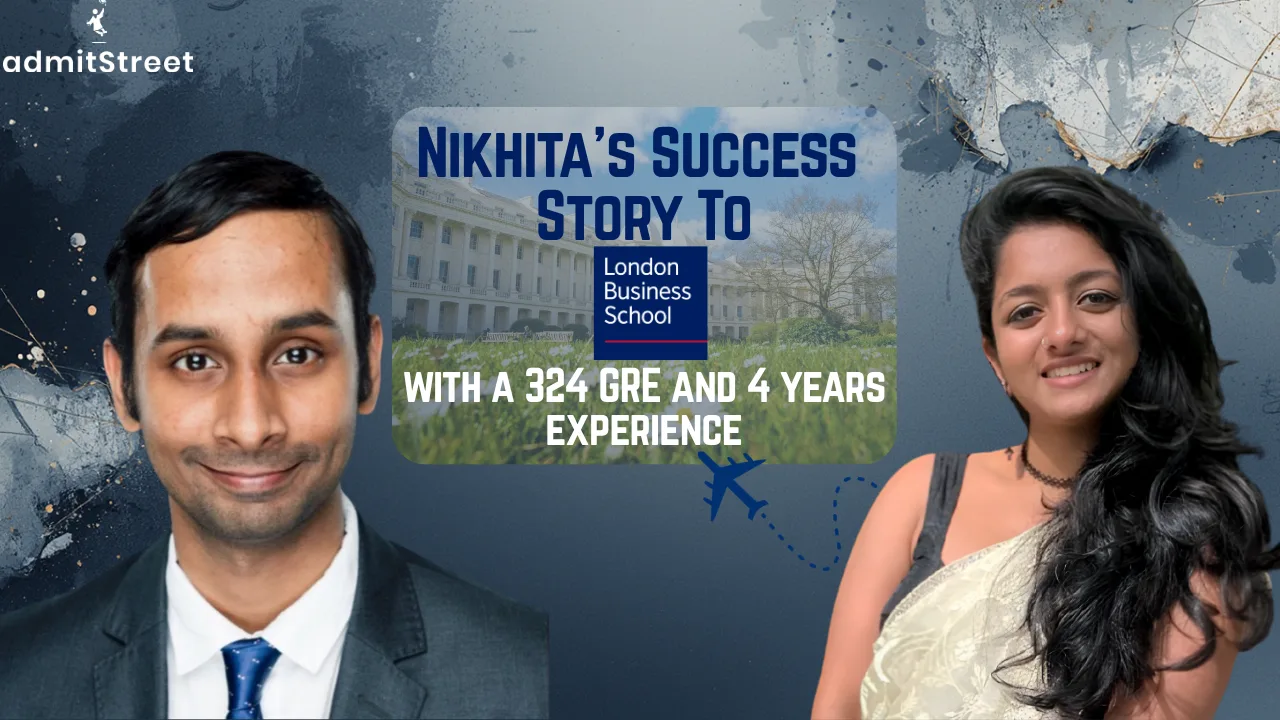
Is it possible to crack a top-tier global MBA like London Business School with four years of work experience and a 324 GRE?
Nikhita’s journey from the warehouse floors of Flipkart to the halls of LBS proves that the answer is a resounding yes.
A Production and Industrial Engineering graduate from Vellore Institute of Technology, Nikhita began her career at Flipkart managing warehouses before moving to a central role overseeing pan-India operations across 31 warehouses.
She had a deep passion for supply chain, rapid promotions, and leadership outside work, as a dancer and dance club head since 12th grade.
Driven by a desire to pivot from a specialized supply chain focus to a more holistic understanding of business, she saw an MBA as the essential next step.
Her MBA application journey was tested by major challenges: she spent her nights preparing for the GRE in a hospital room while supporting her father through heart surgery, later juggling the intense MBA application process alongside the relentless 24/7 demands of Flipkart’s biggest annual sale season.
Yet, she proved that success is about so much more than just numbers: it’s really a test of your clarity, your grit, and how you show up as a leader.
From treating all 18+ application questions as vital ‘micro-essays’ to navigating a marathon two-hour alum interview, she discovered that when you lead with your true story, even the most prestigious doors like LBS begin to open.
In this candid debrief, Nikhita shares her background and application strategy, the highs and lows of the MBA application process, how she balanced work and the application, her interview experience, and tips for prospective applicants.
Whether you are doubting your own stats or trying to balance a high-pressure job with your ambitious goals, this story is the perspective shift you need!
Background and Motivation
Arvind (admitStreet): Could you talk a bit about yourself, your background, work experience, and your motivation to pursue an MBA?
Nikhita: I’ve spent most of my life in Bangalore, and I actually began considering an MBA during my BTech. I studied Production and Industrial Engineering at VIT, a field that initially attracted me because of the core concepts of supply chain and process optimization.
To ground my studies in practice, I took an internship at a warehouse after starting my degree. That experience really sparked my interest in the field: I had the opportunity to design process flows and even train new employees on those systems. I found myself becoming more engaged with the work every day, and my coursework provided a strong theoretical foundation to support that passion.
By the end of those four years, I knew I wanted a career in supply chain. I was fortunate to be placed at Flipkart, one of India’s leading e-commerce companies, and my time there only reinforced my goals. I started in a warehouse role where I managed over 100 unskilled workers and a direct team of five. It was a high-intensity environment where I truly built my leadership acumen.
Wanting to scale my impact, I moved into a central role at Flipkart. This position allowed me to work more deeply with data while overseeing pan-India operations across 31 warehouses and 100 hubs. Being in the midst of such a vast supply chain network was an incredible learning experience, but it also made me realize I wanted to understand business as a whole.
Around that time, my brother completed his MBA in Canada. He spoke about his transformative experience, particularly regarding the networking and the broader business perspective he gained. Realizing how much an MBA could elevate my existing supply chain knowledge and help me pivot toward a more holistic business role, I decided that this was the right next step for my career.
Arvind (admitStreet): A perceived challenge for younger applicants is that work experience can be on the lower side, especially for a school like LBS where the median is six or seven years. Since you had about three or four years at the time of applying, was that a concern? If so, how did the rest of your application package help offset that?
Nikhita: Regarding my projects, I believe that switching roles within the same company and earning a promotion allowed me to significantly increase my scope and the number of people I led.
When I was based in the warehouse, my focus was on day-to-day metrics and local numbers. However, once I moved into a central role, I transitioned to high-level projects that impacted all 31 warehouses and our entire pan-India operations. After being promoted to manager, I began working extensively with cross-functional teams. Beyond the supply chain, I was collaborating with business development, category, tech, and product teams. This mix gave me a holistic understanding of how a business functions, which became a cornerstone of my MBA story.
Regarding my years of experience, it was definitely intimidating to apply with three or four years when the average is much higher. However, I realized that my narrative was compelling on its own. I focused on the fact that supply chain is a field I have consistently followed and mastered, and that I am now ready to expand into broader business knowledge. Combining that clear trajectory with the fact that I had already gained significant experience leading people allowed me to build a very strong case for my candidacy.
Application Strategy
Arvind (admitStreet): Can you talk about your GRE journey? What was your preparation like, and do you have any insights to share about the test itself?
Nikhita: My GRE story is actually a bit of an emotional one. I started preparing for the exam around September 2024, which was right when my father was hospitalized for a heart bypass. During that time, I chose to stay with him through the nights while my mother stayed with him during the day. Since my role at night was simply to stay awake and alert, I used that time to start my preparation because there were no other distractions. I was able to just sit down and focus.
One of the most helpful resources I found was GregMat. I think his videos are absolutely brilliant and very reasonably priced. In total, I took the GRE three times. After my second attempt, I reached out to you with a score of 324. That was on the lower end of the average for top schools, which was honestly quite discouraging and made me hesitant to apply.
However, after speaking with you, I began to see that there were other strong parts of my application I could emphasize. I did attempt the exam once more, which didn’t result in a higher score, but even with my score of 324, I was able to move forward with the application and successfully gain admission.
Arvind (admitStreet): On that note, could you talk about your extracurricular activities? How important were they? What were the key activities you were involved in, and how did you position them in your application?
Nikhita: One of my most significant extracurriculars is dance. I’ve been dancing since the 12th grade, and I held leadership positions both in school and in college, where I headed the dance club. I highlighted this in my MBA application and during my interviews as a key leadership experience, explaining how I learned to lead a team through the creative lens of dance from a young age. I also emphasized that while staying focused on these activities, I ensured my academics never faltered. This point really resonated with my interviewer; she was absolutely fascinated by that balance.
In addition to dance, I played the piano and volunteered with two charity organizations. I positioned these as my way of giving back to the community, something I intend to continue during and after business school. I feel that while extracurriculars might not be strictly mandatory, they definitely help you build a much more compelling and well-rounded story.
Arvind (admitStreet): Let’s talk about LBS, which was your dream school from the beginning. Beyond the global brand, what specific aspects or nuances of the school resonated with you?
Nikhita: Yeah, like you rightly mentioned, the first thing that attracted me was the brand name. But I think the next step, which you pushed me to do, was to talk to a few students about LBS. I spoke to both seniors and the Adcom.
One of the first things that amazed me was how almost every senior I reached out to immediately reciprocated and spoke with me. I think we had about half-hour discussions each, where they answered almost every single one of my questions. They were excitedly explaining the college and how the community they have built is so amazing.
When I was applying, one of the things I was worried about was that in India, there is an entire placement process where companies come to the college, which is not typically the case abroad. But when I spoke to LBS students, they talked about their Career Centre, where it is literally a mentor-mentee process. You are assigned seniors who help you through the entire interview process, help you network, and improve everything.
One thing I heard from almost every LBS student is that these are going to be the best two years of your life. They spoke about so many aspects, clubs, treks, and projects. Everything revolves around the community you build, which is amazing. One of my top reasons for doing an MBA is networking, so when I was able to build a relatively good network even before joining, I felt like that was definitely where I wanted to be.
I also want to mention my interview. It went so well; my interviewer and I spoke for about two hours, and it was honestly an amazing discussion. There were very difficult questions in between which I was able to answer, but it was such a beautiful interaction. About a month or a month and a half later, after I got my admit, she messaged me to congratulate me with a long message telling me how amazing this is going to be and how excited she was for me. At that point, I realized that this community is something I definitely want to join.
Arvind (admitStreet): That’s a great point. I hear that from a lot of folks who applied to LBS and those who made it as students or alumni. It is a close-knit college experience, which is possible because you spend a lot of time with people in a very close setting over those two years. In a way, that forces you to interact with people, not just those with similar backgrounds, but people from various walks of life. Whether it’s through clubs, treks, or social events, there are so many opportunities to form deep bonds with your classmates.
Nikhita: Yeah, and I think the more I spoke to them, the more my “Why LBS” reason was reinforced. By the time I reached the application stage, I had a really good answer. An MBA is inherently competitive; I’ve spoken to my brother and other seniors from different colleges who mentioned how competitive the environment can be. If you can have a close-knit community alongside that competitiveness, I think that is something that will really help me through my journey.
Application Process
Arvind (admitStreet): So let’s switch gears a bit, Nikita. Let’s talk about the application process itself. Could you walk us through the steps we followed and share any insights? Is there anything you recollect or want to share with other applicants regarding the CV, the essays, or the general preparation?
Nikhita: For me, one thing I really want to mention is that when I started this journey, I didn’t even think I could apply to LBS because it felt so out of reach. To this day, I remember our discussion when we were choosing colleges. I told you that while LBS was on my list, I didn’t think I could do it because it was too difficult and I didn’t feel I had a strong enough profile.
You stopped me right there and asked, “Tell me why you don’t think you have a good profile?” You helped me understand why LBS would actually be a good fit for me and reminded me that there was no harm in trying.
Once we started the process, as you mentioned, there were so many essays. One of the best pieces of advice you gave me was to treat every single question on the application as an essay. Most people just focus on the main topics and treat the rest of the form as just an application. But with you, I had to write every response out on a sheet, and we went through so many iterations of even the simple questions, like my background, my family life growing up, or my conversations with alumni.
While that was vital for the application, it was also eye-opening for me personally. When you start the process and put in the funds, time, and effort, you’re always questioning if it’s the right path. But going through the LBS application really helped me understand myself better. I mapped out my journey by answering every single question. I think there were close to 18 of them, and we went through three or four iterations for each. By the end of that process, my story was so well-defined that when it came time for the interview, I was completely ready. If anything, my challenge was making sure I stayed within the time limits because I had so much I wanted to say about my journey.
Interview Experience

Arvind (admitStreet): Regarding the interview, Nikita, what were some of the topics or questions covered, as best as you can recall? You mentioned it was a long conversation. Is there anything you can share, any specific insights, about that experience?
Nikhita: Starting with the preparation, I remember my mock interviews with you were very insightful. As I mentioned, I had my story set and was able to answer the questions, while you helped me tweak those responses to get them just right. I essentially had a script ready for when I started talking to my interviewer. I remember expecting it to be this formal, high-stakes discussion where I had to ensure I didn’t stray from my points.
However, the interviewer made me feel very comfortable. While she asked very difficult questions, it felt more like a discussion. I could see she was responding more to my honesty than to my scripted answers. When we started, the first question was, of course, “Tell me about yourself.” I answered my scripted version as best as I could, but as she started deep-diving into the follow-ups, I noticed her curiosity piqued every time I was truly honest about myself.
I specifically remember one question about women in the workplace. I had mentioned that I was often one of the only women in my professional environment, especially in the warehouse, where I was one of only three. It was difficult to make a name for myself there, but I fought for it and put my heart and soul into the work. She asked me straight up: “Do you think that was because you are a woman, and how would you get out of that situation?” Being able to answer very frankly, acknowledging that it was a factor while discussing other aspects, helped me build a much better connection with her.
Later, she asked why I wanted an MBA. When I mentioned wanting to learn more about business to eventually start my own, she asked, “Why don’t you just start it right away? Why do you think an MBA is necessary for that?” I was honest with her about how I work, my leadership style, and my need for networking beyond India and my current career, where I mostly know people in the supply chain at Flipkart. I would say the most important thing for an interview is to ensure you build your own story and answer as honestly as possible. They can tell when you are being authentic and when you are just giving the “correct” answer.
Arvind (admitStreet): That’s a great point, especially for LBS, because the interviewer is an alum. They have been through the process and attended the school themselves. That experience is slightly different from an Adcom interview. Someone who has lived that journey is likely to figure out if an applicant isn’t being authentic or is just saying what they think the school wants to hear.
Nikhita: Exactly. While I was excited to talk to a former LBS student, I was also quite intimidated. The minute I found out who my interviewer was, I did a deep dive on her. I checked her LinkedIn and found a profile of her on Poets & Quants. She had such an incredible journey, she spoke about overcoming difficulties, going on treks, and starting her own business.
Somehow, after our discussions, I was able to turn that intimidation into curiosity. When she asked, “Do you have any questions for me?” In the end, I had genuine questions for her. I actually wanted to know more about her journey. That is something really exciting about talking to an LBS alum, you get to learn from someone who has already walked that path.
Balancing Work & Application
Arvind: Great. One final topic before we wrap up. You were managing a very high-pressure job. It was hectic, and I know you had a lot on your plate at work, all while handling the various components of the application and interviews. How did you manage it? What were your strategies for balancing both?
Arvind (admitStreet): Great. One final topic before we wrap up. You were managing a very high-pressure job. It was hectic, and I know you had a lot on your plate at work, all while handling the various components of the application and interviews. How did you manage it? What were your strategies for balancing both?
Nikhita: To give you some context, the application process in August and September coincides with Flipkart’s biggest sales period in India. Generally, that means working seven days a week, and I wasn’t even able to take leave. I had decided not to take a sabbatical and instead work through it, but it was incredibly taxing. There were days when all I did was sit in my room, move from my office work straight to my application, and repeat that nonstop.
When it comes to tips, my first piece of advice is to maintain a proper checklist. You have to go through the process step-by-step and carve out the time for it. I remember when we were working on iterations and you would set a deadline; reaching those deadlines was often scary for me. There were moments when I sat down to work while feeling completely burnt out and just felt lost.
Because of that, the second thing I truly appreciated was being able to ask you for help whenever I got stuck. I remember just getting on a phone call with you and saying, “I’m stuck on this question.” You helped guide me through it without writing it for me, which ensured I was still telling my own story. I think the only way to truly avoid burnout is by asking for help when you need it, whether that is from you, my brother and cousin, or even from current LBS students. That support system is how I was able to get through it.
Advice for Prospective Students
Arvind (admitStreet): What are your tips or advice for applicants, particularly those looking at LBS?
Nikhita: My first piece of advice, which I’d say to everyone, is to treat your entire LBS application like a collection of essays. Every single question is extremely important, even if it’s just a 100-word response about your hobbies. Write it, refine it, and read it from the perspective of an outsider. If possible, get a second opinion. You don’t always have to take every suggestion, but getting outside insights helps you improve the final version.
Second, take your time when choosing your schools. I remember having two or three brainstorming sessions with you, and even then, I hadn’t fully decided because I wanted to be sure. One day, I was quite frustrated and spoke to my brother about it. We ended up creating a matrix in an Excel sheet where we listed the colleges against different aspects, finances, proximity to family, geography, and brand name. I had a shortlist of seven schools but needed to narrow it down to three. Using a points system and taking an average helped me realize which schools were the best fit. It is okay if this takes a little longer. I put a lot of unnecessary pressure on myself to finish as fast as possible because I thought Round 1 was the only way to go. But there are so many Round 2 admits; in fact, I know someone who waited until Round 2 because she simply wasn’t ready in Round 1, despite having worked toward LBS for five years. It’s better to take the time to understand your “why” before you apply.
Lastly, be honest. Choosing you as a consultant was an amazing decision because you helped me write my own story rather than writing it for me. Because I worked through that process, I am still incredibly confident about why I want an MBA. I’ve heard of students who have had their entire essays written for them, and they are completely lost when it comes to the interview. You can script an answer as many times as you want, but when you’re hit with a difficult question, you need an honest, deep-rooted reason for why you’re there. Taking the time to work on it yourself and remaining honest at every step is what truly helps.
Arvind (admitStreet): That’s great advice. Thank you, Nikita. All the best at LBS, London is a fantastic city. Make sure you have a great time, and I wish you the best for your journey ahead.
Nikhita: Thank you so much, and thanks for all the help!
Watch the Full Success Story Video here
Planning your MBA journey?
With 1:1 mentorship and strategic support, we’ve helped candidates turn uncertainty into admits and scholarships. Ready to begin?